
How to control light with shutters for your home

Amount of light control shutters
TL;DR:
- Most UK homeowners underestimate the effectiveness of shutters in controlling light, heat, and comfort. They significantly reduce overheating hours and offer precise adjustment for glare, privacy, and thermal regulation. Custom shutters optimize energy efficiency through seasonal adjustments, enhancing both comfort and savings.
Most UK homeowners assume that any window covering will do a reasonable job of managing light and temperature. That assumption is quietly costing them comfort and money. Research shows that shading like shutters can reduce overheating hours above 26°C from over 615 down to just 28 per year in modelled homes. That is a staggering difference. In this guide, we cut through the noise to explain exactly how shutters control light, what the evidence tells us about their real-world performance, and how to choose and use them for maximum benefit in your home.
Table of Contents
- What do we mean by light control with shutters?
- How much control do shutters really provide?
- The science: How shutters affect your home’s comfort and energy use
- Choosing the right shutter style and settings for your needs
- Beyond the basics: What most guides miss about light control shutters
- Explore bespoke shutters for unrivalled light control
- Frequently asked questions
Key Takeaways
| Point | Details |
|---|---|
| Shutters offer precise light control | Interior shutters let you easily adjust natural light levels, giving you more flexibility than blinds or curtains. |
| Energy and comfort benefits | Properly used shutters can help reduce overheating and cooling costs in UK homes, backed by real data. |
| Balanced use is key | To avoid raising heating bills in winter, open your shutters on sunny days to enjoy free warmth. |
| Custom solutions maximise value | Bespoke shutter designs are ideal for tricky window shapes and for achieving your personal mix of light, privacy, and style. |
What do we mean by light control with shutters?
Light control sounds straightforward, but in practice it covers a wide range of outcomes. It includes filtering glare from a bright afternoon sun, softening harsh morning light in a bedroom, protecting your furniture from UV fading, and keeping a room cool without plunging it into darkness. Shutters address all of these needs, often simultaneously, and with a degree of precision that curtains and standard roller blinds simply cannot match.
Understanding shutter types is the starting point. The most popular style in UK homes is the plantation shutter, characterised by wide louvres (the angled slats) that rotate to control how much light enters. Tier-on-tier shutters divide the panel into upper and lower sections that operate independently, letting you admit light from above while keeping the lower half closed for privacy. Solid panel shutters block light entirely when closed, offering the most dramatic light reduction. Café style shutters cover only the lower portion of the window, a practical choice for street-facing rooms where you want sky and treetop views but need privacy at ground level.
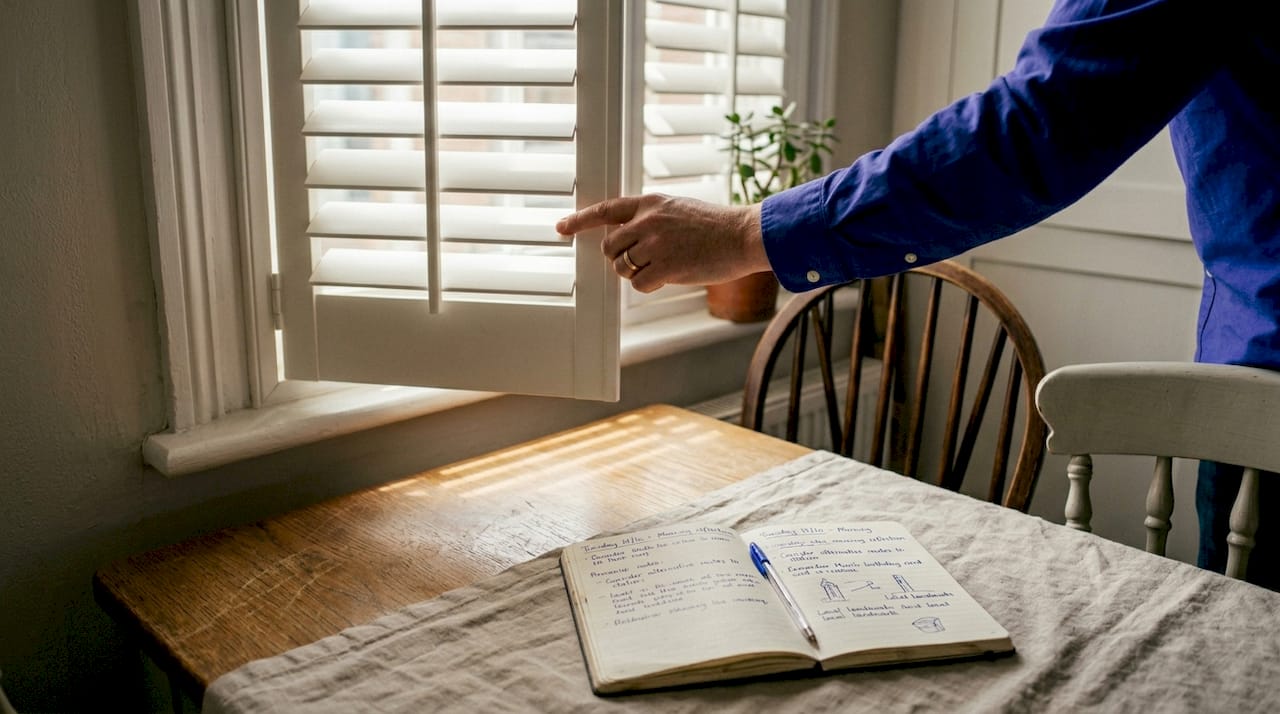
The louvre is where the real engineering lies. When angled downward toward the room, louvres allow diffused, ambient light to filter in while deflecting direct glare toward the ceiling. Angled upward, they draw natural light deeper into the room. Closed completely, they form a tight barrier. Wide louvres (typically 89mm or 114mm) give you more granular control because a small rotation produces a noticeable change in light entry. Narrower louvres at 63mm are more traditional in appearance and suit period properties beautifully.
Material matters too. Our energy efficient shutters in hardwood or premium MDF with polypropylene coating offer slightly different light-interacting properties. Hardwood panels can be finished in a wider palette of colours, allowing darker shades that absorb rather than reflect incoming light, giving rooms a richer, moodier ambience when desired.
Key light control goals that shutters address particularly well:
- Glare prevention without sacrificing natural brightness
- UV protection to prevent furniture, flooring, and artwork from fading
- Privacy at any time of day without resorting to net curtains
- Thermal comfort, since shutters mitigate overheating, reducing high-temperature hours significantly each year
- Mood and ambience, shaping the character of a room throughout the day
Pro Tip: Rather than thinking of shutters as simply “open or closed,” think of them as a precision instrument with a wide spectrum of settings. Even a 15-degree adjustment to your louvre angle can transform a room from uncomfortably bright to perfectly lit.
How much control do shutters really provide?
With a clear understanding of what light control means, we can now compare how shutters perform versus other options, with hard evidence to back it up.
The numbers are genuinely striking. Empirical modelling shows that shutters can reduce overheating hours above 26°C from over 615 to just 28 per year. No curtain or roller blind achieves anything close to that level of thermal control. The reason lies in shutters’ structural rigidity and their ability to create an insulating air gap between the shutter panel and the glass.
Statistic callout: Homes fitted with well-managed shutters experience up to 95% fewer overheating hours annually compared to unshaded equivalents, according to building performance modelling.
Here is how the main window treatments compare across the criteria that matter most to homeowners:
| Feature | Plantation shutters | Roller blinds | Curtains |
|---|---|---|---|
| Light adjustability | Excellent (continuous) | Limited (up/down only) | Moderate (open/closed) |
| Glare reduction | Excellent | Good (blackout only) | Good |
| UV protection | High | High (blackout) | Moderate |
| Thermal insulation | High | Low to moderate | Moderate |
| Privacy at all light levels | Excellent | Good | Moderate |
| Durability | 20+ years | 5 to 10 years | 5 to 15 years |
| Aesthetic longevity | Timeless | Trends-dependent | Trends-dependent |
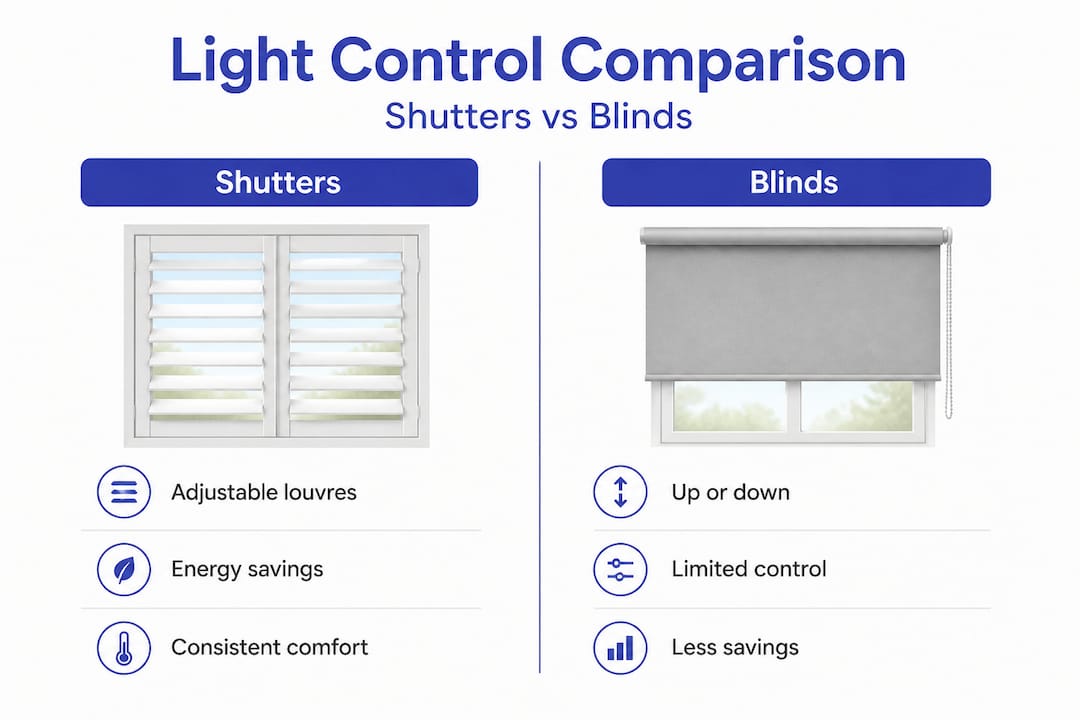
The adjustability column is where shutters pull decisively ahead. A roller blind is essentially binary: up or down, light or dark. Curtains give you a similar open-or-closed choice, with perhaps a partially drawn middle ground. Shutters offer continuous, fine-grained adjustment across the full arc of louvre rotation, from fully open at roughly 90 degrees to fully closed. This means you can track the sun as it moves across the sky throughout the day, adjusting your louvres to maintain consistent comfort without ever feeling confined or cut off from the outside world.
There is one important limitation to acknowledge honestly. Standard plantation shutters, even when fully closed, do not deliver full blackout in the way a dedicated blackout blind does. Light can still filter through the edges of louvres and around panel frames. For bedrooms where total darkness is essential, particularly for shift workers or young children, a layered approach works best: shutters for daytime control and a blackout lining behind for night use. Our shutters for energy savings range includes options designed to maximise both comfort and versatility across every room in the house.
The benefits of shutters’ adjustability in practice:
- Tilt louvres toward the ceiling to flood a room with soft, reflected daylight
- Partially close louvres during the hottest part of a summer afternoon to reduce glare without darkening the room
- Open fully on a grey winter morning to maximise every photon of available natural light
- Adjust upper and lower tiers independently on tier-on-tier shutters for room-specific privacy while keeping light coming in from above
For homeowners thinking about reducing energy bills with shutters, this level of control is directly linked to savings. Less solar gain in summer means less strain on fans and air conditioning. More thoughtful opening in winter means more free warmth from the sun.
The science: How shutters affect your home’s comfort and energy use
Seeing the performance gap in a table is useful, but it helps to understand the underlying principles so you can use your shutters strategically rather than instinctively.
Solar gain is the process by which sunlight passes through glass and warms the interior of your home. In summer, uncontrolled solar gain is the primary cause of overheating in UK homes, particularly in south and west-facing rooms. In winter, the same solar gain is actually desirable because it supplements your central heating at no cost. The key insight is that shutters give you direct, manual control over this process at any moment.
Blocking solar gain strategically can lower overheating in summer, but overly blocking winter sun may increase heating demands. This is not a flaw in shutters. It is simply a reminder that they reward thoughtful use rather than a set-and-forget approach.
Here is how that plays out across the seasons in a typical UK home:
| Season | Recommended shutter use | Benefit |
|---|---|---|
| Summer (south-facing) | Louvres angled to deflect midday sun | Reduces cooling need, protects furniture |
| Winter (south-facing) | Open fully on sunny days | Captures free solar warmth |
| All year (east-facing) | Partially close in mornings, open by midday | Manages early glare, admits afternoon light |
| All year (north-facing) | Keep open as much as possible | Maximises limited natural daylight |
A practical approach to seasonal shutter management:
- Spring and autumn: Use half-open louvre settings as a default, adjusting based on the strength and angle of the sun on any given day.
- Summer: Close south and west-facing shutters between roughly 11am and 4pm to block peak solar gain. Open them fully in the evenings to release stored heat.
- Winter: Keep shutters open throughout daylight hours to absorb every available bit of warmth. Close them at dusk to retain that warmth overnight.
- Bedrooms: Close shutters fully at night for privacy and insulation, then adjust louvres rather than opening panels fully in the morning for a gradual, comfortable wake-up.
Pro Tip: Think of your shutters as a passive heating and cooling system that you operate with your hands. A few seconds of adjustment morning and evening can make a measurable difference to how comfortable your home feels and how much energy you consume.
“The empirical evidence is clear: external and internal shading, when used correctly, significantly reduces the risk of overheating while supporting overall building energy performance.” — Building Cities Journal, peer-reviewed findings on shading performance.
Explore our guides on shutters saving energy and the environmental impact of shutters for a fuller picture of how bespoke shutters contribute to a greener, more comfortable home.
Choosing the right shutter style and settings for your needs
Knowing how shutters work is only half the equation. Here is how to translate that knowledge into practical decisions for your home, room by room.
Shutters offer adjustable light levels that vary significantly by design and user preference. That flexibility means there is genuinely no single “best” shutter for every situation. The right choice depends on your window orientation, the function of the room, and your personal relationship with natural light.
Shutter style characteristics at a glance:
- Full height plantation shutters suit most rooms, offering maximum flexibility and a clean, architectural look that works equally well in modern and period homes.
- Tier-on-tier shutters are ideal for living rooms and kitchens where you want privacy at street level without sacrificing the view or light from the upper portion of the window.
- Café style shutters are perfect for basement rooms or garden-facing kitchens where the view above head height is pleasant but privacy is needed at seated height.
- Solid panel shutters suit rooms where occasional total light exclusion is desirable, such as media rooms or wine stores, though they sacrifice the fine-tuning that louvred shutters offer.
- Tracked and bi-fold shutters work brilliantly for wider windows and sliding doors, stacking neatly to one side when not needed.
For room-by-room guidance:
- Living rooms: Choose full-height shutters with 89mm or 114mm louvres. Orient them to reflect light upward from south-facing windows during summer afternoons.
- Bedrooms: Tier-on-tier designs allow you to keep the upper section closed for privacy while opening the lower section in the morning. Supplement with a blackout lining if shift work or young children demand total darkness.
- Kitchens: Café style or full-height shutters with a durable MDF coating resist steam and condensation far better than fabric blinds, and louvres can be adjusted to reduce glare on worktops without losing light.
- Bay windows: Bespoke shutters fitted with precision across the full bay eliminate the awkward gaps and light leakage that off-the-shelf products inevitably leave. Our shutters and heat retention resource explores this in detail.
- Conservatories and skylights: Specialist shutters designed for angled glazing provide year-round comfort in spaces that are notoriously prone to overheating.
Beyond the basics: What most guides miss about light control shutters
After more than 25 years of fitting bespoke shutters across the UK, we have noticed a consistent pattern: homeowners who get the best results from their shutters think seasonally, not just situationally.
Most guides focus on the moment of purchase. They help you choose the right louvre size or the right material. What they rarely address is the ongoing relationship between you and your shutters across the whole calendar year. The biggest gains, both in comfort and in energy performance, come from developing small daily habits around your shutters rather than treating them as static décor.
There is also an often-overlooked tension between light blocking and solar warmth retention. It is tempting, particularly after a punishing British summer, to keep shutters angled firmly against the sun. But doing this indiscriminately through autumn and winter actively works against you, reducing the free solar heating that could otherwise take the edge off your energy bills during cooler months.
The most sophisticated use of shutters we see in practice involves thinking of each room as having a slightly different daily schedule. A south-facing sitting room might need louvres adjusted three times in a single day to track the arc of winter sun across the sky, while a north-facing study requires almost no intervention at all. Understanding your shutters as a dynamic tool rather than a fixed feature changes everything about how you experience light in your home.
Custom design plays a larger role in this than many people realise. Off-the-shelf shutters are built to standard dimensions and standard louvre sizes. A bespoke shutter, engineered precisely for your window, fits with such accuracy that it leaves no gaps for unwanted light leakage or draughts. That precision is not just aesthetic. It is the foundation of genuinely effective light and thermal control. When every millimetre is accounted for, the shutter performs as intended, and you feel the difference every day.
Explore bespoke shutters for unrivalled light control
If this guide has brought you closer to understanding what genuinely effective light control looks like in practice, the next step is seeing what bespoke craftsmanship can achieve in your own home.

At Shutter World, we combine over 25 years of expertise with meticulous, made-to-measure engineering to deliver shutters that perform as beautifully as they look. Whether you are considering timeless plantation shutters for a classic finish, sleek aluminium window shutters for a more contemporary aesthetic, or a completely bespoke solution for an unusual window shape, our team is here to guide you from survey to installation. Discover the full range of options and the craftsmanship behind every panel at The Bespoke Shutter Company. Book your free in-home consultation today and experience the difference that precision makes.
Frequently asked questions
Do shutters block out all sunlight?
While shutters can dramatically reduce incoming light and glare, most do not provide total blackout unless combined with additional window coverings. Adjustable light levels vary by design and user preference, making layering the best approach for rooms requiring full darkness.
How do shutters affect energy efficiency and bills?
Shutters can decrease overheating and reduce cooling costs, but overly blocking winter sun may increase heating demands. Blocking solar gain strategically is the key, keeping shutters open on sunny winter days to capture free warmth while closing them during summer peak hours.
What’s the best way to use shutters throughout the year?
Use shutters to capture free warmth on sunny winter days and to block harsh sun in summer, adjusting daily for maximum benefit. Shutters mitigate overheating most effectively when homeowners develop a seasonal adjustment routine rather than leaving them in a fixed position.
Can I fit shutters on unusual windows?
Yes, custom shutters can be designed for almost any window shape, from angled loft conversions to sweeping bay windows. At Shutter World, we specialise in precisely engineered solutions for every architectural challenge, ensuring a flawless fit and full performance regardless of how complex your window may be.