
Automatic vs manual shutters: which is right for you?

Automatic vs manual shutters
TL;DR:
- Automatic shutters operate more quickly and offer remote control, smart home integration, and enhanced security features. Manual shutters are lower-cost, easier to repair, and dependable during power outages but are less convenient for homes with many windows. The best choice depends on window quantity, usage frequency, accessibility needs, and budget considerations.
Automatic shutters are motorised window coverings operated by electric controls, remote handsets, or smart home systems, while manual shutters rely entirely on physical effort via cranks, straps, or push mechanisms. The distinction matters far beyond convenience. It shapes your security consistency, installation budget, daily routine, and long-term maintenance commitments. For homeowners and renovators weighing up automatic vs manual shutters in 2026, the right choice depends on how many windows you have, how often you use them, and what you are genuinely prepared to spend.
What are the advantages and disadvantages of automatic shutters?
Automatic shutters, also called motorised shutters, open or close in approximately 3 seconds, compared to 10–15 seconds per window for manual operation. That gap feels trivial for one window. Across six or seven windows operated twice daily, it adds up to a meaningful saving of time and physical effort.
The benefits of automatic shutters extend well beyond speed:
- Remote and app control means you can operate shutters from your sofa, your car, or the other side of the world.
- Smart home integration lets you schedule shutters to close at sunset or open with your morning alarm. Smart home automation is increasingly standard in modern UK renovations.
- Motor locking holds the shutter fully closed under tension, adding a physical barrier that a manually closed shutter cannot always replicate.
- Safety sensors detect obstructions and stop the shutter mid-travel, reducing the risk of injury to children or pets.
- Consistent full closure removes the human error factor entirely. Motorised shutters promote reliable closure, which is the single biggest security advantage they hold over manual systems.
The drawbacks are real and worth naming honestly. Motorised shutters cost significantly more upfront. They depend on a working power supply, so a power cut leaves them inoperable unless a battery backup is fitted. Motors can develop faults, and limit switch calibration requires a qualified electrician. Automated shutters are also less straightforward to repair than a mechanical strap or crank.
Pro Tip: If you are fitting automatic shutters in a new build or renovation, plan the electrical conduit runs before plastering. Retrofitting wiring into finished walls adds cost and disruption that most homeowners do not budget for.
What are the advantages and disadvantages of manual shutters?
Manual shutters are the simpler, lower-cost choice. Installed manual shutters cost £350–£700 per window, compared to £800–£1,600 for a motorised equivalent. That price gap is the primary reason manual shutters remain popular for smaller homes and secondary openings.
The practical advantages of manual shutters include:
- No electrical dependency. They work during power cuts, making them reliable in areas with an unstable supply.
- Simpler mechanics. Cranks, straps, and spring-assist mechanisms are straightforward to repair without specialist tools.
- Lower installation complexity. No motor wiring, no limit switch calibration, and no licensed electrician required for the shutter itself.
- Proven durability. High-quality composite shutters last 15–25 years with proper maintenance, regardless of whether they are motorised.
- Suitable for low-frequency use. Manual shutters work well for secondary openings or windows operated only occasionally.
The disadvantages are equally clear. Manual operation takes 10–15 seconds per window. Physical effort accumulates across a full house. Security relies entirely on the user remembering to close the shutter fully and engage any locking mechanism. Partial closure, even unintentional, reduces the security benefit significantly. Lubrication is more critical for manual shutter longevity because the mechanism cannot force through friction the way a motor can. Neglecting the guide rails accelerates wear on the winding mechanism.
Pro Tip: Apply a silicone-based lubricant to manual shutter guide rails every six months. Avoid oil-based products, which attract dust and grit and create the very friction you are trying to prevent.

How do automatic and manual shutters compare on cost and maintenance?
The cost difference between the two systems is substantial and worth breaking down clearly.
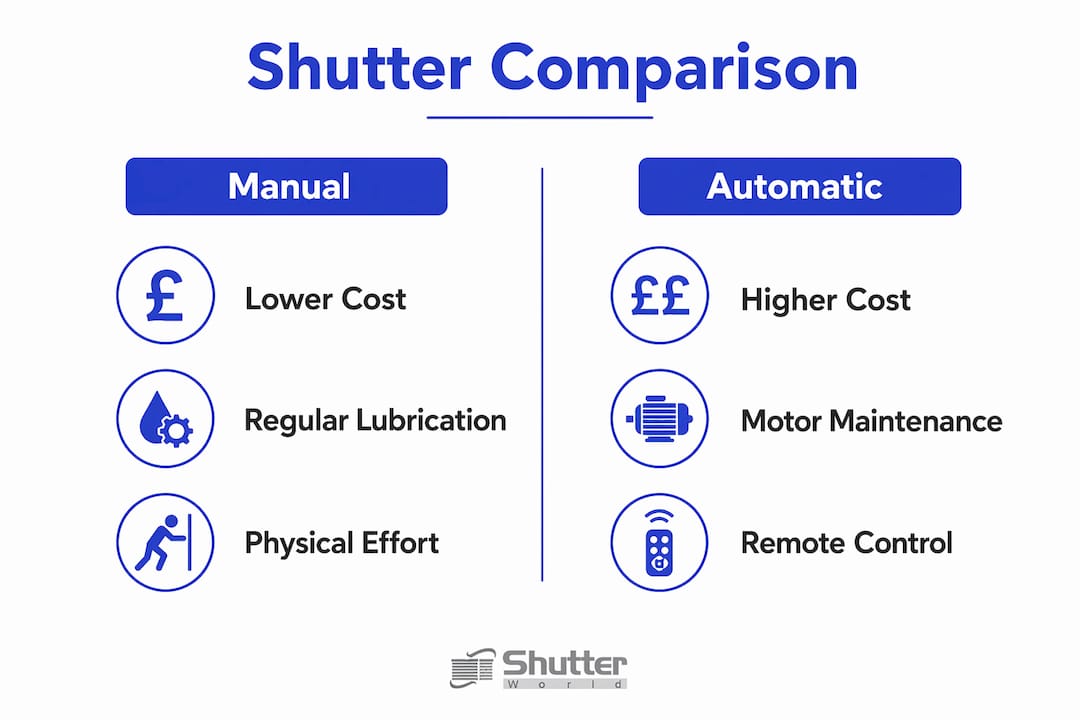
| Factor | Manual shutters | Automatic shutters |
|---|---|---|
| Installed cost per window | £350–£700 | £800–£1,600 |
| Motor unit cost | Not applicable | £250–£580 |
| Electrical labour per window | Not applicable | £250–£550 |
| Power dependency | None | Mains electricity required |
| Maintenance focus | Lubrication, mechanical parts | Motor, limit switches, wiring |
| Repair complexity | Low | Moderate to high |
Motor cost ranges from £250 to £580, with electrical labour adding a further £250–£550 per window. For a home with eight windows, the difference in total installation cost between the two systems can run into several thousand pounds. That figure justifies careful thought before committing.
Maintenance costs tell a different story over time. Manual shutters need regular lubrication and occasional replacement of mechanical components such as springs and straps. These parts are inexpensive and widely available. Motorised shutters require periodic motor servicing and limit switch adjustment. If a motor burns out due to debris jamming the shutter, the replacement cost is significant. Motor burnout is a real risk when guide rails are not kept clean.
The long-term value calculation favours automatic shutters in homes with frequent use across multiple windows. The time saved, the security consistency gained, and the reduced physical effort justify the higher upfront spend for most homeowners in that situation. For a single window or a rarely used outbuilding, manual remains the sensible choice.
How do security benefits differ between automatic and manual shutters?
A shutter’s security level depends on its physical construction, not its operation method. A well-built manual shutter with a solid locking bar is more secure than a flimsy motorised one. Material thickness, locking hardware, and guide rail depth determine how resistant a shutter is to forced entry.
Where automatic shutters genuinely outperform manual ones is in consistency. Motorised systems ensure full, consistent closure every single time. A manual shutter left two centimetres open because someone was in a hurry provides almost no security benefit. Automation removes that variable entirely.
The security features of motorised shutters worth noting include:
- Motor locking under tension, which resists manual lifting from outside.
- Integrated alarm triggers, available on some systems, which alert you if the shutter is forced.
- Safety sensors that stop the shutter if an obstruction is detected, protecting children and pets from injury.
- Remote monitoring, which lets you confirm closure status from anywhere via a connected app.
Automated shutters are increasingly viewed as safety features in family homes, not just convenience upgrades. For households with young children, the combination of safety sensors and reliable full closure makes motorised systems the more responsible choice.
Manual shutters remain effective for security when used correctly and consistently. The weakness is human behaviour, not the hardware itself.
Which shutter type suits your home and lifestyle?
Choosing between the two systems comes down to a clear set of practical questions about your home and how you live in it.
-
How many windows need shutters? In homes with more than three windows, motorised shutters are almost universally preferred for convenience and reliability. Manual operation across a full house becomes a genuine daily burden.
-
How often will you use them? Windows operated twice daily benefit enormously from motorisation. A garage side door opened once a week does not.
-
Do you have accessibility needs? Motorised shutters are the only practical choice for homeowners with limited mobility or strength. A remote control or wall switch removes all physical barriers.
-
What is your existing electrical infrastructure? Retrofitting motorised shutters into an older property without conduit runs adds cost. A renovation project with open walls is the ideal time to install motorised systems affordably.
-
What is your local climate? In exposed coastal or high-wind locations, the added closure reliability of motorised systems provides real peace of mind. Shutter materials suited to your climate matter as much as the operation method.
-
Are precise measurements in place? Measuring width and height at three points and using the smallest dimension prevents binding and operational failures in both shutter types. This step is non-negotiable.
-
What is your budget? Manual shutters suit tighter budgets or secondary openings. Automatic shutters suit homeowners who prioritise long-term convenience and are prepared to invest upfront.
Many homeowners underestimate the cumulative effort of operating multiple manual shutters daily. The regret rate among those who chose manual for a full house is notably higher than among those who chose motorised systems from the outset.
Key takeaways
Automatic shutters deliver security consistency and daily convenience that manual shutters cannot match at scale, but manual systems remain the practical, cost-effective choice for smaller homes or infrequent use.
| Point | Details |
|---|---|
| Cost difference is significant | Manual shutters cost £350–£700 per window; motorised systems cost £800–£1,600 installed. |
| Motorised shutters close consistently | Automation eliminates partial closure, which is the most common security failure in manual systems. |
| Manual shutters need regular lubrication | Neglecting guide rail maintenance accelerates wear and shortens the lifespan of the mechanism. |
| Multi-window homes favour automation | Homes with more than three shuttered windows benefit most from motorised operation in time and effort saved. |
| Material quality determines security | Shutter construction and locking hardware matter more than operation method for resisting forced entry. |
Ken’s honest view on the automatic vs manual debate
Most homeowners arrive at this decision thinking it is primarily about budget. It is not. It is about honesty regarding your own habits.
I have spoken with countless homeowners who chose manual shutters to save money and then admitted, six months later, that they stopped closing them regularly because the effort felt like a chore. A shutter that stays open because it is inconvenient to close is not a security feature. It is a decoration.
The regret pattern is consistent. A household with five or more windows, fitted with manual shutters, almost always wishes they had gone motorised. The upfront saving of a few hundred pounds per window feels significant at the point of purchase. It feels far less significant when you are wrestling with a stiff crank on a cold morning or realising you left three shutters open when you went on holiday.
My practical advice is this. If you have more than three windows to shutter, budget for motorised systems from the start. If you are fitting one or two shutters on secondary openings, manual is perfectly sensible. Do not let the lower price of manual shutters make the decision for you if your lifestyle genuinely calls for automation.
One more thing that rarely gets mentioned: the smart home integration potential of motorised shutters is genuinely undervalued. Scheduling shutters to close at dusk automatically, without a thought from you, changes how secure your home feels. That peace of mind has real value that does not appear in any cost comparison table.
— Ken
Shutterworld’s bespoke shutter solutions for your home
Whether you are drawn to the reliability of motorised systems or the simplicity of manual operation, the quality of the shutter itself determines how well either choice performs.

Shutterworld specialises in bespoke plantation shutters crafted to your exact window dimensions, with options spanning durable MDF through to premium hardwood finishes. For homeowners seeking both style and resilience, aluminium window shutters offer exceptional strength and a clean, contemporary finish suited to a wide range of home designs. Every shutter is measured, made to order, and fitted by experienced professionals, giving you the confidence that your investment is built to last. Contact Shutterworld to arrange your free in-home survey and receive a clear, competitive quotation with no surprises.
FAQ
How much more do automatic shutters cost than manual?
Motorised shutters typically cost £800–£1,600 per window installed, compared to £350–£700 for manual shutters. The difference reflects motor unit costs of £250–£580 and licensed electrical labour of £250–£550 per window.
Are automatic shutters more secure than manual shutters?
Security depends primarily on shutter construction and locking hardware, not the operation method. Automatic shutters do offer better security consistency because they close fully every time, eliminating the risk of partial closure caused by human error.
Can automatic shutters work during a power cut?
Standard motorised shutters require mains electricity and will not operate during a power cut unless a battery backup unit is installed. Manual shutters have no electrical dependency and work reliably regardless of power supply.
How often do manual shutters need maintenance?
Manual shutters need guide rail lubrication every six months to prevent friction damage to the winding mechanism. Motorised shutters require less frequent mechanical maintenance but need periodic motor servicing and limit switch checks.
Which shutter type is best for a home with many windows?
Motorised shutters are the preferred choice for homes with more than three shuttered windows. The time saved, the physical effort avoided, and the security consistency gained outweigh the higher upfront cost for most homeowners in that situation.