
Choosing the best shutter finishes for coastal homes

Shutter finishes for coastal homes
TL;DR:
- Coastal environments require specially engineered, high-resistance shutter finishes like marine-grade coatings or powder coating.
- Proper pairing of finish type with window shape and exposure ensures durability and optimal protection.
- Regular maintenance and inspections significantly extend the lifespan of shutters in harsh seaside conditions.
Living by the sea is a privilege, but it places your home under pressures that inland properties simply never encounter. Salt-laden air, persistent humidity, and intense UV exposure can strip, blister, and corrode ordinary window finishes within just a few seasons. Many coastal homeowners assume that any quality shutter paint or coating will hold up near the water, and that misconception can prove costly. The reality is that the British coastline demands finishes engineered specifically for these conditions. In this guide, we share practical, tested advice to help you choose shutter finishes that genuinely stand the test of time beside the sea.
Table of Contents
- Why coastal conditions demand high-performance shutter finishes
- Types of shutter finishes suitable for UK coastal homes
- Matching finish to window type and usage: bespoke solutions explained
- Care and maintenance: keeping coastal shutters in top condition
- What most guides miss about shutter finishes for coastal homes
- Transform your coastal home with bespoke shutter expertise
- Frequently asked questions
Key Takeaways
| Point | Details |
|---|---|
| Coastal climates demand durability | Salt air, moisture, and sun rapidly break down standard finishes, so choose marine-grade or powder-coated options. |
| Match finish to window and usage | Not all finishes suit every room or window—bespoke choices keep shutters looking and working their best. |
| Professional application matters | Factory finishes outlast site-applied paints significantly, so invest upfront to reduce long-term maintenance. |
| Regular care extends lifespan | Yearly cleaning and inspections help coastal shutters last decades with minimal fading or corrosion. |
Why coastal conditions demand high-performance shutter finishes
The British coastline is a beautiful but unforgiving environment for any window treatment. Salt air, driven by prevailing winds, deposits microscopic particles onto every exposed surface. Those particles attract moisture and accelerate corrosion in ways that are almost invisible until real damage has already taken hold. Add persistent damp, frequent temperature swings, and strong UV from south-facing elevations, and you have a combination that tests even quality materials severely.
The core coastal home shutter challenges break down into three main threats:
- Salt spray corrosion: Chloride ions penetrate porous coatings, attacking timber fibres and metal fixings beneath the surface.
- Moisture ingress: Persistent humidity causes untreated or poorly sealed timber to swell, warp, and eventually crack.
- UV degradation: Intense sunlight bleaches pigments and breaks down binders in standard paints, leading to chalking, peeling, and colour fade.
Basic site-applied paints are particularly vulnerable. Applied in ambient conditions, they often fail to penetrate the substrate deeply enough to create a lasting seal. A brush-on coat that looks pristine in a showroom can begin lifting at the edges within a single winter season when exposed to salt-laden gusts.
Factory-applied and specialist coatings change this picture entirely. Applied under controlled conditions with precise film thicknesses, they bond at a molecular level with the substrate. As recommended for coastal UK homes, the best shutter finishes prioritise resistance to salt spray, humidity, and UV from the very start of the manufacturing process. Marine-grade and powder-coated options have been developed precisely for this environment, offering a level of resilience that no site-applied alternative can match.
Key insight: The finish is not merely decorative. In a coastal setting, it is your shutter’s primary line of defence.
Types of shutter finishes suitable for UK coastal homes
Not all finishes perform equally beside the sea. Understanding the differences helps you make a confident, informed choice rather than an expensive mistake.
Factory-applied marine-grade coatings penetrate timber better and outperform site-applied paints in salt-spray testing, while aluminium powder coating delivers excellent durability in the most exposed positions. Here is how the main options compare:
| Finish type | Best environment | Durability rating | Maintenance needs |
|---|---|---|---|
| Factory marine coating (timber) | Sheltered bays, south-facing | ★★★★☆ | Annual clean, bi-annual check |
| Powder-coated aluminium | Direct sea spray zones | ★★★★★ | Minimal; wipe-down only |
| Waterproof PVC/composite | Wet rooms, high humidity | ★★★★★ | Very low; soap and water |
| Site-applied paint (timber) | Inland or very sheltered only | ★★☆☆☆ | Frequent repainting required |
For homes directly facing the sea, powder-coated aluminium is the standout performer. The electrostatically applied coating bonds uniformly to the metal, leaving no pores for chloride ions to exploit. For selecting the right shutter finish in sheltered bays or south-facing rooms where UV is the primary concern, a factory-applied marine coating on premium hardwood offers warmth and character alongside genuine resilience.
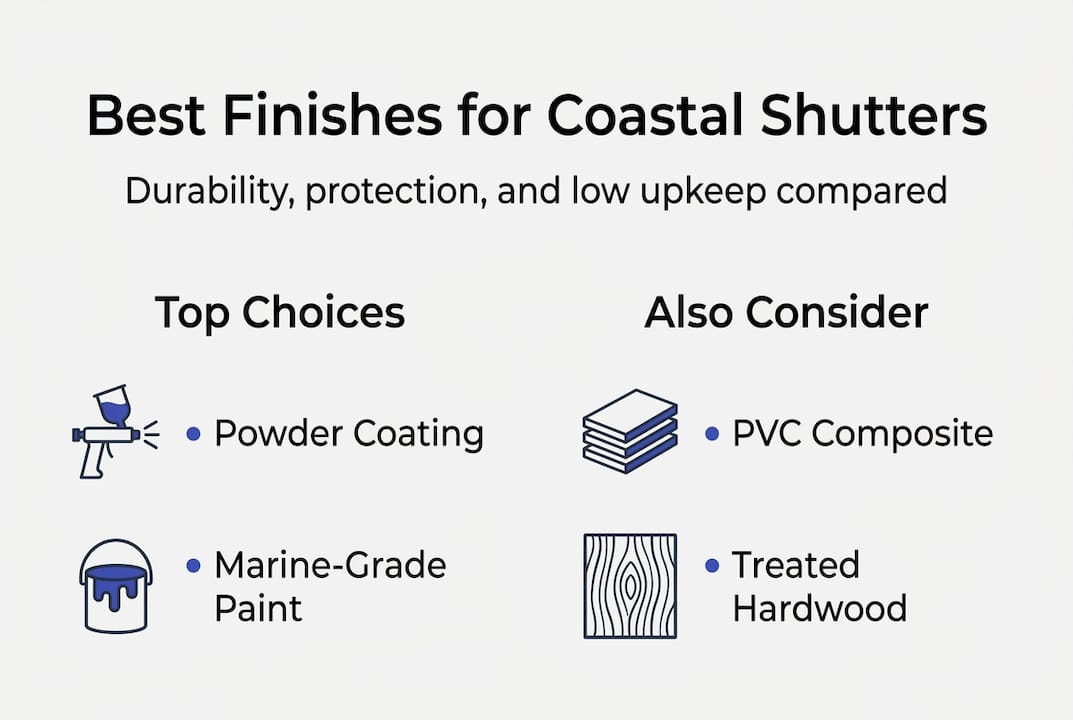
Waterproof PVC and composite shutters suit moisture-prone interiors such as bathrooms and utility rooms. They resist swelling and require almost no specialist upkeep. For those wanting the best shutters for humidity and complex window shapes, composite materials offer a particularly versatile solution.
Pro Tip: Always pair your chosen finish with corrosion-resistant hardware. Stainless steel or brass hinges and fixings prevent rust streaks that can undermine even the finest shutter coating.
Matching finish to window type and usage: bespoke solutions explained
Coastal homes rarely feature straightforward, standard windows. Bay windows that wrap around a sea-facing elevation, arched frames in period properties, wide picture windows designed to frame ocean views, and compact bathroom lights all present different challenges. The optimal finish shifts depending on both the window’s shape and its intended use.
For arched or round windows, stability under temperature change is critical. Timber expands and contracts with humidity, so premium hardwood for stability with a factory marine coating is the preferred pairing. The dense grain of hardwood resists movement better than softwood or MDF, keeping the shutter’s geometry true over many years.

Wide bay windows face amplified wind pressure and prolonged UV exposure. Powder-coated aluminium frames suit these positions well, combining structural rigidity with a finish that shrugs off salt and sun alike. For bespoke internal shutter solutions in these configurations, precision engineering ensures every panel sits flush regardless of the bay’s angle.
High-traffic or moisture-heavy rooms such as nurseries, bathrooms, and kitchens call for polymer or composite shutters. As noted in durability research, polymer materials offer superior impact and moisture resistance in exactly these conditions, making them the practical first choice where daily wear and steam are constant factors.
Here is a simple framework for deciding on the right finish:
- Measure your exposure: Assess how directly the window faces the sea, prevailing winds, and sun.
- Identify the window type: Note the shape, size, and any unusual geometry that demands precision fitting.
- Match material and finish: Pair direct-exposure windows with powder-coated aluminium or marine-coated hardwood; use composite for wet or high-traffic interiors.
- Confirm hardware compatibility: Specify corrosion-resistant fixings to complete the system.
For shutters for tricky-shaped windows, bespoke engineering ensures the finish and the form work together seamlessly, rather than compromising one for the other.
Care and maintenance: keeping coastal shutters in top condition
Even the finest finish requires some attention to deliver its full potential lifespan. The good news is that high-performance coastal finishes are designed to make maintenance straightforward rather than burdensome.
Annual cleaning and bi-annual inspections can extend shutter life by up to 40%, and composites or treated hardwoods with the right finish routinely last 20 years or more with consistent care. That is a compelling return on a modest investment of time.
Here are the key maintenance steps for each finish type:
- Powder-coated aluminium: Wipe down with a damp cloth and mild detergent every few months. Inspect for chips or scratches twice yearly, as exposed metal beneath the coating is vulnerable to salt corrosion.
- Marine-coated hardwood: Clean gently with a soft brush and warm soapy water. Check the finish annually for any areas of lifting or micro-cracking, and address them promptly with a compatible touch-up product.
- Composite and PVC: The simplest to maintain. Soap and water is all that is needed. Inspect the louvre joints and frame edges bi-annually for any signs of discolouration or seal failure.
For detailed shutter maintenance advice tailored to your specific material, specialist guidance makes a real difference. You can also find further reading on coastal shutter care and advice on how to protect shutters from sunlight to keep UV fade at bay.
Pro Tip: Pay particular attention to edges and hardware during every inspection. Edges are where coatings are thinnest and where moisture finds its first foothold. Catching early signs of wear here prevents far more costly repairs later.
“Consistent, simple maintenance is the single most effective way to protect your investment in quality coastal shutters.”
What most guides miss about shutter finishes for coastal homes
After years of helping coastal homeowners specify and install shutters that genuinely last, we have noticed a pattern. Most guides focus on finish type and material, which is important, but they rarely address the ecosystem view. A flawless marine coating on your shutters means little if the hinges are mild steel and the frame fixings are untreated. Salt air finds every weakness, and one corroding component can compromise the whole installation.
We have also seen the consequences of DIY paint applications on coastal shutters. A brush-on coat applied on a damp morning, or without proper surface preparation, can fail within a single season. The repair cost almost always exceeds what a factory-applied finish would have cost at the outset.
The hidden win with composite and marine finishes is not just durability. It is the low-maintenance lifestyle they enable. Coastal living should feel freeing, not like a constant battle against the elements.
Finally, consider the energy benefits of quality shutters when specifying your finish. Premium materials and tight-fitting bespoke shutters improve thermal insulation noticeably, reducing heat loss through coastal windows where draughts are common. Finish choice and energy performance are more closely linked than most people realise.
Transform your coastal home with bespoke shutter expertise
Choosing the right finish is only part of the picture. Getting the fit, the engineering, and the installation right is equally critical for coastal windows that perform year after year.

At Shutter World, we bring over 25 years of bespoke shutter expertise to every coastal project. Our team surveys your home, assesses your specific exposure and window shapes, and specifies the precise finish and material combination to deliver flawless, lasting results. Whether you are exploring bespoke shutter solutions, classic plantation shutter installations, or versatile bespoke shutter blinds, we handle every detail from survey to installation. Book your free consultation today and let us help you protect and transform your coastal home with shutters built to last.
Frequently asked questions
Which shutter finish lasts longest in UK coastal homes?
Factory-applied marine-grade coatings and powder-coated aluminium outlast all alternatives in coastal conditions, offering the strongest resistance to salt air, UV, and persistent moisture.
How often should coastal shutter finishes be cleaned or inspected?
Clean your shutters annually and carry out a thorough inspection bi-annually. Annual cleaning and bi-annual inspections can extend shutter life by up to 40%, making this simple routine well worth the effort.
Are composite or hardwood shutters better for moisture-prone rooms?
Composites offer superior moisture resistance and require minimal upkeep, but treated hardwoods with sealants also perform very well when paired with a quality marine-grade finish.
What hardware should pair with shutters in salt-air environments?
Always specify stainless steel or brass fixings and hinges. Pairing with corrosion-resistant hardware prevents rust streaks and structural weakening in salt-air environments.
Can I refresh my old shutters’ finish for better protection?
Professional, factory-applied finishes bond far more effectively than site-applied alternatives. In many cases, professional finishes extend lifespan by up to 40%, making replacement with a properly finished shutter more cost-effective than repainting.
Recommended
- Choosing the best shutters for coastal homes in the UK
- How to Choose Shutter Styles: A Step-by-Step Guide | Shutter World
- Shutter Colour Matching Tips for a Perfect Home Look | Shutter World
- Top Shutter Styles for Rustic Homes in the UK (2025 Guide) | Shutter World
- Best flooring types for South Florida homes 2026