
Blinds and shutters: enhance your home with bespoke solutions

Blinds and window treatments
TL;DR:
- Bespoke window treatments ensure a perfect fit for unusual and architectural window shapes.
- Properly chosen shutters and blinds improve home comfort, energy efficiency, and property value.
- Layered, customized solutions outperform standard off-the-shelf options in durability and aesthetics.
Your windows do far more than frame a view. The treatments you choose for them shape how your rooms feel throughout the day, how much privacy you enjoy, and even how much you spend on heating and cooling. Yet many UK homeowners treat window coverings as an afterthought, reaching for the nearest ready-made blind without considering whether it truly suits their space. This guide walks you through the full picture: the real challenges posed by unusual window shapes, the key types of treatments available, the measurable impact on comfort and energy use, and why a bespoke, made-to-measure approach so often delivers results that standard solutions simply cannot match.
Table of Contents
- Understanding your window challenges
- Types of blinds and window treatments for every need
- How blinds and shutters influence comfort and energy
- Choosing bespoke solutions for unique windows
- Why bespoke always outshines ‘off-the-shelf’ for UK homes
- Transform your windows with tailored expertise
- Frequently asked questions
Key Takeaways
| Point | Details |
|---|---|
| Custom solutions matter | Bespoke blinds and shutters offer the best performance and aesthetics, especially for unique windows. |
| Energy and comfort impact | Smartly chosen window treatments can control both overheating and heating bills in your home. |
| Match treatments to needs | Evaluate light, privacy, and insulation needs before choosing standard or custom options. |
| Professional support helps | Expert advice simplifies tricky installations and ensures flawless results for all window shapes. |
Understanding your window challenges
Every home has its own character, and that character is often expressed most clearly in its windows. Victorian terraces carry tall sash windows. Edwardian properties boast wide bay fronts. Modern new-builds frequently feature floor-to-ceiling glazing or awkward roof lights. Each of these presents a distinct challenge when it comes to finding a window treatment that looks polished, performs well, and lasts.
The most common difficulties homeowners face include:
- Odd-shaped windows: Arched, triangular, circular, and angled windows are notoriously difficult to cover with standard products.
- Bay windows: The multi-angled structure of a bay means a single flat blind rarely sits flush or looks intentional.
- Oversized glazing: Large panes can flood a room with glare, making it uncomfortable for screens and fading furnishings.
- Street-facing rooms: A lounge or ground-floor bedroom that faces a busy road demands effective privacy without sacrificing natural light.
- Strong directional light: East-facing bedrooms can be brutally bright at dawn, while west-facing rooms bake in late afternoon sun.
The hidden cost of getting this wrong goes beyond aesthetics. Shading reduces overheating by more than 200 hours per year, but when used excessively or incorrectly, it can increase heating demand by 34 to 45 kWh per square metre per year. That is a meaningful figure on an energy bill.
“The right window treatment is not just a design decision. It is a comfort and cost decision that affects your home every single day.”
If you are already wondering how to approach covering tricky-shaped windows, the answer begins with understanding your specific challenge rather than defaulting to whatever is in stock at the local home store.
Types of blinds and window treatments for every need
Having pinpointed your window challenges, next comes finding the right treatment for each scenario. The market offers a wide range of options, each with genuine strengths and real limitations.
| Treatment type | Best for | Light control | Privacy | Unusual shapes | Insulation |
|---|---|---|---|---|---|
| Roller blinds | Simple, rectangular windows | Good | Moderate | Limited | Low |
| Venetian blinds | Offices, kitchens | Adjustable | Moderate | Limited | Low |
| Roman blinds | Living rooms, bedrooms | Moderate | Good | Limited | Moderate |
| Interior shutters | All rooms, complex shapes | Excellent | Excellent | Excellent | High |
| External roller blinds | Overheating prevention | Excellent | High | Moderate | Moderate |
Roller blinds are popular for good reason: they are affordable, easy to operate, and come in a wide range of fabrics. External roller blinds are most effective at reducing overheating, keeping rooms cooler by intercepting solar heat before it enters the glass. However, standard roller blinds are almost always rectangular, which means they are a poor fit for anything beyond a straightforward window opening.
Venetian blinds offer excellent adjustability, allowing you to tilt the slats to redirect light rather than simply block it. They work well in kitchens and home offices where you want to control glare without losing daylight entirely. Maintenance is their weakness: horizontal slats collect dust readily and can be fiddly to clean thoroughly.
Roman blinds bring a softer, more tailored look to a room. They fold neatly when raised and lie flat when lowered, making them a popular choice in living rooms and master bedrooms. Like roller blinds, though, they are not designed for non-rectangular openings.
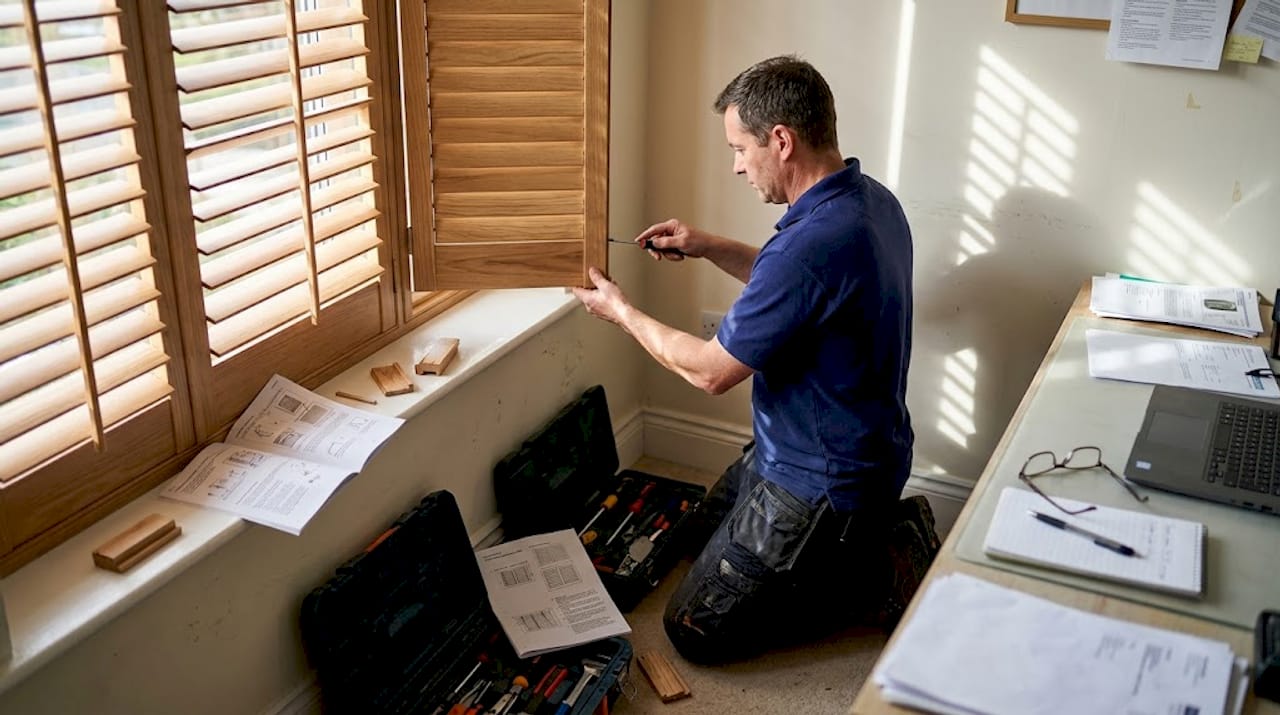
Interior shutters stand apart from all of the above. Crafted from timber or high-quality composite materials, they are built directly to the measurements of your window, which means they can be engineered to fit arched frames, bay configurations, and angled roof lights. They also deliver superior energy efficiency window coverings performance, with the solid panels and tight frame seals reducing draughts and heat loss noticeably.
Pro Tip: Consider layering treatments for the best of all worlds. Sheer curtains paired with interior shutters, for example, give you soft diffused light during the day and complete privacy at night, without sacrificing style in either mode.
When it comes to longevity, shutters consistently outperform fabric blinds. A well-made set of energy-efficient shutters can last 20 years or more with minimal maintenance, whereas fabric blinds typically need replacing every five to eight years as they fade, warp, or lose their mechanism.
How blinds and shutters influence comfort and energy
With a grasp of your options, let us look at the practical impact on comfort and energy use, because the numbers are genuinely worth understanding.
Key seasonal adjustments to make:
- In summer, close shutters or blinds on south and west-facing windows during peak afternoon hours to prevent solar heat gain.
- In winter, open shutters fully during daylight hours to allow passive solar warming, then close them at dusk to retain heat.
- On overcast days, use adjustable louvres on shutters to maximise diffused natural light without direct glare.
- For rooms with skylights, prioritise external or top-down treatments that intercept heat before it enters the room.
- In spring and autumn, use layered treatments to adapt quickly as temperatures fluctuate day to day.
📊 Energy insight: Shading reduces overheating by more than 200 hours per year in UK homes. However, the same research notes that excessive or year-round shading can increase annual heating demand by 34 to 45 kWh per square metre, making seasonal adjustment essential rather than optional.
The distinction between external and interior treatments matters enormously here. External roller blinds intercept solar radiation before it reaches the glass, making them the most effective single solution for overheating. Interior shutters, by contrast, work primarily by reducing convective heat loss in winter and providing a degree of solar control in summer. The two approaches are complementary rather than competing.
For a typical UK semi-detached home with south-facing living room glazing, the shutters impact on heating bills can be meaningful. Reduced draughts through well-fitted shutter frames, combined with the insulating air gap created by solid panels, can lower heat loss through windows noticeably, particularly in older properties where glazing may not be triple-pane.
The practical takeaway is this: window treatments are not passive decorations. They are active tools for managing your home’s thermal environment. Used thoughtfully, they reduce your reliance on both air conditioning in summer and central heating in winter. You can explore more about energy-saving window shutters to understand how the right choice pays for itself over time.
Choosing bespoke solutions for unique windows
After understanding the impact of your choices, let us focus on how bespoke options tackle those awkward or stunningly individual windows that give your home so much of its personality.
Standard, ready-made blinds are designed for the most common window sizes. They are produced in fixed widths and drops, which means that even with extension brackets or trimming, they rarely achieve a truly clean, intentional finish. On an arched window, a flat roller blind leaves the curved section entirely uncovered. On a bay, individual standard blinds create visible gaps at the angles. The result looks improvised rather than considered.
Bespoke solutions address this at the design stage. Here is how the made-to-measure process typically works:
- Professional survey: An experienced fitter visits your home to take precise measurements of every window, noting any irregularities, depth constraints, or architectural features that will influence the design.
- Design consultation: You discuss materials, finishes, louvre sizes, and operating mechanisms, with guidance tailored to your specific rooms and lifestyle.
- Precision manufacturing: Your shutters or blinds are crafted to exact specification, with frames shaped to follow arches, angles, or curves as required.
- Expert installation: Fitters return to install the finished product, ensuring everything sits flush, operates smoothly, and looks precisely as intended.
- Aftercare and guarantee: A reputable specialist backs their work with product and workmanship guarantees, giving you confidence that any issue will be resolved promptly.
The pitfalls of attempting this process without professional support are real. Incorrect measurements, even by a few millimetres, can result in shutters that bind in their frames, blinds that let in unwanted light at the edges, or treatments that simply cannot be installed as planned. DIY measuring on an arched or bay window is particularly unforgiving because the geometry is more complex than it appears.
Managing shutter installations for unusual windows requires experience that comes from having done it many times before. When the window is the architectural centrepiece of a room, getting the treatment exactly right is not a luxury. It is the entire point.
Pro Tip: Always request a professional in-home survey before committing to any made-to-measure product. Photographs and self-taken measurements, however careful, rarely capture the full picture of an unusual window opening.
External blinds and shutters, when tailored, are especially effective for complex window shapes, combining precise fit with strong thermal and light-control performance.
Why bespoke always outshines ‘off-the-shelf’ for UK homes
Here is an uncomfortable truth that the window treatment industry rarely states plainly: most ready-made blinds are a compromise that homeowners accept because they do not realise a better option is accessible to them.
We have visited thousands of homes across the UK over more than 25 years. Time and again, we see the same pattern. A homeowner has fitted a standard roller blind on a bay window, and it sits awkwardly, never quite covering the full opening, always slightly skewed. Or they have hung curtains across an arched window, obscuring the very architectural feature that makes the room special. The blind or curtain was inexpensive upfront, but it has never really worked, and it will need replacing within a few years.
The true cost of a ready-made solution is not just the purchase price. It is the ongoing dissatisfaction, the replacement cycle, and the lost opportunity to have a window treatment that genuinely enhances your home. Bespoke internal shutters are built into the fabric of your home in a way that a clip-in blind simply cannot be.
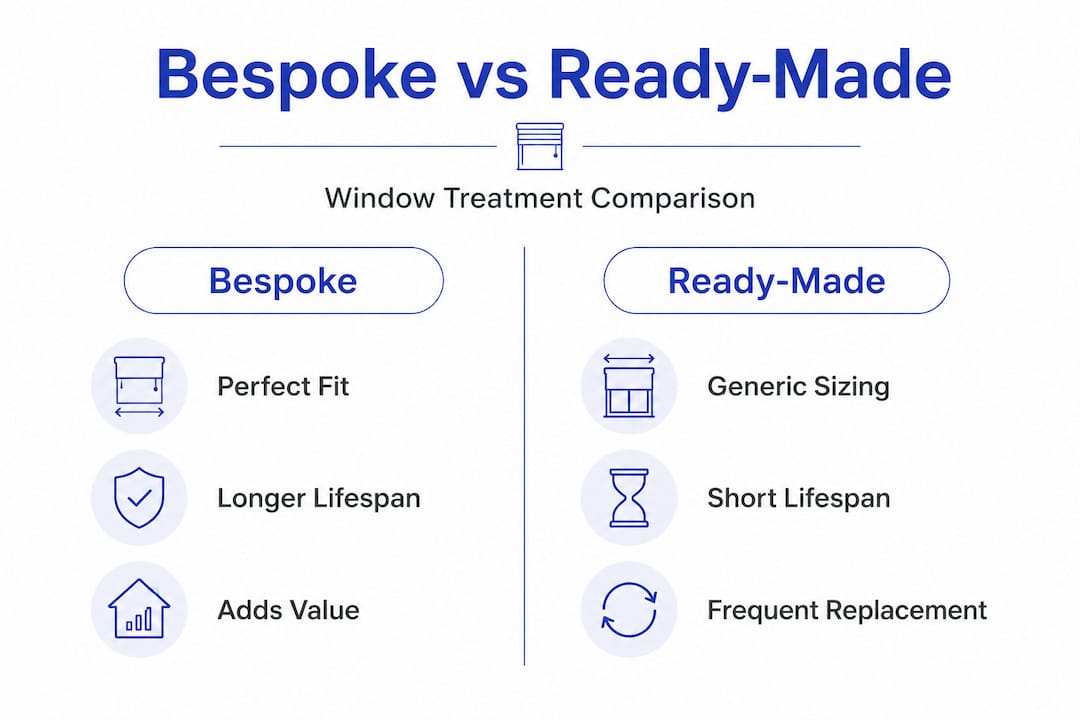
There is also a property value dimension that is frequently overlooked. Well-fitted, high-quality shutters are a recognised feature in the UK property market. Estate agents and buyers alike respond positively to them because they signal quality, care, and attention to detail. A set of tired, sagging blinds sends precisely the opposite message.
We also challenge the assumption that bespoke is unaffordable. When you factor in the lifespan of a quality shutter installation against the replacement cycle of standard blinds, the long-term cost difference is far smaller than the upfront price gap suggests. Understanding what makes shutters bespoke helps clarify why the investment is structured the way it is and why it delivers lasting value.
The homeowners who are most satisfied with their window treatments are consistently those who chose a solution designed specifically for their windows, their rooms, and their lives. That is not a coincidence. It is the natural result of craftsmanship applied with precision.
Transform your windows with tailored expertise
Ready to bring everything together? At Shutter World, we have spent over 25 years helping UK homeowners find window treatments that genuinely work for their homes, including the most complex, characterful, and architecturally demanding windows you can imagine.

Whether you are dealing with a sweeping bay, a graceful arch, or a modern rooflight, our team will survey your space, guide you through every option, and deliver a finished installation that exceeds your expectations. Explore the full range of benefits of bespoke shutters and see how our approach differs from anything you will find off the shelf. Browse our tailored window shutters range to find the perfect style for your home, or discover the full scope of our made-to-measure shutters service. Book your free in-home survey today and take the first step towards windows that truly transform your home.
Frequently asked questions
Can window blinds and shutters help with energy bills?
Yes. Correct use of shading and shutters can significantly reduce overheating in summer, lowering cooling costs, though shading may increase heating demand if used excessively in winter, so seasonal adjustment is important.
What is the best solution for arched or round windows?
Bespoke blinds or shutters are the only reliable solution for non-standard shapes, as they are engineered to follow the exact contour of the opening, ensuring a perfect fit for complex window shapes and effective light control.
Should I choose roller blinds, shutters, or layered treatments?
Layered solutions offer the greatest flexibility for most rooms. External roller blinds excel at preventing overheating, while bespoke interior shutters provide superior control, insulation, and suitability for unusual window shapes.
Are made-to-measure blinds worth the extra investment?
Absolutely. Made-to-measure products provide a precise fit, significantly longer lifespan, and optimal performance, particularly on windows where standard sizes leave gaps or look unfinished. The long-term value consistently outweighs the upfront cost difference.
Can window treatments add value to my property?
Well-chosen, professionally installed shutters are a recognised quality feature in the UK property market, enhancing both kerb appeal and interior presentation in ways that prospective buyers and valuers respond to positively.