
Control natural light and privacy with bespoke shutters

Shutters for light control
TL;DR:
- Bespoke shutters reduce heat loss by 33% and offer superior insulation compared to blinds.
- They provide precise light and privacy control, especially for challenging window shapes like bays and arches.
- Proper use and adjustment of shutters enhance energy savings, comfort, and their long-term performance.
Up to 25% of a home’s heat escapes through its windows, yet most homeowners reach for curtains or off-the-shelf blinds without questioning whether there’s a better solution. There is. Bespoke shutters reduce heat loss by 33%, depending on glazing type and fit, outperforming both blinds and curtains by a considerable margin. Beyond insulation, shutters offer a level of light and privacy control that mass-produced window coverings simply cannot match. This guide walks you through the practical benefits, the key shutter types, how to handle awkward windows, and how to get the very best from your investment every single day.
Table of Contents
- Why light control matters in modern UK homes
- Types of shutters for light and privacy control
- Getting a perfect fit: Handling bay, arched, and awkward windows
- Getting the most from your shutters: Best practices and pitfalls
- Why bespoke shutters are an investment, not just a style statement
- Transform your home with tailored shutters
- Frequently asked questions
Key Takeaways
| Point | Details |
|---|---|
| Shutters cut heat loss | Insulating shutters can lower energy bills more effectively than blinds or curtains. |
| Daylight control stays flexible | You can enjoy up to 70% of natural light while managing privacy and glare. |
| Custom solutions fit any window | Bespoke engineering prevents light leaks for bay, arched, or awkward frames. |
| Regular use maximises value | Adjusting shutters daily brings year-round comfort and efficiency. |
Why light control matters in modern UK homes
Natural light is one of the most powerful forces shaping how a room feels. Too much of it at the wrong time creates glare on screens, overheats south-facing rooms in summer, and fades furniture over the years. Too little leaves a space feeling cold and uninviting. For UK homeowners, managing daylight is a genuine daily challenge, particularly in terraced streets, urban flats, and homes with large glazed extensions.
Privacy is equally pressing. Many UK homes sit close to pavements, neighbouring properties, or busy roads. Standard net curtains block the view but also block the light. Blinds offer a binary choice: open or closed. Shutters, by contrast, give you precise, layered control. Tilt the louvres and you can flood a room with soft, diffused light while keeping prying eyes firmly outside.
The energy argument is compelling too. Well-fitted energy efficient shutters act as a secondary insulating layer at the window, reducing draughts and heat transfer throughout the year. In winter they retain warmth; in summer they deflect solar gain. The shutter energy savings available to UK homeowners are not trivial, particularly as energy bills remain high.
Here is a quick summary of the everyday challenges shutters address:
- Glare on televisions, monitors, and dining tables during morning and evening sun
- Overheating in south and west-facing rooms during summer months
- Privacy loss in ground-floor rooms facing streets or shared gardens
- Heat loss through single or older double-glazed windows in winter
- Noise from busy roads, softened by the added mass of solid or louvred panels
Statistic: Bespoke shutters reduce heat loss by 33% depending on glazing type and fit, a significant improvement over standard blinds.
Pro Tip: Fit shutters on north-facing windows too. They may receive less direct sun, but they are often the biggest source of winter draughts and heat loss in older properties.
Having seen why light and energy loss are such big issues, let’s look at what’s possible with bespoke shutters.
Types of shutters for light and privacy control
Not all shutters work the same way, and choosing the right style for each room makes an enormous difference to how well they perform. The main types available from a bespoke specialist each have distinct strengths.
Full-height shutters cover the entire window from top to bottom in a single panel or pair. They offer the cleanest look and the most consistent light control, making them ideal for living rooms and hallways where you want a uniform, architectural finish.
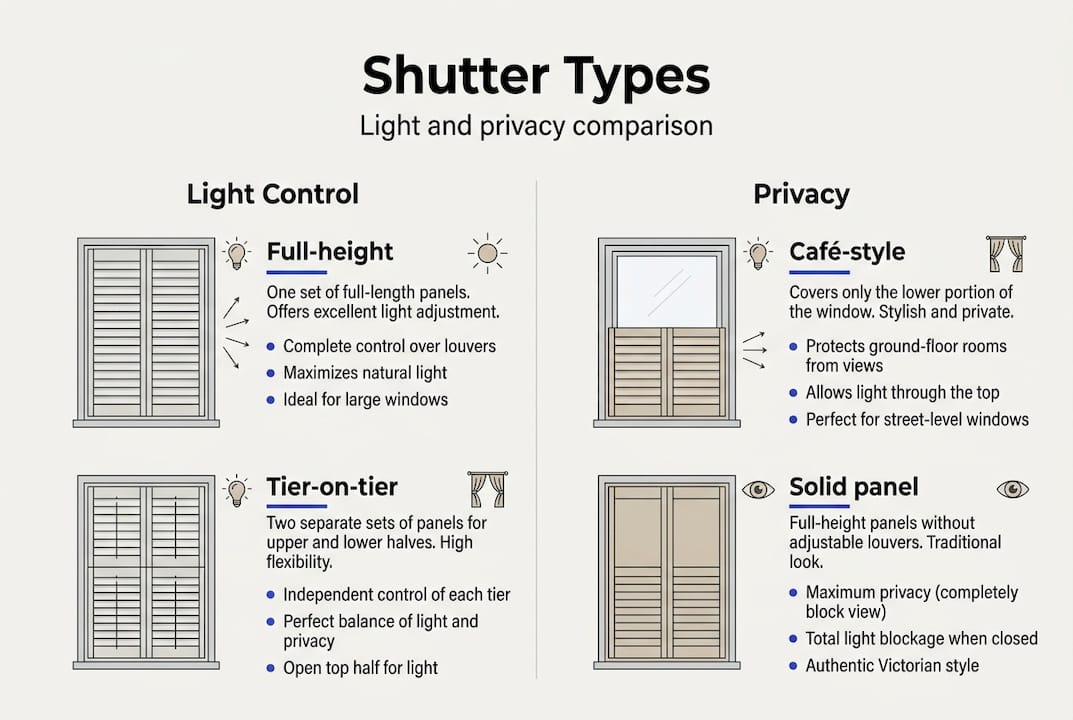
Tier-on-tier shutters split the window into two independent sections. The lower panels can stay closed for privacy while the upper panels open fully to flood the room with light. This design is particularly well suited to street-facing bedrooms and ground-floor sitting rooms.
Café-style shutters cover only the lower half of the window, leaving the top open. They are a popular choice for kitchens and dining rooms where you want natural light from above but privacy at eye level from passers-by.
Solid panel shutters contain no louvres at all, providing a complete blackout when closed. Combined with a blackout blind or blackout-lined panel, they are the gold standard for nurseries and shift workers’ bedrooms.
Here is a quick comparison to help you choose:
| Shutter type | Light control | Privacy | Best room |
|---|---|---|---|
| Full-height | Excellent | Excellent | Living room, hallway |
| Tier-on-tier | Outstanding | Outstanding | Bedroom, street-facing room |
| Café-style | Moderate | Good | Kitchen, dining room |
| Solid panel | Full blackout | Full blackout | Nursery, bedroom |
Our sunlight control guide explores each option in greater detail, including louvre sizing and paint finish choices. For bedrooms specifically, our shutter types for bedrooms resource covers blackout integration and child-safe operating systems.
One often-overlooked advantage is layering. Properly adjusted shutters maintain over 70% natural daylight while controlling glare, meaning you rarely need to choose between a bright room and a comfortable one.
- Start with the room’s primary use: sleep, work, or socialising.
- Identify the key light challenge: glare, overheating, or privacy.
- Choose a shutter style that addresses both the challenge and the aesthetic.
- Select louvre size: larger louvres (89mm or 114mm) let in more light when open.
Pro Tip: For home offices, tier-on-tier shutters on east or west-facing windows let you eliminate screen glare in the morning or afternoon without darkening the whole room.
Now that the advantages are clear, you’ll want to know how bespoke solutions handle the windows that standard products simply cannot fit.
Getting a perfect fit: Handling bay, arched, and awkward windows
Bay windows, arched frames, triangular skylights, and angled rooflines are among the most beautiful architectural features in UK homes. They are also the windows that off-the-shelf shutters cannot handle. Standard products are manufactured to fixed dimensions, so they leave gaps at the edges, fail to follow curves, and allow light to leak through at every angle.

Bespoke engineering solves this precisely. The key lies in the frame system used to mount the shutters. A Z-frame is used where the shutter panel needs to sit proud of the window reveal, creating a neat, flush finish around irregular surrounds. An L-frame fits inside the reveal itself, ideal for deep-set windows where you want the shutter to sit within the frame rather than over it.
For bay windows, each section of the bay is measured and manufactured individually, then fitted as a cohesive unit. The result is a seamless run of shutters that follows the geometry of the bay without gaps or misaligned panels. Bespoke engineering ensures no light leakage for bay or arched windows, using Z-frames or L-frames alongside solid panels or blackout blinds where a true blackout is required.
For tricky-shaped windows such as arches and triangles, panels are shaped to follow the exact curve or angle of the frame, often using a tracked or hinged system that allows the shutter to open and close smoothly despite its unusual outline.
Before selecting a supplier, ask these questions:
- Do you carry out your own in-home survey, or do you rely on the customer’s measurements?
- Can you provide a frame sample so I can see the finish before committing?
- What is your process for arched or shaped sections above a standard panel?
- Do you offer a blackout guarantee, and how is light leakage tested post-installation?
“A truly bespoke shutter is engineered from the window outward, not forced into a shape it was never designed to fill.”
For bay window shutters in particular, the difference between a bespoke fit and a standard approximation is visible from across the room. Precision matters, and it is worth insisting on it.
| Window type | Frame solution | Blackout option |
|---|---|---|
| Bay window | Individual panels per section | Solid panel or blackout blind |
| Arched window | Shaped fixed panel above louvred section | Solid shaped panel |
| Triangular skylight | Custom-cut fixed panel | Full solid panel |
| Angled roofline | Tracked hinged system | Blackout fabric integration |
So, what about making the most of your shutters once they are installed? Let’s cover the practices that protect your investment.
Getting the most from your shutters: Best practices and pitfalls
No matter which shutter you choose, using them correctly makes a dramatic difference to the comfort, energy savings, and longevity you experience. Most homeowners fit shutters and then operate them in only one or two positions, missing much of the benefit.
Here are the four best practices we recommend:
- Adjust louvres by season. In winter, close louvres fully at night to maximise insulation. In summer, tilt them upward to deflect direct sun while allowing warm air to circulate near the ceiling.
- Use tier-on-tier independently. If you have tier-on-tier shutters, treat the upper and lower sections as separate tools rather than opening or closing them together as a single unit.
- Clean louvres regularly. Dust accumulation on louvres reduces their reflective properties and can subtly affect airflow. A soft cloth or a purpose-made louvre brush keeps them performing well.
- Check hinges and tilt rods annually. A small adjustment once a year prevents the stiffness that leads homeowners to stop using their shutters altogether.
Shading reduces overheating but inconsistent use limits the benefits, and the same principle applies to shutters. The homes that see the greatest energy savings are those where occupants actively adjust their shutters morning and evening rather than leaving them in a fixed position.
Common pitfalls to avoid:
- Leaving shutters fully open on south-facing windows during peak summer afternoons
- Keeping shutters permanently closed in winter, which blocks free solar gain on bright days
- Ignoring the insulating value of shutters on internal doors and partition glazing
- Assuming energy-efficient shutters work automatically without any adjustment
Our shutters energy savings guide sets out a practical seasonal routine that takes less than a minute each day and can meaningfully reduce heating and cooling costs across the year.
Pro Tip: On bright winter days, open louvres fully between 10am and 3pm to capture free solar heat, then close them at dusk to retain it. This simple habit can reduce your heating demand noticeably over a full winter season.
Retrofitting is also worth considering if your existing shutters are more than ten years old. Frame seals degrade, louvres warp slightly, and the insulating performance of older units rarely matches what a modern bespoke shutter delivers.
Why bespoke shutters are an investment, not just a style statement
After more than 25 years fitting shutters across the UK, we have noticed a consistent pattern. Homeowners come to us focused on how shutters will look. They leave understanding what shutters actually do. The two are not the same conversation.
Style is the starting point, not the destination. The real returns from bespoke shutters accumulate quietly: lower energy bills, fewer draughts, better sleep, reduced glare, and a home that feels genuinely well considered rather than merely decorated. These are not abstract benefits. They shape how you live in your home every single day.
What surprises many of our customers is how permanent the upgrade feels. Unlike curtains that fade or blinds that buckle, a well-made shutter becomes part of the architecture. It is built into the fabric of the window itself, and it stands the test of time in a way that soft furnishings never quite manage.
With energy costs remaining volatile and daylight patterns shifting with the seasons, light control is not a luxury. It is a form of household infrastructure. We believe shutters and sustainability are inseparable, and the homes that invest in bespoke solutions today are the ones best protected against the costs and discomforts of tomorrow.
Transform your home with tailored shutters
If this guide has clarified what bespoke shutters can genuinely offer, the next step is seeing what they can do for your specific windows and rooms.
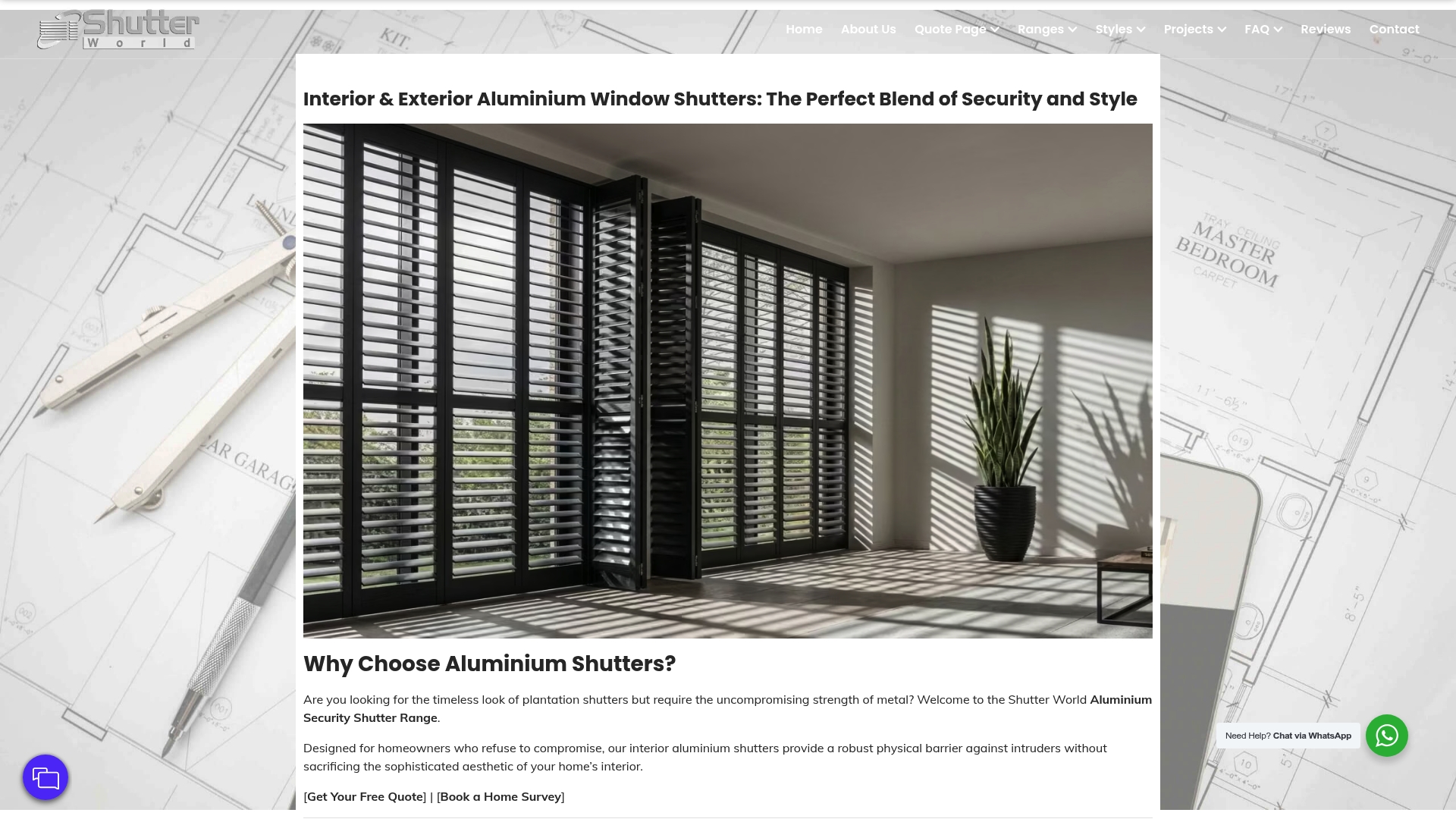
At Shutter World, we provide expert in-home surveys, precise measurements, and full installation for every window type, including the most challenging shapes. Whether you are exploring tailored window shutters for a single room or planning a whole-home project, our team is ready to guide you. Browse our plantation shutters range or discover the sleek, low-maintenance appeal of aluminium window shutters. Book a no-obligation consultation today and take the first step towards a home that is as comfortable as it is beautiful.
Frequently asked questions
Are shutters better than blinds for blocking out sunlight?
Bespoke shutters reduce heat loss by 28–58% depending on glazing type and fit, outperforming blinds at 22%, and their tighter seal makes them far superior for both light blocking and insulation.
Can shutters really help cool my rooms in summer?
Yes. Shading reduces overheating significantly, and shutters allow you to tilt louvres for airflow while shielding interiors from direct solar gain, something blinds cannot replicate as effectively.
Will fitting shutters work on my bay or arched windows?
Bespoke engineering ensures no light leakage for bay or arched windows by using Z-frames, L-frames, and custom-shaped panels that follow the exact geometry of your window.
How much daylight do shutters let through?
Properly adjusted shutters maintain over 70% natural daylight while controlling glare, so you can brighten a room without the harsh, unfiltered light that causes discomfort and fading.
Recommended
- Shutters and Natural Light: Transforming Your Living Space | Shutter World
- Choosing Shutters for Sunlight Control: A Step-by-Step Guide | Shutter World
- Daylight management with shutters: optimise light in 2026
- Privacy with Shutters: Smart Solutions for UK Homes in 2025 | Shutter World
- How To Choose The Perfect Barn Window – System Equine