
Enhance fire safety and style with interior shutters

Fire safety and shutters
TL;DR:
- Window treatments like shutters influence fire spread and smoke migration in homes.
- Fire-resistant materials like aluminium and treated hardwood offer better passive fire protection.
- Regular maintenance and proper installation are essential for shutters to effectively enhance fire safety.
Most homeowners spend a great deal of time choosing window shutters for their look, their louvre size, or the way they filter afternoon light. Fire safety rarely enters the conversation. Yet the window treatments you choose play a genuine, if often overlooked, role in how quickly a fire can spread through your home. This guide takes a close look at the relationship between interior shutters and fire safety, helping you understand which materials and designs offer the strongest passive protection, how to keep your shutters performing well over time, and how to achieve a beautiful interior without compromising on safety.
Table of Contents
- Understanding fire risks in the home
- How shutters can contribute to fire safety
- Best practices for fire-safe shutter selection and maintenance
- Combining fire safety with aesthetics and home value
- Why careful maintenance matters more than most realise
- Find your perfect fire-safe shutter solution
- Frequently asked questions
Key Takeaways
| Point | Details |
|---|---|
| Shutters as fire barriers | Properly chosen shutters can slow fire spread and aid home safety. |
| Material choice matters | Aluminium and certified fire-rated shutters offer better fire resistance than untested types. |
| Maintenance is key | Regular inspection and care are critical for shutters to provide ongoing protection. |
| No style compromise | Modern fire-safe shutters come in attractive designs to suit all interiors. |
Understanding fire risks in the home
To fully appreciate how shutters can enhance safety, it is important to first understand the common fire risks that affect UK homes. Fire spreads faster than most people expect. Within minutes, a small ignition point can engulf an entire room, and the materials surrounding your windows play a direct role in how quickly flames travel.
Windows are a known weak point in a home’s passive fire resistance. Glass can shatter under heat, opening a pathway for flames and toxic smoke to move between rooms or floors. The window treatments you use, whether curtains, blinds, or shutters, sit directly in that pathway. Lightweight or synthetic fabrics can ignite quickly and feed a fire rather than slow it. Even timber blinds, if poorly maintained or made from low-grade materials, can act as fuel rather than a barrier.
Passive fire barriers are the elements of your home’s structure and fittings that slow fire progression without requiring anyone to operate them. They are your first line of defence when occupants may be asleep or unable to react quickly. This is where the quality and condition of your shutters genuinely matters.
The wider picture of passive fire protection in the UK is, frankly, concerning. Approximately 65% of inspected fire doors failed to comply with legal minimum standards, revealing the risks of poor maintenance and inspection of passive fire barriers. While fire doors and shutters serve different purposes, this statistic underlines a broader problem: the effectiveness of any passive barrier depends entirely on its quality and upkeep.
Understanding window shutter regulations in the UK is a sound starting point for every homeowner. Key risks that shutters can help address include:
- Rapid flame spread along lightweight window coverings made from synthetic or untreated materials
- Smoke migration through gaps around poorly fitted window treatments
- Structural exposure when windows fail early under heat, removing any separation between rooms
- Delayed escape when window fittings obstruct emergency egress routes
“The risks associated with passive fire barriers are not theoretical. Failure rates in real-world inspections demonstrate that the quality and condition of every barrier in your home genuinely matters.”
When fire doors fail at such a high rate, it is a powerful reminder that no passive barrier should be treated as an afterthought. Selecting and maintaining the right shutters is a small but meaningful part of protecting your household.
How shutters can contribute to fire safety
Having covered why passive barriers matter, let us look at how well-chosen shutters can serve this crucial role in your home.
The material your shutters are made from is the single most important factor in their fire performance. Not all shutters behave the same way under heat, and understanding the differences helps you make a better-informed choice.
| Shutter material | Fire resistance | Typical use | Notes |
|---|---|---|---|
| Solid hardwood | Moderate | Living rooms, bedrooms | Slows ignition but will eventually burn |
| MDF with coating | Low to moderate | Budget installations | Coating can improve surface resistance |
| Aluminium | High | Any room, high-risk areas | Does not combust; retains shape under heat |
| Composite/uPVC | Low to moderate | Conservatories | Can melt or warp; limited barrier value |
| Fire-rated timber | High | Specialist applications | Treated to resist ignition significantly longer |
Aluminium shutters stand apart from the rest. Unlike timber or composite alternatives, aluminium does not combust. It retains its structural form under significant heat, meaning it continues to act as a barrier even as temperatures rise in a room. For hallways, stairwells, or rooms adjacent to kitchens, this resilience is genuinely valuable.
Hardwood shutters, such as those found in our Montana range, still offer meaningful passive resistance compared to thin curtain fabrics or standard roller blinds. A solid hardwood louvre is far slower to ignite than a synthetic blind, giving occupants additional time to respond or escape. The key is that the shutter is well fitted, properly closed, and regularly maintained.
Fire protection can be undermined by poor maintenance and inspection, a concern that applies equally to shutters used as passive barriers. A warped louvre, a loose frame, or a shutter that no longer closes flush leaves gaps through which smoke and heat travel freely.

Design also matters. Full-height shutters with tight-fitting frames compartmentalise a room more effectively than café-style shutters that cover only the lower half of a window. Tier-on-tier designs, which allow the top and bottom panels to operate independently, can be closed fully at night to maximise the barrier effect. You can explore the relationship between shutters and home security to understand how similar principles of robust fitting apply across safety contexts.
Pro Tip: If fire safety is a priority, specify aluminium shutters for rooms nearest the kitchen or utility areas. Their superior heat resistance and shutter safety features make them the most resilient choice in high-risk zones of the home.
Standard fabric blinds offer negligible passive fire resistance. A close-fitting, full-height shutter in a fire-rated or high-resistance material provides a meaningfully superior barrier, buying precious minutes in an emergency.
Best practices for fire-safe shutter selection and maintenance
Knowing the theory is not enough. Here is how you can make it work in your own home, from the initial specification stage through to long-term upkeep.
Choosing the right specification
When selecting shutters with fire safety in mind, look for products that carry relevant certifications or are made from inherently fire-resistant materials. Aluminium shutters need no chemical treatment to achieve their fire resistance; the material itself delivers that performance. For timber shutters, ask your supplier whether the wood has been treated with a fire-retardant finish and whether that treatment is maintained over the product’s lifespan.
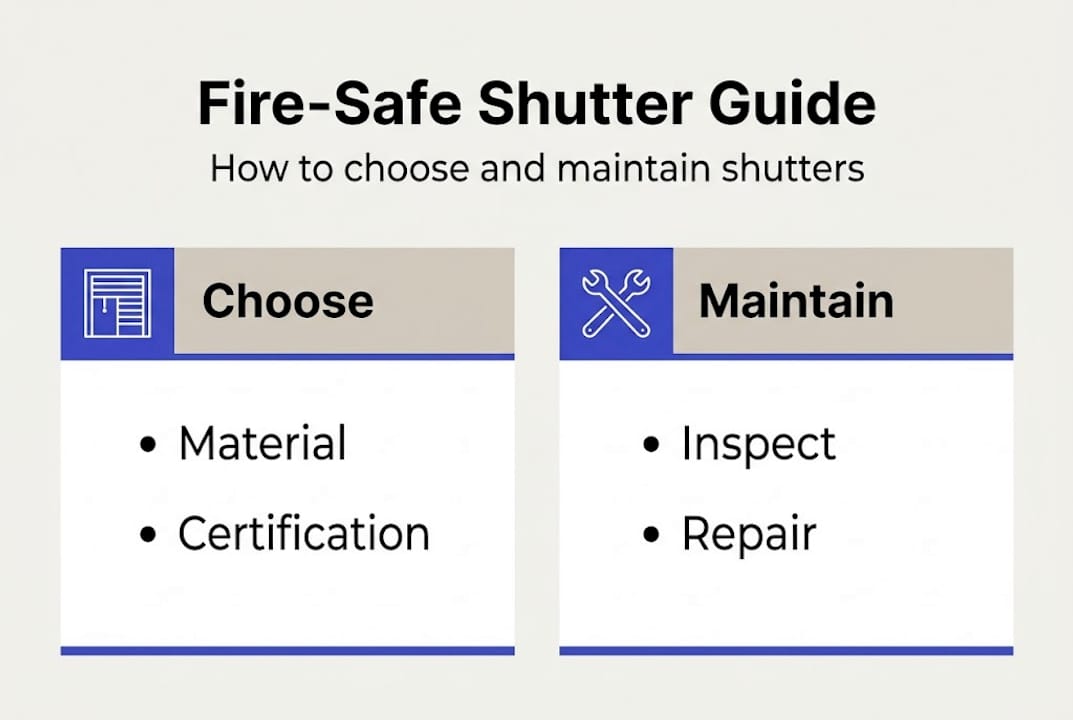
Frame fit is equally important. A shutter that sits loosely in its frame, or one that has warped over time, provides far less protection than a precisely engineered, close-fitting installation. This is one of the reasons bespoke, made-to-measure shutters offer a genuine safety advantage over off-the-shelf alternatives.
Ongoing maintenance: a practical routine
Regular inspection and proper upkeep are as crucial for shutters as they are for fire doors, ensuring effectiveness as passive barriers over the long term. We recommend the following maintenance steps:
- Check louvre alignment. Each louvre should open and close smoothly without catching or sticking. Misaligned louvres indicate wear in the tilt mechanism or warping in the slat itself.
- Inspect the frame for gaps. Run your fingers around the full perimeter of the shutter frame. Any gap wider than a few millimetres represents a potential pathway for smoke.
- Examine hinges and fixings. Loose hinges not only affect smooth operation but can cause the shutter panel to sit away from the frame, reducing its effectiveness as a barrier.
- Clean and condition timber shutters. Dry, cracked timber ignites more readily than well-maintained wood. A light application of appropriate conditioning oil helps preserve both the appearance and the integrity of hardwood shutters.
- Test the full close position. Close every shutter panel fully and check from both sides that no light or draught passes through the louvres or frame joins.
Pro Tip: Schedule your annual shutter inspection on the same day you test your smoke alarms and replace alarm batteries. Grouping these checks together means fire safety as a whole receives consistent, annual attention rather than being treated as separate tasks that are easy to forget.
Understanding shutter compliance rules for your property type is also worthwhile, particularly if you live in a period property or a building that has undergone recent conversion or extension.
Wear to look out for includes surface bubbling or peeling on treated shutters, which may indicate that the fire-retardant coating is breaking down, as well as any discolouration, cracking, or splitting across louvres or frames.
Combining fire safety with aesthetics and home value
Fire safety does not have to come at the expense of beauty. This is a misconception we encounter regularly, and it is one worth setting aside completely.
Homeowners are increasingly considering both safety and style in window treatment decisions, especially where traditional protection has been unreliable. The good news is that the shutters offering the strongest passive fire resistance are often among the most visually striking choices available.
Aluminium shutters, for example, lend a clean, contemporary look to any room. Their slim profiles and precise engineering give them a refined appearance that suits modern interiors exceptionally well. They are available in a wide range of powder-coated finishes, from crisp whites and warm creams through to anthracite grey and deep charcoal, meaning you can achieve a specific look without any compromise on material performance.
Hardwood shutters remain a timeless choice. The natural grain and warmth of premium timber bring character to period properties and classic interiors in a way that no synthetic alternative quite replicates. Paired with a fire-retardant treatment and meticulous finishing, a hardwood shutter delivers beauty and meaningful passive protection simultaneously. You can explore the full breadth of shutter design options to find the style that best suits your home’s character.
From a property value perspective, the benefits of high-quality shutters are well established. Buyers and valuers recognise shutters as a premium, durable feature, and fire-safe specifications add a further layer of appeal in a market where safety consciousness is growing.
| Shutter feature | Impact on aesthetics | Impact on safety | Impact on property value |
|---|---|---|---|
| Full-height aluminium | High, modern appeal | Excellent fire resistance | Positive, especially in urban homes |
| Solid hardwood, treated | Timeless, premium look | Good passive resistance | Strong, particularly in period properties |
| MDF with quality coating | Versatile, clean finish | Moderate | Moderate |
| Certified fire-rated timber | Can be stained or painted | High fire resistance | Positive in all property types |
Key aesthetic and practical benefits that fire-safe shutters deliver include:
- Thermal performance. Well-fitted shutters reduce heat loss, lowering energy bills and contributing to a more comfortable home. Our energy saving shutters page sets out the full picture.
- Privacy and light control. Full-height shutters offer unmatched flexibility in managing natural light without sacrificing privacy.
- Noise reduction. The additional mass and close fit of quality shutters noticeably reduces external noise, particularly in urban settings.
- Kerb appeal. From the street, shutters give a home a well-appointed, cared-for appearance that enhances overall presentation.
The combination of these factors means that investing in fire-safe, premium shutters is rarely a cost that stands alone. It pays dividends across comfort, safety, and long-term property value.
Why careful maintenance matters more than most realise
Here at Shutter World, we have spent over 25 years fitting shutters across the UK, and one pattern stands out clearly: the gap between a well-performing shutter and a poor one rarely comes down to the product itself. It comes down to whether anyone has checked it in the past two or three years.
Most conversations about fire safety focus on what to buy. The material, the certification, the rating. That is important, but it represents only half of the equation. Fire safety features become inadequate if not regularly checked and maintained, as seen with high rates of fire door failures across the UK. We believe the same truth applies to shutters.
We have seen beautiful, well-specified shutters on managing shutter installations projects where a single loose hinge or a slightly warped louvre has quietly undermined the whole installation’s integrity. The shutter looked fine. It just no longer closed properly.
Our advice is straightforward: do not install and forget. Build shutter maintenance into your annual household safety routine, treat it with the same seriousness as your alarm testing, and you will preserve both the appearance and the protective value of your investment for years to come.
Find your perfect fire-safe shutter solution
Ready to take the next step toward a safer, more beautiful home?
At Shutter World, we design and install bespoke internal window shutters crafted to meet your exact requirements, whether you are prioritising fire-resistant materials, a specific design aesthetic, or both. Our aluminium fire-safe shutters represent the strongest passive fire protection available in a stylish interior shutter format.

Every installation begins with a professional in-home survey, ensuring a precise fit that maximises both safety and visual impact. From contemporary aluminium to luxurious hardwood, our made-to-measure shutters are built to stand the test of time. Contact us today to book your free consultation and discover the shutter solution your home deserves.
Frequently asked questions
Are all shutters equally effective for fire safety?
No, fire resistance varies by material and design, with aluminium and certified fire-rated shutters generally offering superior protection compared to standard timber or composite options.
How often should I inspect my shutters for fire safety?
Annual inspection is recommended, mirroring the guidance applied to fire doors, to ensure that frames, louvres, and fixings remain in a condition that supports continued effectiveness as passive barriers.
Do fire-safe shutters affect my home’s appearance?
Not at all. Modern fire-safe shutters are available in a wide range of styles, finishes, and colours, making it straightforward to achieve a beautiful interior while maintaining meaningful passive fire protection.
Is there a legal requirement for fire-rated shutters in UK homes?
There is no blanket legal requirement for all homes, but regulatory requirements apply in certain contexts, such as converted properties, flats, and buildings subject to specific planning or building regulation conditions. Always check compliance with your local authority if in doubt.