
How window shutters optimise room brightness and style

How shutters affect room brightness
TL;DR:
- Properly chosen shutters can enhance natural light, making rooms feel airier and warmer.
- Louver size, material, colour, and tilt angle significantly influence brightness and privacy control.
- Assess room orientation and layout to select shutters that balance light, privacy, and energy efficiency.
Many homeowners assume that fitting shutters means sacrificing natural light. In reality, the opposite can be true. The right shutter style, material, and louvre configuration can transform how light moves through your rooms, making spaces feel airier, warmer, and more considered. Understanding how shutters interact with daylight is the difference between a window treatment that serves you well and one that leaves your home feeling dimmer than it should. In this guide, we walk through the science of light and shutters, compare popular styles for brightness, share practical design tips, and help you strike the ideal balance between privacy, energy efficiency, and natural light.
Table of Contents
- The science of light: How shutters interact with natural brightness
- Comparing shutter styles: Which options maximise room brightness?
- Practical design tips to boost brightness with shutters
- Balancing privacy, energy efficiency, and brightness
- Our perspective: What most guides miss about shutters and room brightness
- Enhance your home’s brightness with custom shutters
- Frequently asked questions
Key Takeaways
| Point | Details |
|---|---|
| Shutters as light enhancers | The right style and configuration of shutters can boost room brightness rather than reduce it. |
| Custom design matters | Choosing louvre size, colour, and installation method directly affects natural light in a space. |
| Balance with privacy | Shutters offer adjustable levels of privacy without sacrificing brightness or energy efficiency. |
| Practical upgrades | Simple changes like lighter colours and larger louvres can dramatically improve the brightness of any room. |
The science of light: How shutters interact with natural brightness
Natural light does far more than illuminate a room. Natural light significantly impacts health, mood, and energy costs, which means every decision you make about your window coverings carries real consequences for how your home feels day to day. Shutters, when chosen and fitted correctly, are one of the most precise tools available for managing that light.
The material of your shutters plays a significant role. Here is a quick overview of how common materials compare for light transmission:
| Material | Light transmission | Key characteristic |
|---|---|---|
| Premium hardwood | Low to medium | Warm tone, absorbs some light |
| MDF with polypropylene coating | Low to medium | Smooth finish, good for light colours |
| Aluminium | Low | Highly durable, minimal light bleed |
| Vinyl | Low to medium | Moisture resistant, suits humid rooms |
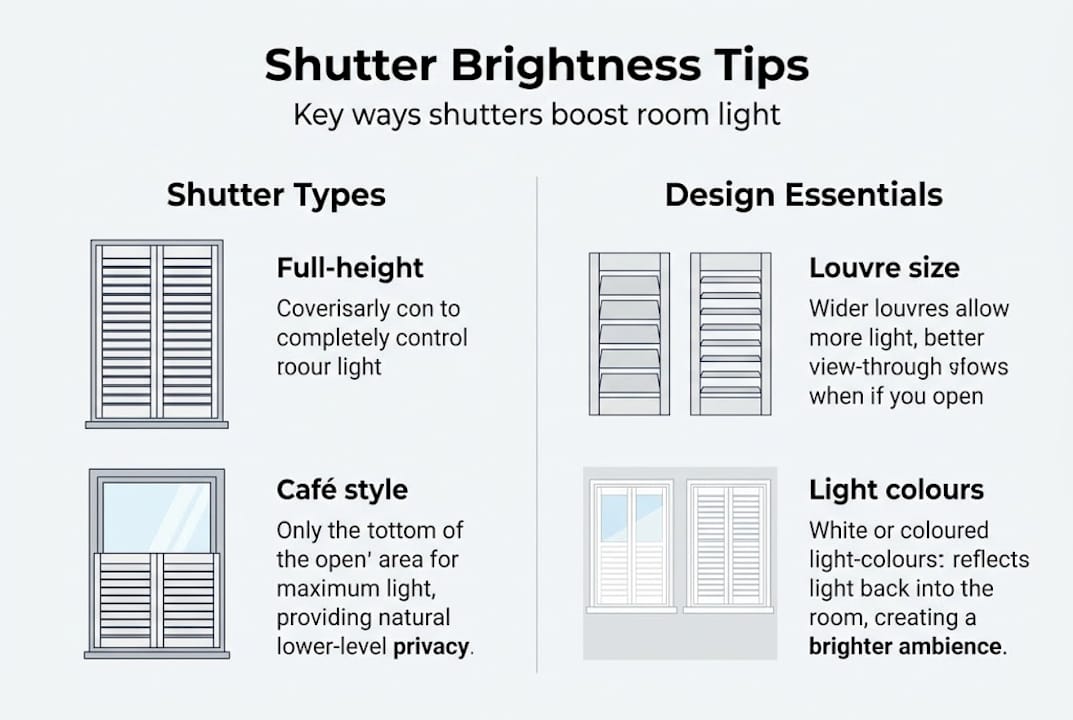
Beyond material, louvre size makes a striking difference. Larger louvres, typically 89mm or 114mm, allow more light to pass through when open and create a more expansive view. Smaller louvres, around 47mm or 63mm, give a more traditional look but restrict light flow when tilted. Colour matters too. White and off-white finishes reflect light back into the room, while darker stains or painted finishes absorb it.
“The amount and quality of daylight entering a building is profoundly affected by the window treatment chosen. Precise control mechanisms, such as adjustable louvres, offer the best outcome for visual comfort and energy performance.” — CIBSE Journal, Daylighting in Buildings: Energy and Visual Comfort
Tilt angle is the factor most homeowners overlook. By angling louvres upward rather than downward, you direct incoming light toward the ceiling, which then bounces it deeper into the room. Learning how shutters and natural light work together at this level of detail is what separates a well-lit interior from one that feels persistently gloomy. When combined with thoughtful material and colour choices, the right louvre configuration means you can have both privacy and brightness simultaneously. Investing in energy efficient shutters also means the light you do capture works harder for your home’s thermal performance.
With the basics set, let’s explore how specific types of shutters impact brightness.
Comparing shutter styles: Which options maximise room brightness?
Not every shutter style delivers the same brightness potential. Understanding the trade-offs between popular UK styles helps you make a confident, informed choice rather than one based purely on aesthetics.
| Shutter style | Brightness potential | Privacy level | Light control | Visual impact |
|---|---|---|---|---|
| Full-height | High (with large louvres) | High | Excellent | Classic, versatile |
| Café style | Very high (upper window open) | Medium | Good | Light and airy |
| Tier-on-tier | High | Very high | Excellent | Elegant, flexible |
| Solid panel | Very low | Complete | None | Rustic, bold |
Each style serves a different purpose. Here is a concise summary of how they perform for brightness:
- Full-height shutters: Cover the entire window and offer the widest range of light settings. With large louvres fully open, they flood a room with light. Closed, they offer near-complete privacy.
- Café shutters: Cover only the lower portion of the window, leaving the upper section permanently open. This is arguably the most effective style for maximising daylight in street-facing rooms.
- Tier-on-tier shutters: Feature independently opening top and bottom panels, giving you fine control over where light enters and where privacy is maintained.
- Solid panel shutters: Offer no light transmission when closed. Best used as decorative or occasional coverings rather than everyday window treatments in light-sensitive rooms.
A common mistake homeowners make is choosing a style based solely on the look in a showroom, without considering the orientation of their windows or the function of each room. A north-facing bedroom, for instance, benefits enormously from café shutters or large-louvre full-height panels, while a south-facing living room may need more control to manage glare.
You can explore how shutters and home decor interact to help you picture the broader visual effect before committing. A detailed sunlight control guide can also walk you through the decision step by step.
Pro Tip: As confirmed by shutter specialists, louvre size impacts both privacy and brightness. Choosing 89mm or 114mm louvres over smaller alternatives is one of the simplest ways to transform how light behaves in your room.
Now that we know the basics, let’s see how popular shutter styles perform in real homes.
Practical design tips to boost brightness with shutters
Choosing the right shutter style is only the first step. How you design and position your shutters within a room determines whether you get the full benefit of natural light or inadvertently limit it.
Here is a practical, step-by-step approach to evaluating your room and selecting the optimal shutter setup:
- Assess your window orientation. South and west-facing windows receive the most direct sunlight. East-facing windows get bright morning light. North-facing windows rely on diffused, ambient light. Each orientation calls for a different louvre size and tilt strategy.
- Choose the lightest finish that suits your style. Reflective, light-coloured shutters enhance room brightness by bouncing available light around the space rather than absorbing it.
- Select the largest louvre size your window allows. Larger louvres mean more glass visible when open and a broader arc of light adjustment when tilted.
- Opt for a slim, precision-fit frame. Oversized or poorly fitted frames block the window reveal and reduce the usable glass area. A professional survey ensures the frame is as unobtrusive as possible.
- Consider split tilt rods or independent panel operation. This lets you angle the upper louvres to bounce light toward the ceiling while keeping lower louvres angled for privacy at eye level.
Shutters also help maintain warmth while allowing light, which matters particularly in older UK properties where heat loss through windows is a persistent concern. Combining shutters with reduced energy bills is a genuine dual benefit, not a marketing claim.
Equipped with a comparison, it’s time to put brightness-enhancing strategies into practice.
Pro Tip: Positioning a large mirror on the wall opposite your shuttered window creates a powerful secondary light source. The mirror catches and redistributes incoming daylight, making even a modest window feel significantly more generous. This approach works especially well in hallways and smaller rooms where daylighting strategies are often most needed.
Balancing privacy, energy efficiency, and brightness
Beyond pure brightness, homeowners balance multiple needs, so let’s examine how to get the mix right.
The three-way relationship between privacy, thermal comfort, and brightness is where most shutter decisions become genuinely personal. There is no universal answer, but there are clear strategies depending on your priorities.
📊 Key stat: Energy-efficient shutters reduce heat loss by up to 51%, making them one of the most effective passive insulation upgrades available for UK windows.
The right choice depends on which factor matters most to you at different times of day and in different rooms:
- Prioritise brightness if your room faces north or receives limited direct sunlight. Choose café or full-height shutters with large louvres in a light finish.
- Prioritise privacy if your windows face a busy street or a neighbour’s property. Tier-on-tier shutters give you independent control of upper and lower panels without sacrificing all incoming light.
- Prioritise thermal performance if your home has older, single-glazed windows or you notice significant cold draughts. Solid or close-fitting full-height shutters create an additional insulating layer that supports your central heating.
- Balance all three by using adjustable louvres with a split tilt rod. This single feature allows you to direct light upward into the room while maintaining street-level privacy, all without compromising insulation.
Futureproofing your home means thinking about seasonal changes too. In winter, tilting louvres to maximise solar gain during daylight hours reduces the demand on your heating system. In summer, angling them to admit morning light while blocking harsh afternoon sun keeps rooms comfortable without closing them entirely. A thorough guide to energy-saving shutters can help you plan for year-round performance. For those specifically looking at energy efficient home shutters, the range of materials and configurations available today makes it entirely possible to meet all three goals without significant compromise.
Our perspective: What most guides miss about shutters and room brightness
Most shutter guides focus almost entirely on the product itself. Louvre size, material, and finish are all important, and we cover them thoroughly. But after over 25 years of fitting shutters in UK homes, we have observed something that product-focused guides rarely address: the room itself plays an equal role in determining the outcome.
As we note in our own research, room layout and window orientation are just as crucial as shutter specification for light optimisation. A beautifully specified shutter fitted to a window that is obscured by heavy furniture or flanked by dark walls will underperform every time. The shutter is only one part of a system.
We also find that personal preference for light intensity is far more varied than most guides acknowledge. Some homeowners want a room filled with crisp, bright light. Others prefer a softer, more filtered quality that feels calm and private. Neither is wrong. The best shutter solution is the one that matches your lifestyle, not a specification chart. Pairing shutters with energy-efficient interior shutters and considered room design produces results that feel genuinely transformative rather than merely functional.
Enhance your home’s brightness with custom shutters
If this guide has sparked ideas for your own home, the next step is seeing what a truly tailored solution looks like in practice. At Shutter World, every shutter we design and install is made to measure, crafted to suit your specific windows, room orientation, and personal style preferences.

From our bespoke internal window shutters designed to fit even the most unusual window shapes, to our full gallery of plantation shutter installations showing real results in real homes, we are here to help you achieve the perfect balance of brightness, privacy, and style. Browse our inspiration gallery and discover how you can transform your home with shutters. Book your free in-home survey today and let our experts guide you from first measurement to flawless installation.
Frequently asked questions
Do shutters make rooms darker or brighter?
The right shutter style and louvre size can brighten a room by letting in and reflecting more natural light, rather than reducing it. It depends on the configuration you choose and how you adjust the louvres throughout the day.
Which is the best shutter style for maximum brightness?
Full-height and café shutters with larger louvres usually offer the best balance of privacy and brightness in UK homes. As specialists confirm, louvre size and design directly affect how much light enters and how well privacy is maintained simultaneously.
Can shutters help save on energy bills while improving brightness?
Yes. Modern shutters improve insulation and reduce the need for artificial lighting, cutting both heat loss and electricity use. Energy-efficient shutters maximise the effect of available daylight while reducing heat loss through the window.
Does shutter colour affect room brightness?
Absolutely. Lighter-coloured shutters reflect more light and can make rooms appear noticeably brighter. The paint or finish applied to your shutters determines how much light is reflected back around the room rather than absorbed.
How do I choose shutters for a room that needs both privacy and brightness?
Opt for shutters with adjustable louvres or tier-on-tier designs, which allow precise, independent control of light and privacy at different heights. Adjustable louvres allow fine-tuning of light and privacy at any time of day without closing the shutters entirely.