
How to evaluate shutter suppliers

How to evaluate shutter suppliers
TL;DR:
- Choosing a reputable supplier involves verifying credentials, reviews, portfolios, and guarantees for quality assurance.
- Prioritize craftsmanship, project experience, and clear guarantees over low prices or well-known brands.
- Conduct in-home surveys, check industry memberships, and speak to previous clients to ensure project success.
Choosing the right shutter supplier can feel overwhelming, particularly when your home has bay windows, arched frames, or unusual angles that demand precision. Many homeowners discover too late that the cheapest quote came with poor materials, ill-fitting panels, and an installer who vanished after the job. The consequences are not merely aesthetic. Ill-fitted shutters can compromise privacy, thermal performance, and the overall character of your interior. This guide walks you through a clear, evidence-based process for finding a supplier whose craftsmanship, credentials, and customer record genuinely match your project’s demands.
Table of Contents
- Understand your needs and set your criteria
- Research potential suppliers: reviews, portfolios and standards
- Compare proposals: pricing, guarantees and craftsmanship
- Verify credentials and final decision-making
- A better way: why trusting only price or branding fails
- Discover bespoke shutter solutions for your home
- Frequently asked questions
Key Takeaways
| Point | Details |
|---|---|
| Be clear on your needs | Define your window requirements and must-have supplier qualities before you start your search. |
| Rely on independent reviews | Trust supplier ratings above 4.8 and real client testimonials more than marketing promises. |
| Examine craftsmanship | Scrutinise portfolios and guarantees to compare quality, not just price. |
| Insist on credentials | Choose suppliers with BWF or BSI memberships for objective proof of quality and safety standards. |
Understand your needs and set your criteria
Before you contact a single supplier, the most valuable thing you can do is get precise about what you actually need. This sounds straightforward, but homeowners often skip this stage and end up comparing proposals that are not measuring the same things at all. A little preparation here saves a great deal of frustration later.
Start by identifying your window types. Are you dealing with a classic rectangular sash, a sweeping bay, a triangular gable window, or a curved arch? Each shape demands a different level of bespoke engineering, and not every supplier is equally capable across all categories. Write this down. Then consider what the shutters need to do beyond looking beautiful. Do you need maximum light control in a bedroom? Strong thermal insulation in a north-facing living room? Privacy without sacrificing natural light in a ground-floor kitchen? Your functional priorities will shape the materials and configurations you require.
Next, think about material preferences. Premium hardwood, such as the kind used in a Montana-range shutter, delivers a luxurious finish and exceptional longevity. A quality MDF option with a polypropylene coating, like the Seattle range, offers excellent durability at a more accessible price point. Knowing your preference before you speak to suppliers means you can evaluate each quote on a consistent basis.
Once you have clarity on your window types and functional needs, you can define your non-negotiables as a checklist. Knowing what you will not compromise on is just as important as knowing what you want. Consider including:
- Portfolio evidence of completed projects on windows similar to yours
- Membership of the British Woodworking Federation (BWF) or compliance with BSI standards, which serve as objective quality benchmarks rather than mere marketing claims
- Detailed written guarantees covering both product and workmanship
- A professional in-home survey rather than a remote estimate based on your own measurements
- Clear aftercare and support commitments post-installation
We recommend that you learn how to select shutter suppliers based on project fit before you make contact, and consider preparing a list of important questions for suppliers to bring to each consultation.
Pro Tip: Draft a one-page requirements checklist before you pick up the phone. Share it with every potential supplier from the outset. The quality of their response to your specific needs tells you a great deal about how seriously they will approach your project.
Research potential suppliers: reviews, portfolios and standards
Once you are clear about what you need, turn to concrete sources of evidence when shortlisting potential suppliers. The internet offers a wealth of information, but not all of it is equally reliable. Knowing where to look and what signals to prioritise will sharpen your shortlist considerably.
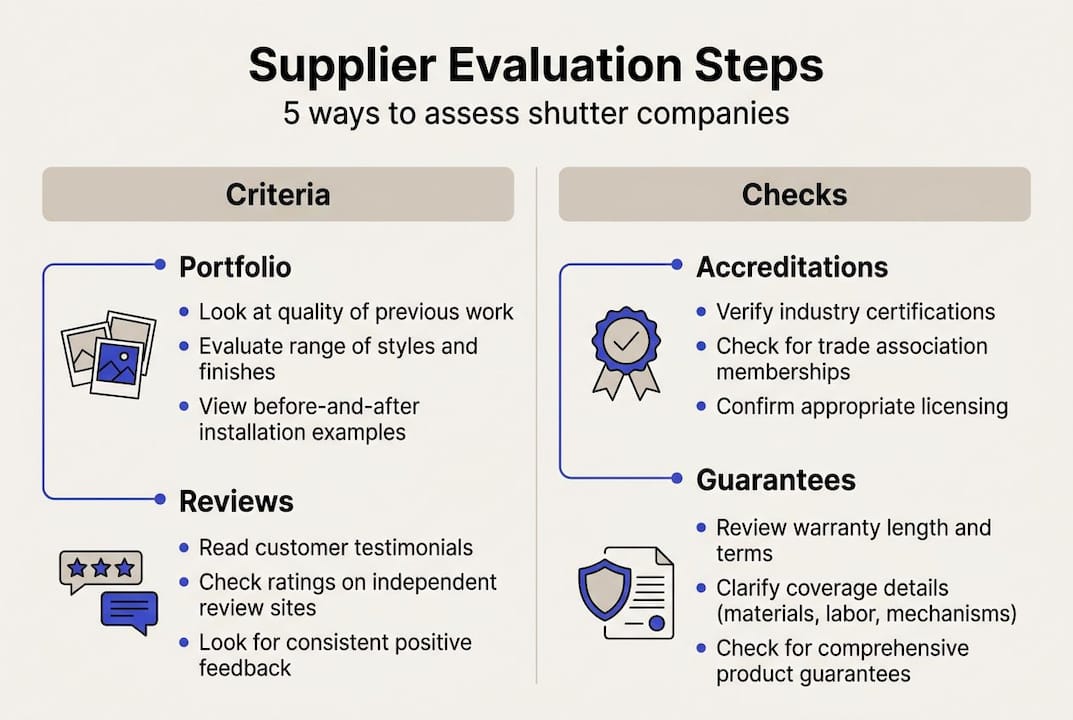
Independent review platforms are your first port of call. Trustpilot and Google Reviews both provide verified customer feedback that suppliers cannot easily manipulate. When browsing reviews, prioritise suppliers with ratings of 4.8 or above and read recent testimonials rather than those from several years ago. Pay particular attention to comments that mention specific scenarios: difficult window shapes, communication during the project, the installation team’s professionalism, and the quality of the finished product. A pattern of glowing feedback on standard windows but silence on bespoke projects is itself informative.
Portfolios are your next critical resource. Any reputable supplier should maintain a detailed gallery of completed work, and you should look specifically for projects that mirror your own situation. If you have an angled roofline window or a wide bay with a central fixed panel, find a supplier whose portfolio features similar challenges. Shutter craftsmanship insights can also help you understand the level of finish and engineering precision to expect.
Here is a quick-reference comparison of the key research sources:
| Research source | What it tells you | Reliability |
|---|---|---|
| Trustpilot / Google Reviews | Customer experience, reliability, quality | High (verified) |
| Supplier portfolio | Project capability and finish quality | High (visual evidence) |
| BWF / BSI membership | Standards compliance and accountability | Very high (third-party verified) |
| Social media | General brand presence | Moderate |
| Word of mouth | Personal endorsement | High (direct experience) |
Where possible, contact previous clients directly. A reputable supplier will encourage this rather than deflect from it. Speaking to a homeowner who had a similar project completed gives you an honest, unfiltered account of what working with that supplier is truly like.
Finally, verify accreditation. BWF and BSI standards are objective quality benchmarks, not marketing badges. Suppliers who hold these memberships are held to defined performance and safety criteria that protect you as a consumer. Knowing how to spot quality shutters from the outset makes this research stage far more productive.
Compare proposals: pricing, guarantees and craftsmanship
After you have narrowed your list to two or three credible suppliers, the true differences emerge once you receive formal proposals. This is where many homeowners make costly mistakes, either choosing the lowest figure without reading the detail, or assuming all quotes are broadly equivalent. They rarely are.
Read every proposal carefully, line by line. A thorough review process looks like this:
- Read the materials section first. Is the timber species or composite grade specified clearly? Vague descriptions like “high-quality wood” are a warning sign.
- Check what is excluded. Some proposals omit installation costs, hardware, or fixings. Others exclude delivery or post-installation adjustments.
- Examine the guarantee terms. A five-year product guarantee is very different from a ten-year workmanship guarantee. Understand precisely what each covers and what would void it.
- Scrutinise aftercare commitments. Will the supplier return to make adjustments if louvre tension changes over time? Is there a helpline or a dedicated aftercare team?
- Assess the survey process. Did the supplier offer a professional in-home survey, or are they quoting from dimensions you provided yourself? The former demonstrates far greater rigour.
Using a structured comparison table helps you evaluate each supplier on consistent criteria rather than being swayed by presentation style or persuasive sales language. Here is an example format you might use:
| Criteria | Supplier A | Supplier B | Supplier C |
|---|---|---|---|
| Material specification | Hardwood, specified grade | MDF, unspecified | Hardwood, named species |
| Installation included | Yes | No | Yes |
| Product guarantee | 5 years | 3 years | 10 years |
| Workmanship guarantee | 2 years | 1 year | 5 years |
| Aftercare commitment | Written | Verbal only | Written |
| In-home survey | Yes | No | Yes |
| BWF/BSI membership | Yes | No | Yes |
When you compare craftsmanship between suppliers, look for evidence of meticulous joinery, consistent louvre alignment, and precision framing. These details are visible in portfolio photography and become very apparent once shutters are installed. Consider also how to hire shutter installers whose track record on similar projects speaks for itself.

Pro Tip: How-to-evaluate-shutter-suppliers
Never assume all proposals include aftercare or the same level of craftsmanship. A supplier offering a lower price may be cutting costs on installation quality or material grade, which will cost you more to rectify later than the initial saving was worth.
Reviews consistently show that customers who focus solely on price often report dissatisfaction with the final result, while those who weigh craftsmanship and guarantees alongside cost report far greater long-term satisfaction with their investment.
Verify credentials and final decision-making
With clear, well-compared proposals in hand, you are close to a decision. But before you commit, it is essential to verify that your preferred supplier can genuinely deliver on every promise they have made. This final stage is about due diligence, not distrust.
Begin by confirming BWF and BSI memberships directly. Do not rely on a supplier’s own website claim. Visit the relevant organisation’s member directory and search for the supplier by name. This takes minutes and removes any doubt. The BWF’s published standards are objective quality benchmarks, not simply marketing credentials, and membership signals accountability to an independent body.
Next, confirm that all guarantees and aftercare commitments are provided in writing, as part of the formal contract rather than a verbal assurance during a consultation. A trustworthy supplier will have no hesitation in putting these details on paper before you sign anything.
Request two or three references from recent, local clients with similar window types to yours. Speak to those clients directly and ask specific questions:
- Was the installation completed on time and within the agreed scope?
- How did the supplier handle any issues that arose during or after installation?
- Does the finished product look and function as described in the proposal?
- Would you use this supplier again?
Before making your final decision, run through these essential checks:
- Confirmed BWF or BSI membership via the relevant member directory
- Public liability insurance verified (ask for certificate of insurance)
- All guarantees and aftercare terms provided in writing
- At least two recent client references followed up by telephone
- In-home survey completed with accurate, professionally recorded measurements
- Payment terms clearly outlined with no large upfront demands
“Industry accreditations like the BWF are objective benchmarks for quality, not just marketing. Homeowners who look beyond the sales pitch and verify credentials consistently report greater satisfaction with their chosen supplier.”
You can also review a structured list of questions for shutter suppliers to ensure nothing important goes unasked at this stage. Understanding how leading suppliers manage shutter installations for unusual windows will also give you greater confidence during your final conversations.
A better way: why trusting only price or branding fails
Here is something many homeowners only discover after a costly mistake: choosing a shutter supplier based on the lowest quote or a well-known brand name almost never produces the best outcome.
We have seen it time and again. A homeowner chooses a national brand with heavy advertising because it feels safe, or goes with the cheapest proposal to keep costs down. Months later, they are dealing with louvres that will not align, frames that do not fit the window architecture, or an aftercare team that is impossible to reach. The real cost, financial and emotional, far exceeds any initial saving.
What genuinely predicts satisfaction is project fit. That means a supplier whose portfolio shows they have successfully completed work on windows like yours, who holds verified quality credentials, and whose customers consistently report that the experience matched the promise. Membership in respected industry bodies matters more than marketing hype precisely because it represents accountability to an independent standard.
The smartest approach is to treat your shutter investment the way you would treat any significant home improvement: look for evidence, not advertising. A supplier who earns your confidence through verified reviews, a demonstrable portfolio, and clear written commitments will almost always deliver greater long-term value than one who wins on price alone.
Discover bespoke shutter solutions for your home
If you are ready to move from research to action, we are here to help you every step of the way.

At Shutter World, our bespoke window shutters are precisely crafted to fit your home’s unique architecture, whether you have a sweeping bay, a curved arch, or an angled roofline. From our popular plantation shutters to fully custom designs, every solution is backed by over 25 years of expertise, a professional in-home survey, and written guarantees on both product and workmanship. Explore what makes shutters bespoke and discover why thousands of UK homeowners trust us to transform their interiors. Book your free home consultation today and see the Shutter World difference for yourself.
Frequently asked questions
How can I verify a shutter supplier’s credentials easily?
Check for membership in the British Woodworking Federation or British Standards Institution directly via their member directories, and insist that insurance and guarantees are confirmed in writing before signing any contract.
What rating should I look for in online reviews when choosing a supplier?
Aim for Trustpilot or Google ratings of at least 4.8 and read recent, detailed testimonials that specifically mention quality, reliability, and how any issues were handled after installation.
Why do industry accreditations matter when evaluating shutter suppliers?
Accreditations from the BWF or BSI provide objective, third-party verified proof that a supplier meets defined quality and safety standards, offering far stronger reassurance than self-reported marketing claims.
Is it important to see a supplier’s previous work before choosing?
Yes, portfolios of similar projects give you direct visual evidence of a supplier’s ability to handle bespoke window shapes and achieve the standard of finish you expect in your own home.
Should I prioritise price or craftsmanship when comparing shutter suppliers?
Always weigh craftsmanship, guarantees and project fit at least as heavily as price, since a poorly fitted or low-quality shutter will cost significantly more to correct than any initial saving on the original quote.