
How to plan window coverings for unique UK homes

How to plan window coverings
TL;DR:
- Custom window coverings for non-standard windows enhance insulation, privacy, and architectural appeal.
- Accurate measuring and bespoke solutions prevent gaps, fitting issues, and long-term costs.
- Selecting the right style and materials requires careful planning to match home design and function.
Planning window coverings for non-standard windows can feel like solving a puzzle with missing pieces. You find something you love, only to discover it won’t fit your arched recess, bay projection, or angled roofline. The frustration is real, and it’s far more common than most guides acknowledge. Get it right, however, and the rewards are significant: a home that feels polished and private, rooms that stay warmer in winter, and windows that become genuine architectural features rather than awkward afterthoughts. This guide walks you through every stage, from clarifying your needs and measuring accurately, to choosing materials, fitting your coverings, and knowing when to call in a specialist.
Table of Contents
- Understanding your needs and window types
- Step-by-step guide to measuring your windows
- Choosing styles and materials for your space
- Fitting, adjustments, and troubleshooting
- Why unique windows deserve bespoke solutions — what most guides miss
- Explore bespoke shutter solutions for your home
- Frequently asked questions
Key Takeaways
| Point | Details |
|---|---|
| Assess window needs | Look at privacy, insulation, and aesthetics before making any window covering choice. |
| Measure with care | Accurate measuring is essential—especially for unique window shapes. |
| Choose materials wisely | Pick coverings that match your room’s style and boost energy efficiency. |
| Don’t ignore fitting | Professional installation can save headaches and ensure a perfect finish. |
| Bespoke solutions excel | Custom coverings are especially valuable for non-standard and feature windows. |
Understanding your needs and window types
With the key benefits in mind, the first step is to clarify exactly what you need and the type of windows you have. Before you browse a single catalogue or request a single quote, spend a few minutes thinking about what you actually want your window coverings to do.
Most homeowners have a mix of priorities. Some need blackout privacy in a bedroom facing a busy street. Others want to preserve a stunning garden view while keeping draughts at bay. Energy efficiency window coverings can dramatically improve insulation and reduce household energy costs, which matters enormously in older UK properties where heat loss through windows is a persistent problem.
Common homeowner priorities include:
- Privacy without sacrificing natural light
- Thermal insulation to reduce heating bills
- Aesthetic cohesion with the rest of the interior
- Light control for different times of day
- Ease of cleaning and long-term durability
Understanding which of these matters most to you shapes every decision that follows. Once you’re clear on your goals, consider your window type, because not all window treatment options suit every shape.
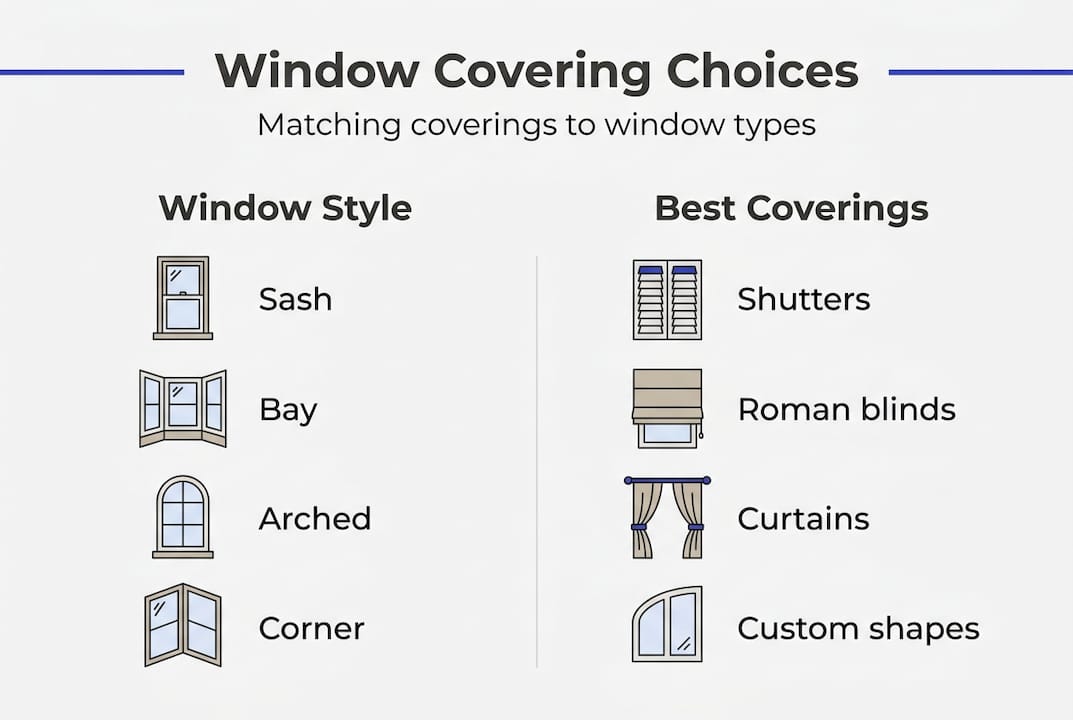
Here’s a quick-reference guide to common UK window types and their covering challenges:
| Window type | Best covering options | Key challenges |
|---|---|---|
| Sash | Shutters, Roman blinds | Avoiding obstruction of sash mechanism |
| Casement | Shutters, roller blinds | Inward-opening frames limit recess depth |
| Bay | Bespoke shutters, café-style blinds | Angled joins between panels |
| Arched or round | Custom-shaped shutters | Precise templating required |
| Skylight | Specialist roof blinds | Heat gain and awkward access |
| Non-standard | Bespoke only | No off-the-shelf solution fits reliably |
The table above makes one thing very clear: the more unusual your window, the more important it is to plan carefully from the outset. Rushing this stage is where most homeowners lose both time and money.
Step-by-step guide to measuring your windows
Once you know your window type and desired outcome, it’s time to take accurate measurements. This is arguably the most critical stage of the entire process. Correct measurement before ordering custom coverings is non-negotiable, and even a few millimetres of error can mean a covering that binds, gaps, or simply won’t install.
Tools you’ll need:
- Steel tape measure (fabric tapes stretch and distort)
- Pencil and notepad or a measuring app
- Spirit level
- Step ladder for tall windows
Follow these steps for standard rectangular windows:
- Measure the width at the top, middle, and bottom of the recess. Note the smallest figure.
- Measure the height on the left, centre, and right. Again, note the smallest.
- Check for square by measuring diagonally from corner to corner in both directions. If the figures differ by more than 5mm, your window is out of square and needs specialist attention.
- Note the recess depth to confirm whether a face-fix or recess-fix installation is feasible.
- Photograph the window from straight on and at an angle to capture any quirks.
For angled or curved windows, the process is more involved. You’ll need to record the angle of any slopes and the radius of any curves, which typically requires a flexible curve ruler or a cardboard template traced directly from the frame.
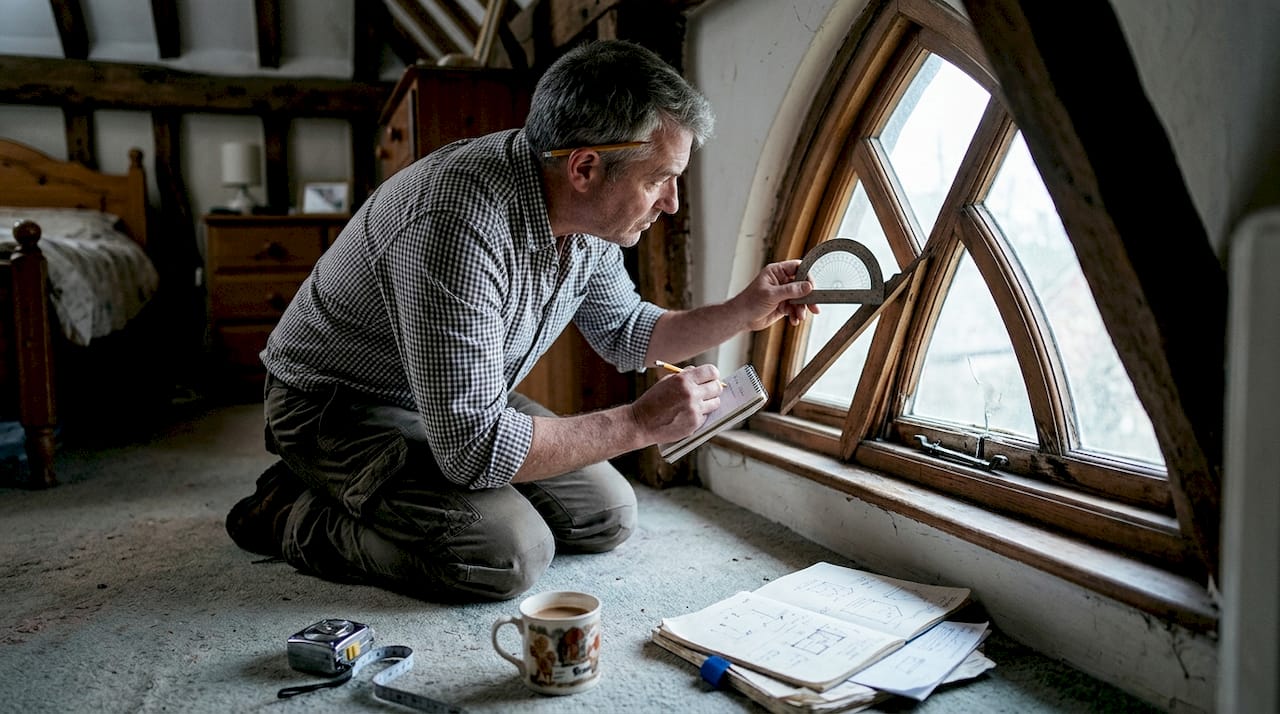
Pro Tip: If your window is arched, triangular, or has an unusual projection, we strongly recommend booking a professional survey rather than relying on DIY measurements. A single inaccurate reading on a shaped window can result in a covering that cannot be installed at all.
| Approach | Typical cost | Accuracy | Risk level |
|---|---|---|---|
| DIY measuring | Free | Moderate | Higher for complex shapes |
| Professional survey | Often free with order | Very high | Minimal |
The professional survey option, which we offer as part of our end-to-end service, eliminates guesswork entirely and protects your investment from the start.
Choosing styles and materials for your space
With accurate measurements in hand, you can confidently select coverings that match your home’s style and function. This is where the process becomes genuinely enjoyable, because the range of options available to UK homeowners today is broader and more refined than ever.
Shutters, blinds, or curtains?
Each has its place, but they serve different purposes:
- Shutters offer unmatched light control, insulation, and longevity. They suit period homes, bay windows, and any space where a clean, architectural look is desired.
- Blinds are versatile and space-efficient, working well in kitchens, bathrooms, and modern interiors.
- Curtains add softness and warmth, particularly in living rooms and bedrooms, though they’re less suited to non-standard shapes.
When it comes to materials, certain options offer better insulation and durability in the UK climate than others. Solid hardwood shutters, for instance, provide excellent thermal performance and age beautifully. Composite or MDF options with a polypropylene coating resist moisture, making them ideal for bathrooms and kitchens where timber might warp.
Style-matching tips by interior theme:
- Period or Victorian homes: Hardwood shutters in classic white or heritage colours; full-height or café-style panels
- Modern or minimalist spaces: Clean-line roller blinds or slim-louvred shutters in neutral tones
- Coastal or relaxed interiors: Woven blinds or painted shutters in soft, chalky finishes
- Contemporary open-plan: Stylish window coverings that create visual continuity across multiple windows
Pro Tip: Choose a finish that works with both your current décor and a potential future refresh. Neutral whites, off-whites, and natural timber tones have remained consistently popular for decades and are far less likely to date than bold or trend-led colours.
The best window covering is the one that balances how your room looks with how it performs. A beautiful shutter that also insulates well is not a luxury; it’s a long-term investment in your home’s comfort and value.
Fitting, adjustments, and troubleshooting
Selecting your coverings leads to the next crucial stage: fitting them correctly and knowing what to do if anything isn’t quite right. Even the most precisely made covering can underperform if it’s installed poorly.
Here’s a general overview of the installation process:
- Prepare the window area by clearing the sill and ensuring the frame is clean and structurally sound.
- Fix the mounting brackets at the correct positions, checking for level before drilling.
- Attach the covering to the brackets and test the opening, closing, and tilting mechanisms.
- Check the fit from inside and outside, looking for gaps, misalignment, or uneven louvres.
- Make fine adjustments to tension, louvre angle, or panel alignment as needed.
A professional installer will also check that the covering doesn’t interfere with window handles, locks, or ventilation gaps, something that’s easy to overlook on a DIY fit. Professional installation measurably reduces the risk of fit issues, particularly for energy efficient shutters where a tight, precise fit is essential to thermal performance.
Common mistakes to avoid during installation:
- Misalignment of panels on multi-section windows, leading to visible gaps
- Over-tightening fixings into uPVC or softwood frames, causing cracks
- Ignoring out-of-square frames, which cause coverings to bind or warp over time
- Fitting too close to the glass, restricting louvre movement and airflow
- Skipping the level check, resulting in a visibly crooked finish
If something doesn’t look or feel right after installation, don’t force it. A covering that requires excessive pressure to open or close is either incorrectly sized or incorrectly fitted. Contact your supplier promptly, because most reputable companies, including ourselves, back their work with product and workmanship guarantees.
Why unique windows deserve bespoke solutions — what most guides miss
Stepping back, it’s worth asking: why not simply settle for the quickest, cheapest covering available? It’s a fair question, and the honest answer comes from years of working with homeowners who tried exactly that.
Off-the-shelf coverings are designed for standard rectangular windows in standard sizes. When you force them onto a bay projection, an arched fanlight, or a sloping roofline, the result is rarely satisfying. Gaps appear. Light leaks in at the edges. The covering looks like an afterthought rather than a considered design choice. Worse, poor insulation performance means you’re still losing heat and paying for it every month.
What most generic guides miss is that bespoke planning isn’t just about aesthetics. It’s about respecting the architecture of your home. A bespoke shutters guide will tell you that made-to-measure solutions are engineered to the exact geometry of your window, which means better insulation, better light control, and a finish that looks intentional rather than compromised.
Our experience consistently shows that homeowners who invest care at the planning stage, clarifying needs, measuring precisely, and choosing materials thoughtfully, end up with results they’re genuinely proud of for years. Those who rush the process often revisit it within two or three years, spending more in the long run.
Explore bespoke shutter solutions for your home
If you’re ready to transform your windows with a tailored finish that truly fits, we’d love to help you find the right solution.
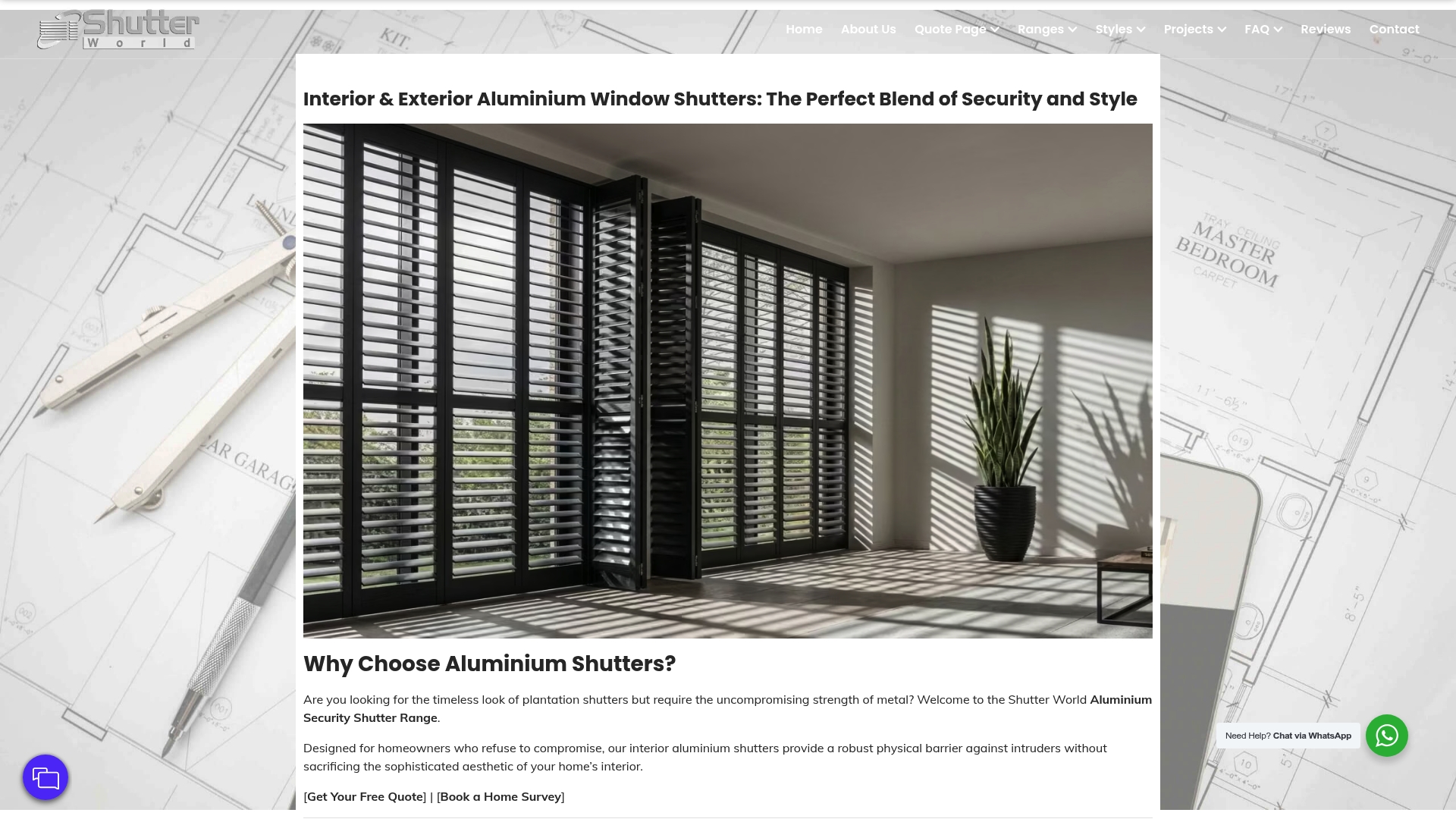
At Shutter World, our made to measure shutters are precision-crafted to suit every window shape, from straightforward casements to complex arched or bay configurations. Our bespoke internal shutters are designed with your specific space in mind, delivering superior insulation, flawless light control, and a finish that enhances your home’s character. For contemporary spaces or high-moisture environments, our aluminium window shutters offer exceptional resilience alongside a sleek, modern aesthetic. Book your free in-home survey today and let our experts guide you from first measurement to final installation.
Frequently asked questions
How do I choose the best window coverings for a bay window?
Bay windows require tailored solutions for the best fit, so measure each section individually, consider bespoke shutters or angled blinds, and prioritise coverings that offer both privacy and insulation without blocking natural light.
Do I need a professional to measure for custom window coverings?
For complex or unusually shaped windows, professional measurement is strongly recommended to ensure accuracy, though straightforward rectangular windows can be measured at home using a proper step-by-step guide.
What is the most energy-efficient window covering?
Shutters improve energy efficiency and reduce heat loss significantly, making them one of the most effective choices for UK homes alongside thick, well-fitted blinds.
How can I future-proof the style of my window coverings?
Choose neutral finishes, classic profiles, and high-quality materials that complement a range of interior styles, as these tend to remain relevant far longer than trend-led colours or finishes.
Are bespoke window coverings worth the investment?
Yes, particularly for non-standard windows, because bespoke options deliver the best possible fit, superior insulation, and a polished, considered look that off-the-shelf products simply cannot match.
Recommended
- Best Window Coverings for Developers: Stylish Choices for UK Homes | Shutter World
- 7 Inspiring Shutter Design Ideas for Unique UK Windows | Shutter World
- Absolutely How to Incorporate Shutters in Design for UK Homes
- Bespoke interior design window solutions for unique UK homes
- Custom window coverings: stylish, efficient choices for 2026