
Noise reduction window treatments: your UK home guide

Window treatments can meaningfully reduce the noise that reaches you indoors, but they work best as part of a broader acoustic strategy rather than a standalone fix. Shutters, blinds, heavy curtains, and acoustic window films all contribute through sound absorption and partial blocking. None of them replaces the performance of well-sealed double or secondary glazing. Secondary double windows can reduce traffic noise by around 34 dB(A), while opening a window notably reduces that insulation depending on aperture size. Window treatments sit in a different league, offering comfort-level improvements rather than structural acoustic gains. Used alongside quality glazing and airtight seals, though, they make a genuine difference to daily life.
Utilising noise reduction window treatments can enhance your home’s comfort, making them an essential aspect of any effective noise control strategy.
Common noise reduction window treatments include:
Among noise reduction window treatments, heavy curtains can significantly improve your living environment.
-
- Interior shutters (plantation, full height, bay window styles)
- Specialist acoustic blinds such as the Hush Sound Barrier range
- Heavyweight thermal curtains with dense, layered fabrics
- Noise reduction window treatments tailored to your specific needs.
- Acoustic window films applied directly to the glass
Choosing the right noise reduction window treatments will determine your home’s peace and tranquility.
Why noisy windows are a real problem for UK homeowners
Windows are the weakest point in any home’s acoustic envelope. Walls, floors, and ceilings provide substantial mass; a single pane of glass offers far less. Traffic, neighbour noise, and urban activity all find their easiest path indoors through the glazing and its frame.
The consequences go beyond mild irritation. Approved Document O sets night-time bedroom noise thresholds at 40 dB LAeq,8hr and 55 dB LAmax, levels that are regularly exceeded near busy roads without adequate window insulation. When noise pushes past these thresholds, sleep quality suffers and wellbeing declines.
Window treatments alone cannot close this gap. Their limitations are worth stating plainly:
- They absorb and partially block sound; they do not add meaningful mass to the glazing itself.
- Trickle vents remain a notorious weak point, compromising acoustic performance even when closed.
- Poor sealing causes around a 3 dB drop in insulation performance at frequencies above 800 Hz.
- Open windows reduce insulation substantially, regardless of what covers them. Opening a window reduces sound insulation by 8–16 dBA depending on aperture size, with much higher noise ingress compared to sealed windows.
Treatments are supplementary. Structural controls, including quality glazing and airtight frames, carry the real acoustic load.
How shutters reduce noise: types, materials, and benefits
Solid, rigid shutters add a physical layer between the window and the room. They are not acoustic panels, but a well-fitted shutter does absorb some mid and high-frequency sound and reduces the direct transmission path from glass to living space.
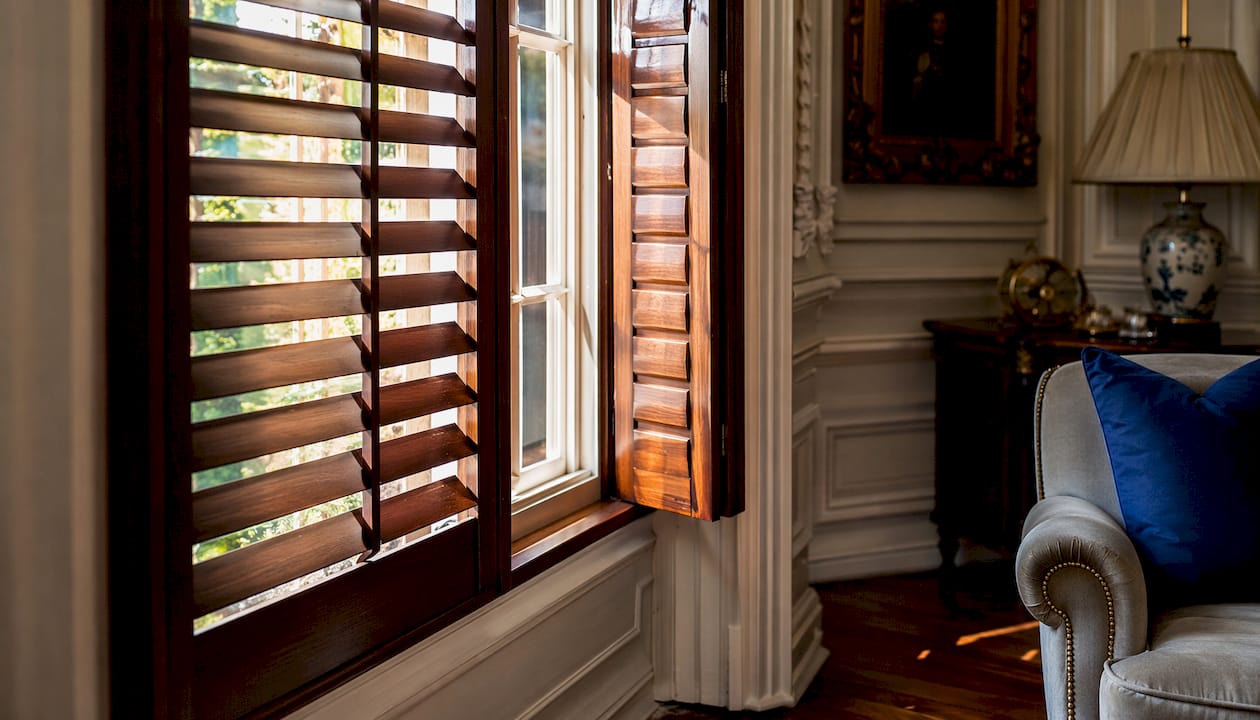
Material matters considerably. Hardwood shutters, such as those in Shutter World’s Montana range, offer greater density than MDF composites and absorb slightly more sound energy. Aluminium shutters provide durability and a tight fit that limits flanking paths around the frame. The key variable in all cases is how well the shutter seals against the window reveal.
Shutter types suited to noise reduction:
- Full height shutters cover the entire window aperture, leaving no gaps at top or bottom.
- Plantation shutters with adjustable louvres allow light control while still providing a solid barrier when louvres are closed.
- Bay window shutters, precisely engineered to fit angled reveals, eliminate the gaps that standard off-the-shelf products leave behind.
Beyond acoustics, shutters deliver thermal insulation, privacy, and light control. Shutter World’s shutters for noise reduction are made to measure, with a professional survey and fitting service backed by product and workmanship guarantees.
In cities, noise reduction window treatments can be a game-changer for improving indoor serenity.
Pro Tip: Close louvres fully and ensure the shutter frame sits flush against the reveal. Even a small gap around the perimeter will allow sound to bypass the panel entirely.
Blinds for noise reduction: what works and what doesn’t
Blinds are more flexible than shutters but generally less effective acoustically. Their thinner profiles and fabric constructions absorb some sound, particularly at higher frequencies, but they add little mass and rarely seal tightly against the frame.
The best performing options use dense, layered materials:
- Cellular (honeycomb) blinds trap air in their structure, adding a modest insulating layer that helps with both thermal and acoustic performance.
- Roller blinds with blackout backing use heavier fabrics that absorb more sound than standard weaves.
- Hush Sound Barrier blinds are a specialist product engineered specifically for noise reduction, using multi-layer construction to improve attenuation beyond standard blind materials.
Blinds complement structural soundproofing but cannot replace it. They are most effective when combined with double or secondary glazing, where the blind adds absorption to a system that already provides meaningful insulation. For a direct comparison of how blinds and shutters perform across multiple criteria, Shutter World’s shutters vs blinds guide covers the practical trade-offs in detail.
Incorporating noise reduction window treatments into your design will enhance both aesthetics and functionality.
How shutters soundproof your windows in practice
Fitting shutters for soundproofing is as much about installation quality as product choice. A shutter that sits proud of the reveal, or has louvres that don’t close flush, will underperform regardless of the material it’s made from.
Shutter World’s approach starts with a professional in-home survey, measuring each window precisely so the shutter frame fits the reveal without gaps. Bespoke engineering matters here: standard sizes leave flanking paths at the edges that defeat the purpose. Full height shutters fitted to the full window aperture, with louvres closed, create the most complete barrier a shutter can provide. For complex shapes, including arched, angled, or bay windows, precision fitting is the only way to achieve consistent acoustic performance across the whole reveal.
How blinds soundproof your windows in practice
A blind’s soundproofing contribution depends on how completely it covers the window and how close it sits to the glass. Blinds mounted inside the recess, tight to the frame, perform better than those hung proud of the wall, because they reduce the air gap through which sound travels around the edges.
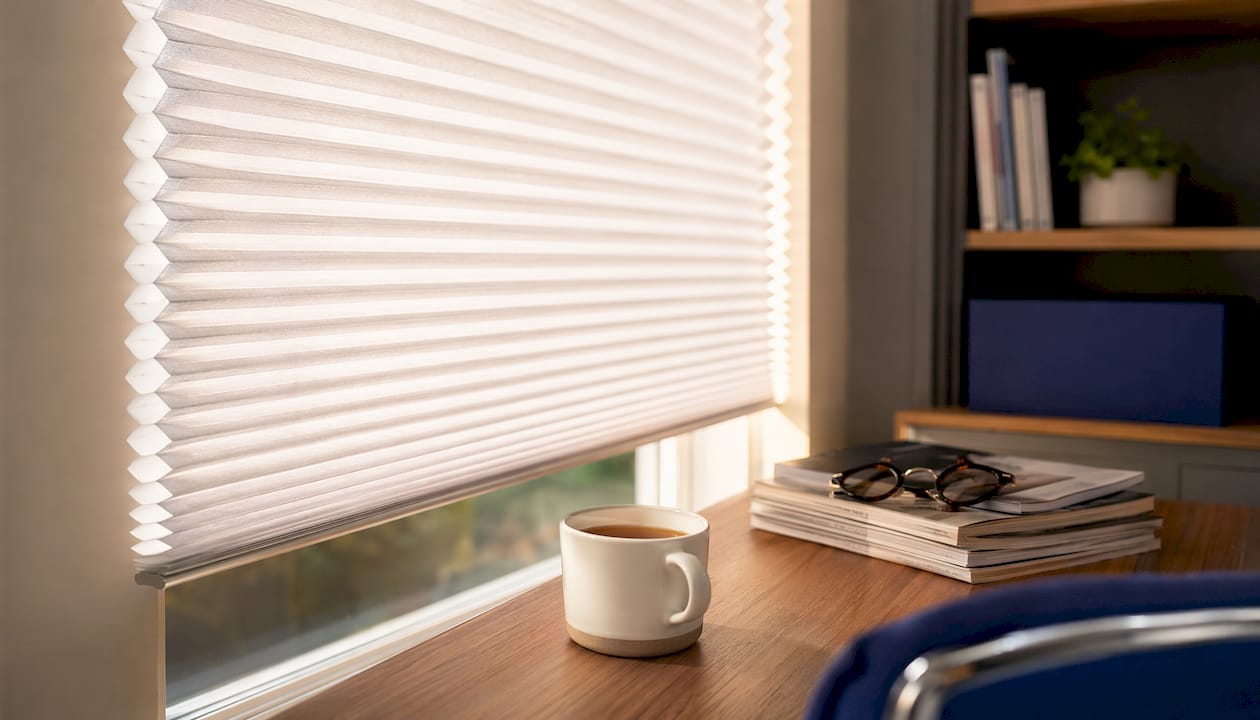
Cellular blinds work on the same principle as double glazing: trapped air slows sound transmission. Fitting them as close to the glass as possible, with side channels to seal the edges, improves their acoustic contribution noticeably. Hush Sound Barrier blinds take this further with their multi-layer construction, though even these are best understood as a comfort enhancement rather than a structural solution.
Comparing noise reduction effectiveness across window treatment options
Investing in noise reduction window treatments not only improves acoustics but also adds value to your home.
Not all treatments perform equally, and the differences are worth understanding before you invest.
| Treatment | Mechanism | Relative effectiveness | Best suited for |
|---|---|---|---|
| Secondary glazing | Air gap and mass | High (up to ~34 dB(A)) | Maximum noise reduction |
| Interior shutters | Absorption and partial blocking | Moderate | Everyday comfort improvement |
| Acoustic blinds (e.g. Hush) | Multi-layer absorption | Low to moderate | Supplement to glazing |
| Heavyweight curtains | Fabric absorption | Low | Budget option, soft furnishing |
| Acoustic window film | Surface damping | Minimal | Minor high-frequency reduction |
BS 8233:2024 is clear that interior treatments like blinds and shutters have negligible structural acoustic impact compared with the building envelope itself. The table above reflects that reality: treatments improve comfort, but glazing quality and sealing determine the acoustic baseline.
Ultimately, noise reduction window treatments are essential for creating a comfortable living space.
Materials and technology behind effective noise reduction treatments
The physics of sound absorption comes down to mass, density, and air gaps. Heavier, denser materials absorb more energy; air cavities slow transmission by forcing sound to cross multiple boundaries.
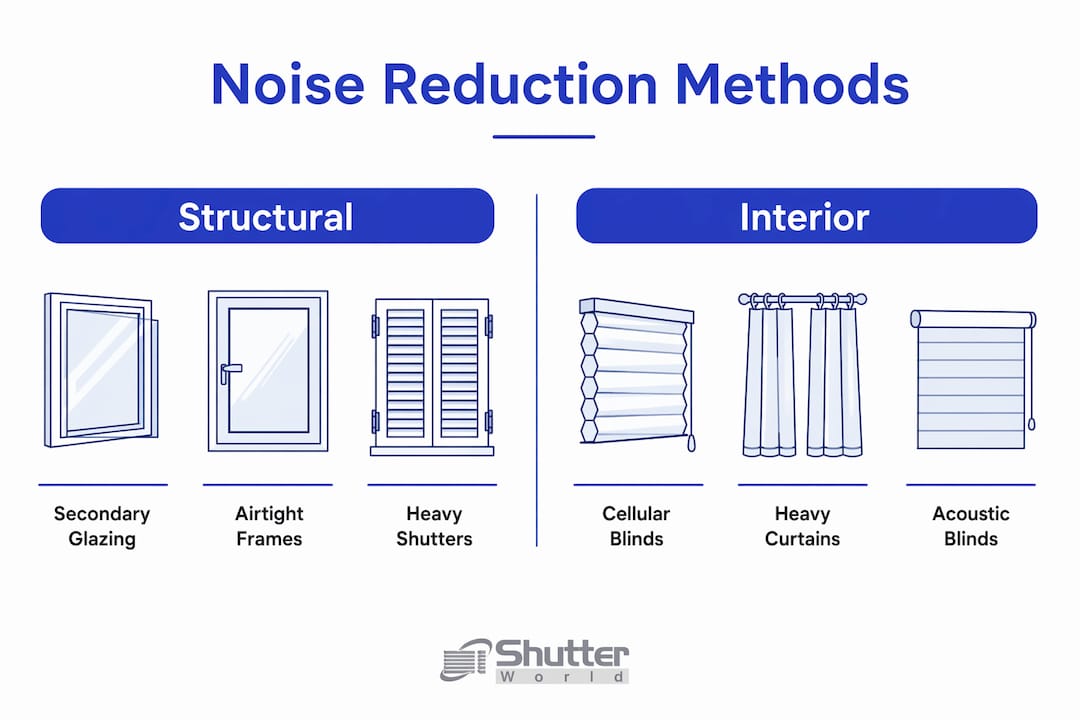
Hardwood shutters exploit density. Cellular blinds exploit trapped air. Multi-layer acoustic blinds like the Hush Sound Barrier combine both principles in a thinner profile. Window films work differently, adding a damping layer to the glass surface that reduces resonance at certain frequencies, though the gains are modest.
Airtight sealing is the most significant factor in any window treatment’s acoustic performance. A slight warp in a frame, or a louvre that doesn’t close fully, creates a flanking path that undermines everything else. This is why bespoke, professionally fitted treatments consistently outperform off-the-shelf alternatives: the fit is the product.
For homeowners interested in the thermal side of the same equation, Shutter World’s guide to energy efficient shutters explains how the same principles of mass and sealing apply to heat retention.
What do noise reduction window treatments cost in the UK?
Costs vary considerably by treatment type, window size, and whether fitting is included.
Noise reduction window treatmentsConsider noise reduction window treatments for a better living experience.The right noise reduction window treatments can dramatically change your environment.
| Treatment | Approximate UK cost range | Notes |
|---|---|---|
| Heavyweight curtains | — | DIY fitting; no acoustic guarantee |
| Roller or cellular blinds | — | Specialist acoustic versions cost more |
| Plantation shutters (MDF) | — | Bespoke fitting recommended |
| Hardwood shutters | — | Premium material; longer lifespan |
| Secondary glazing | — | Structural solution; highest acoustic gain |
Pro Tip: Investing in fewer, better-fitted treatments outperforms buying multiple cheap options. A single well-sealed hardwood shutter will outperform three layers of budget curtains on the same window.
Professional fitting of noise reduction window treatments can ensure optimal performance.
Shutter World’s plantation shutters are made to measure, with pricing that reflects bespoke engineering and professional installation rather than off-the-shelf compromise.
UK research and expert guidance on window noise reduction
The UK’s acoustic standards are unambiguous about where the real work happens. BS 8233:2024 places the responsibility for noise control firmly on the building envelope, not interior furnishings. The Noise Policy Statement for England reinforces this, emphasising that acoustic improvement comes through managing the building envelope rather than decorative coverings.
Reveal liners offer only a 2–3 dB improvement at higher frequencies, confirming that minor additions to the window reveal have limited impact. The UK Noise Insulation Regulations specify insulation packages that reduce noise by around 34 dB(A), a figure that window treatments alone cannot approach.
Shutter World’s expertise, built over 25 years in the industry, reflects this understanding. Their bespoke shutters are recommended as a comfort-enhancing complement to good glazing, not a replacement for it. Every installation comes with product and workmanship guarantees, giving homeowners confidence that the fit will perform as intended for years to come.
Noise reduction window treatments are a critical part of maintaining a peaceful home.
Ready to reduce noise in your home?
Shutter World’s made-to-measure shutters are designed to fit your windows precisely, maximising every acoustic and thermal benefit a shutter can deliver. From the entry-level Seattle range to the premium Montana hardwood collection, every shutter is surveyed, engineered, and installed by experienced fitters.
For the best results, combine different types of noise reduction window treatments to cover all bases.
Book your free in-home survey today and discover how bespoke plantation shutters can transform the comfort of your home.
Key takeaways
Window treatments improve acoustic comfort but cannot replace the structural noise reduction delivered by quality glazing and airtight seals.
Many homeowners overlook the importance of noise reduction window treatments in their acoustic strategy.
In summary, noise reduction window treatments form an integral part of your noise management approach.
| Point | Details |
|---|---|
| Glazing does the heavy lifting | Secondary glazing significantly reduces traffic noise; window treatments offer modest supplementary gains. |
| Sealing is critical | Poor sealing causes around a 3 dB drop in performance; fit quality determines how well any treatment works. |
| Shutters outperform curtains | Solid, bespoke-fitted shutters absorb more sound than fabric alternatives due to greater density and a tighter reveal fit. |
| Open windows negate treatments | Opening a window reduces sound insulation by 8–16 dBA, depending on the aperture size, regardless of what covers it. |
| UK standards set the benchmark | Approved Document O sets bedroom night-time limits at 40 dB LAeq,8hr, a threshold treatments alone rarely achieve near busy roads. |
FAQ
What can you put on windows to reduce noise?
Shutters, acoustic blinds, heavyweight curtains, and window films all help reduce noise through absorption and partial blocking. For meaningful results, combine them with double or secondary glazing and ensure the window frame is fully sealed.
What are the best sound-absorbing window treatments?
Bespoke interior shutters with a tight reveal fit offer the best absorption among interior treatments, followed by specialist acoustic blinds such as the Hush Sound Barrier range. Heavyweight curtains with dense, layered fabrics provide a budget-friendly option with modest gains.
Investing in noise reduction window treatments is a smart choice for long-term comfort.
Do soundproof window inserts really work?
Secondary glazing inserts deliver genuine acoustic performance, reducing traffic noise by around 34 dB(A) when properly installed and sealed. Interior window treatments like blinds and shutters are supplementary; they improve comfort but cannot match the insulation of a well-fitted secondary pane.
How do you stop sound coming through windows?
The most effective approach combines quality double or secondary glazing with airtight sealing, eliminating trickle vents where possible, and adding interior shutters or acoustic blinds as a final comfort layer. No single treatment solves the problem; the building envelope carries the primary acoustic load.
The cumulative effect of noise reduction window treatments can significantly improve your home’s peace.
Recommended
- Shutters for Noise Reduction – Enhancing UK Homes | Shutter World
- Bespoke decorative shutters: expert guide for UK homes
- Further reading on noise reduction window treatments
- Epic Comfort: The Impact of Shutters on Insulation
- Best Window Coverings for Developers: Stylish Choices for UK Homes | Shutter World