
shutter finishes guide UK homes: 2026 guide

Shutter finishes guide
TL;DR:
- Properly finished shutters can reduce heat loss by 20 to 50 percent.
- Factory-applied finishes outperform site-applied coatings in durability and longevity.
- Custom finishes are essential for unique window shapes and climate-specific conditions.
The finish on your shutters is far more than a cosmetic choice. It directly influences how well your windows perform thermally, how easily they clean, and how long they last before showing signs of wear. In fact, properly finished shutters can reduce heat loss by 20 to 50%, which is a figure that challenges the common assumption that all finishes are created equal. For homeowners with unusual window shapes such as arches, bays, or triangles, the right finish also needs to work in harmony with bespoke engineering. This guide walks you through every practical consideration, from finish types to climate-specific performance, so you can make an informed choice with confidence.
Table of Contents
- Understanding shutter finishes: Types and benefits
- Factory-applied vs site-applied finishes: longevity and performance
- bespoke shutter finishing for unique window shapes
- finishing for UK climates: moisture, salt and thermal comfort
- Expert perspective: What most guides miss about shutter finishes
- Find your perfect shutter finish with bespoke expertise
- frequently asked questions
Key Takeaways
| Point | Details |
|---|---|
| Finish choice matters | The right shutter finish improves both longevity and energy efficiency in your home. |
| Factory-applied finishes last longer | Finishes applied in factory settings resist peeling and extend the lifespan of shutters, especially in damp climates. |
| Bespoke solutions fit unique windows | Custom finishing techniques ensure shutters fit complex window shapes perfectly, preventing draughts and gaps. |
| Moisture resistance is vital | Gloss and waterproof finishes are essential for kitchens, bathrooms and coastal homes to avoid damage and simplify maintenance. |
| Expert guidance pays off | Consulting professionals ensures finishes and measurements match your home’s particular requirements for lasting results. |
Understanding shutter finishes: Types and benefits
Choosing a shutter finish is one of the most consequential decisions in the entire specification process, yet it rarely receives the attention it deserves. Each finish type brings its own set of visual qualities and practical properties, and matching these to your room’s demands is what separates a lasting investment from a costly mistake.
painted finishes provide colour flexibility and suit modern interiors, making them the most popular choice for contemporary UK homes. They offer a clean, uniform look and can be specified in virtually any shade to complement your existing décor. stained finishes, by contrast, highlight the natural wood grain and are best suited to traditional or rustic interiors where warmth and character are priorities.
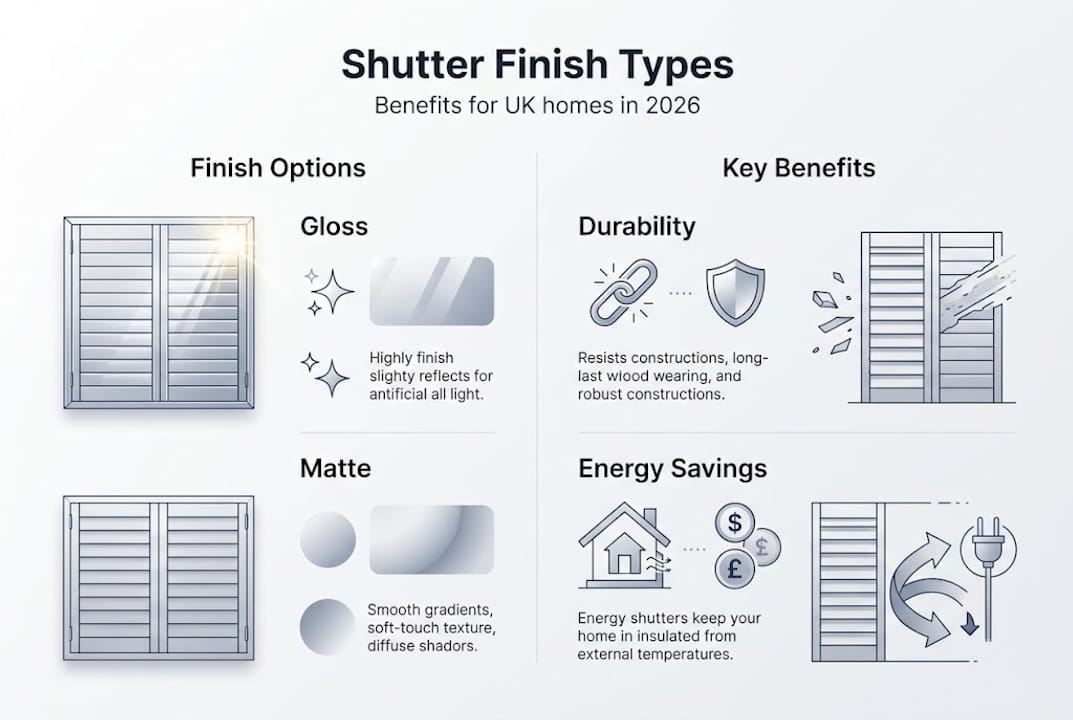
When it comes to surface quality, the choice between gloss, matte, and satin matters enormously. gloss finishes offer superior moisture resistance and clean with minimal effort, making them the preferred choice for kitchens and bathrooms. matte finishes absorb light rather than reflect it, which helps to disguise everyday dust and fingerprints in living rooms and bedrooms. satin finishes sit neatly between the two, providing a subtle sheen with reasonable durability and ease of maintenance.
| finish type | best room | key benefit | maintenance | aesthetic |
|---|---|---|---|---|
| painted | living room, bedroom | colour flexibility | moderate | modern/contemporary |
| stained | study, dining room | natural wood grain | low to moderate | traditional/rustic |
| gloss | kitchen, bathroom | moisture resistant | very easy | sleek, reflective |
| matte | living room, bedroom | hides dust/marks | easy | understated, calm |
| satin | any room | balanced durability | easy | subtle, versatile |
Here is a quick summary of what each finish does well:
- painted: widest colour range, suits modern interiors, easy to refresh
- stained: reveals timber character, feels warm and organic
- gloss: easiest to wipe clean, resists moisture and condensation
- matte: forgiving in high-traffic rooms, minimal glare
- satin: practical all-rounder, works across most interior styles
Pro tip: If you are unsure which finish suits your space, request shutter craftsmanship insights from a specialist before committing. A sample board viewed in your own lighting will always tell you more than a brochure photograph.
For ongoing care, following proven shutter maintenance tips will extend the life of whichever finish you choose, regardless of room type.
Factory-applied vs site-applied finishes: longevity and performance
How a finish is applied matters just as much as which finish you select. Factory-applied and site-applied processes produce noticeably different results in terms of durability, uniformity, and long-term performance.
In a factory setting, shutters are finished under controlled temperature and humidity conditions. The paint or lacquer penetrates the surface with exceptional uniformity, curing fully before the product is even packaged. Factory-applied finishes extend shutter lifespan by up to 40% compared to site-applied paints, primarily because of superior penetration and consistency. This is a significant performance gap that is easy to overlook when comparing quotes.

Site-applied finishes, on the other hand, are carried out once the shutter is installed. Environmental variables such as ambient humidity, dust, and temperature all interfere with adhesion and curing. In the UK’s famously damp climate, this can lead to premature peeling, bubbling, and uneven colour within just a few years.
| factor | factory-applied | site-applied |
|---|---|---|
| application environment | controlled | variable |
| curing quality | full, even | inconsistent |
| lifespan advantage | up to 40% longer | standard |
| risk of peeling | very low | higher |
| cost | included in product | additional labour |
“In our experience, homeowners who opt for site-applied finishes often return within three to five years with issues that factory finishing would have prevented entirely. The UK climate is simply too unpredictable for anything less than a controlled factory process.”
Key maintenance points to protect your finish long-term:
- clean regularly with a soft, damp cloth rather than abrasive materials
- avoid placing shutters in prolonged direct contact with standing water
- inspect joints and edges annually for early signs of moisture ingress
- use a mild, pH-neutral cleaning solution for persistent marks
- re-coat only when advised by a specialist, using a compatible product
For rooms where moisture is an ongoing concern, explore best shutters for humidity to identify materials and finishes built for the challenge. Understanding the shutters impact on heating bills is equally worthwhile, particularly when selecting thermally optimised finishes.
Pro tip: Always ask your supplier whether the finish was applied in a factory or on-site. This single question can save you from years of frustration and unnecessary maintenance costs.
bespoke shutter finishing for unique window shapes
Standard finishing processes are designed with standard windows in mind. When your home features arched openings, deep bay projections, or sharply angled roof lights, an entirely different approach is required.
For unique window shapes such as arches, bays, and triangles, bespoke shutters use custom-cut panels, curved rails, and precise laser measurements to ensure a flawless fit and smooth operation. The finish must then be applied to components that are irregular in geometry, which demands specialist knowledge and equipment.
At bespoke shutter insights level, the finishing process follows a clear sequence:
- Professional survey: A skilled surveyor visits your home to assess the window shape, dimensions, and surrounding architecture.
- laser measurement: Every angle, curve, and recess is captured digitally to eliminate margin for error during fabrication.
- material selection: The right substrate is chosen, whether MDF with a polypropylene coating for moisture-prone areas or premium hardwood for architectural statement pieces.
- Custom panel design: Each panel is cut to the precise profile of the window, including curved top rails for arched openings.
- Factory finishing: The bespoke panels receive their finish in a controlled environment, ensuring complete coverage of every edge and surface.
- Quality inspection: Each component is checked against the survey data before dispatch.
- Expert installation: Your fitter ensures the finished shutters align perfectly with the window frame, with no visible gaps or uneven margins.
The materials used for unusual windows each have specific advantages:
- MDF with polypropylene coating: dimensionally stable, moisture-resistant, suited to high-humidity environments
- premium hardwood: naturally strong, aesthetically distinctive, ideal for bay window finishes
- marine-grade coatings: for coastal or damp locations where salt air and condensation are persistent concerns
- powder coatings: applied electrostatically for outstanding durability on complex shapes
Pro tip: For triangular or trapezoidal windows, laser measurement is not optional. Even a two-millimetre discrepancy can cause panels to bind or leave visible gaps at the apex, undermining both the finish and the function. Always insist on a professional survey before any finishing decisions are made.
If you are curious about how modern shutter designs are adapting to non-standard architecture, the variety of solutions available today is genuinely impressive.
finishing for UK climates: moisture, salt and thermal comfort
The UK’s climate is not a single entity. A coastal home in Cornwall faces salt-laden air and frequent moisture cycling. A Victorian terrace in Leeds contends with condensation, cold walls, and heating bills that escalate fast in winter. Your finish choice needs to reflect where you live, not just how you want your home to look.
MDF with polypropylene coatings or waterproof materials are best for high-humidity areas, while hardwood remains the premium choice for properties where aesthetics and structural stability in complex shapes are the priority. For homes near the coast or in persistently damp environments, the stakes are even higher.
Marine-grade or powder-coated finishes offer superior resistance to salt and UV exposure, outlasting standard paint finishes by up to 40% in challenging coastal conditions. That is a material difference in both cost-of-ownership and maintenance burden over the lifetime of your shutters.
“UK homes require finishes that are engineered for their specific environment, not simply decorated. The difference between a finish that lasts ten years and one that lasts twenty often comes down to whether the correct coating was specified at the outset.”
Top five finish choices for UK climates:
- polypropylene-coated MDF: resists warping and moisture in bathrooms, kitchens, and conservatories
- marine-grade paint: formulated to withstand salt air, UV, and coastal dampness
- powder coating: highly durable, chip-resistant, and UV-stable for exposed or complex shapes
- hardwood with lacquer: combines natural beauty with a protective barrier suited to temperate interiors
- gloss finish: easiest to clean in high-humidity rooms, reflects light effectively in darker spaces
For shutter material for bathrooms, moisture resistance is non-negotiable, and the finish specification should be treated with the same seriousness as the material itself. When correctly specified, energy efficient shutters with the appropriate finish can reduce heat loss by 20 to 50%, delivering measurable savings on heating costs year after year.
Expert perspective: What most guides miss about shutter finishes
Most articles on shutter finishes focus almost entirely on aesthetics. They guide you through colour palettes and sheen levels but stop short of the harder questions that determine whether your investment will hold up for a decade or begin failing within a few years.
The most overlooked risk is site-applied finishing. Many homeowners do not realise they are receiving this inferior process until problems emerge. Factory-applied finishes are always preferred to avoid peeling and ensure longevity, particularly in the UK’s damp climate, yet site-applied work is still common in the industry and rarely flagged as a drawback at the point of sale.
Equally neglected is the question of climate-specific preparation. A finish appropriate for a dry, centrally heated flat in Manchester may perform poorly in a stone cottage on the Yorkshire coast. Reading generic advice without filtering it through your home’s actual conditions is a recipe for disappointment.
Our guidance is clear: always request a professional in-home survey before any finish is specified, particularly for unusual window shapes. A surveyor will assess your environment, your window geometry, and your practical priorities together, producing recommendations that a catalogue or website simply cannot replicate. For long-term care, a reputable maintenance tip guide is an invaluable resource once your shutters are installed.
Find your perfect shutter finish with bespoke expertise
Choosing the right shutter finish becomes far simpler when you have expert guidance from the very first conversation. At bespoke internal shutters, every finish is specified as part of a fully managed process that begins with a professional in-home survey and ends with a flawless installation.

Whether your priority is moisture resistance, thermal performance, or a finish that complements an unusual window shape, our team has the expertise to match the right solution to your home. Visit our made to measure shutters page to explore the full range of options, or discover the bespoke shutter benefits that set a truly custom installation apart from off-the-shelf alternatives. Book your free consultation today and let us bring precision craftsmanship to every window in your home.
frequently asked questions
How long do different shutter finishes typically last?
Factory-applied finishes extend shutter lifespan by up to 40% compared to site-applied paints, particularly in damp UK regions where environmental variability accelerates deterioration.
Which shutter finish is best for bathrooms and kitchens?
gloss or waterproof finishes are best for moisture resistance and effortless cleaning, while MDF with polypropylene coatings provides excellent dimensional stability in high-humidity environments.
Do shutter finishes make a difference in energy efficiency?
Yes. properly finished shutters can reduce home heat loss by 20 to 50%, delivering meaningful improvements in thermal comfort and lower heating bills throughout the year.
How are shutter finishes applied to unusual window shapes?
Bespoke shutters use custom panels and curved rails alongside precise laser measurements to achieve accurate finishing and a perfect, gap-free fit on arched, triangular, and bay windows.
What is the main advantage of marine-grade or powder-coated finishes?
Marine-grade or powder-coated finishes offer superior resistance to salt air and UV exposure, outlasting standard paint finishes by up to 40% in coastal and persistently humid UK environments.
Recommended
- Shutter Trends in UK Homes: 2025 Style and Design Guide | Shutter World
- Bespoke decorative shutters: expert guide for UK homes
- Shutter Trends for Homes in the UK: 2025 Style & Innovation | Shutter World
- Absolutely How to Incorporate Shutters in Design for UK Homes
- Design Trends in 2026: Shaping Modern UK Homes – Homable
- Upgrade your home: 2026’s modern lighting trends revealed – New Way Ref