
Shutter terminology glossary for UK homeowners

TL;DR:
- A shutter terminology glossary defines key terms related to window shutters, focusing on their parts, styles, and uses for home improvement. Understanding components like frames, louvers, stiles, and rails helps homeowners assess quality and make informed decisions. Knowing the differences between shutter types and hardware ensures better product choices and long-lasting results.
A shutter terminology glossary is a concise reference defining the key terms related to window shutters, covering their structural parts, styles, and practical uses. This glossary focuses exclusively on window shutters for home improvement. If you have arrived here searching for photography shutter definitions or camera shutter terminology, note that the term “shutter” applies to both a camera mechanism and a window covering. This article covers window shutters only. Understanding the correct terms before you speak with a supplier or installer saves time, prevents costly mistakes, and helps you choose the right product for your home.
Shutter terminology glossary: core parts every homeowner must know
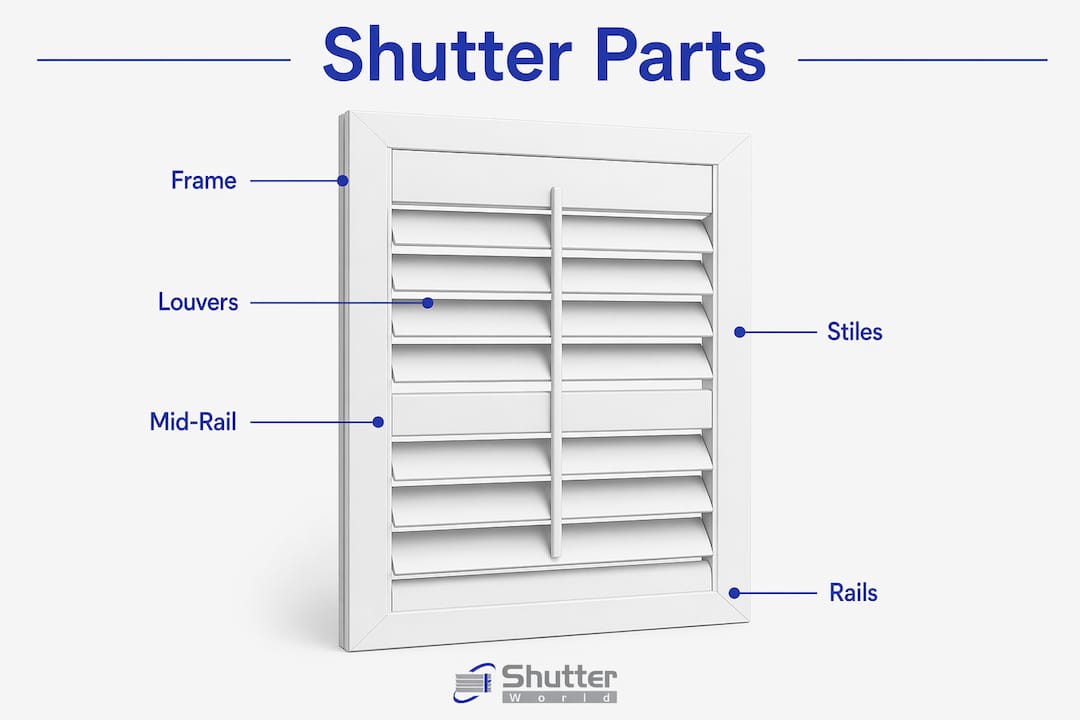
The essential anatomy of a window shutter consists of four main components: frame, louvres, stiles, and rails. Each part has a distinct structural role, and knowing what each one does helps you assess quality before you buy.
Frame
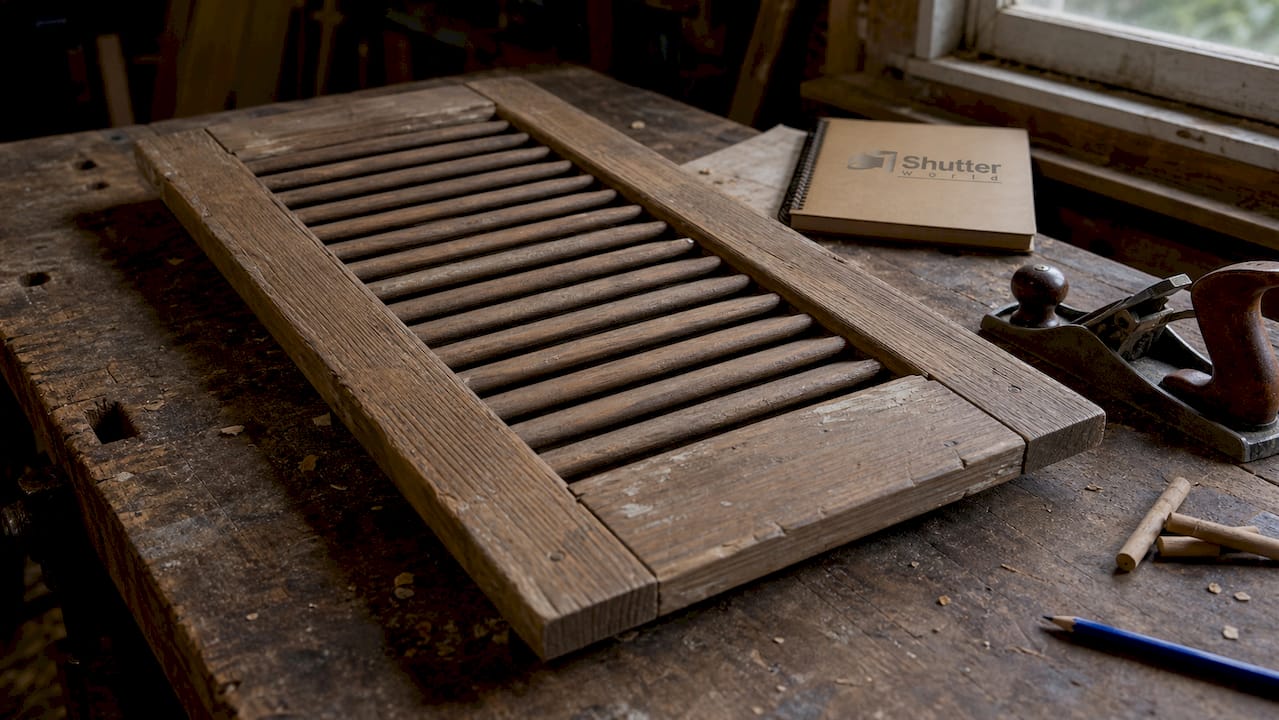
The frame is the outermost border of the shutter panel. It mounts directly to the window reveal or surrounding wall. The frame holds all other components in place and determines how the shutter sits within the window opening. A well-fitted frame is the foundation of a shutter that looks clean and operates smoothly for years.
Louvers
Louvers are the horizontal slats that run across the shutter panel. They rotate to control the amount of light entering a room and the degree of privacy from outside. Louver width is one of the most important choices you will make. Wider louvers (typically 89mm or 114mm) offer a more open, contemporary look and a clearer view when open. Narrower louvers (typically 47mm or 63mm) suit period properties and traditional interiors.
Stiles
Stiles are the vertical side pieces that form the structural backbone of each shutter panel. Poor quality stiles cause panel twisting or sagging over time, which throws louvers out of alignment and makes the shutter difficult to operate. This is the component most homeowners overlook when comparing prices. It is also the one that separates a long-lasting shutter from one that fails within a few years.
Rails
Rails are the horizontal bars at the top, bottom, and sometimes the middle of a shutter panel. They hold the stiles apart and keep the panel square. A mid-rail divides the panel into two independently operable sections, allowing you to tilt the upper louvers for light while keeping the lower section closed for privacy. Strong stiles and rails are critical for structural integrity and smooth operation over the life of the shutter.
Hardware terms
- Hinges: The fittings that attach the shutter panel to the frame, allowing it to swing open.
- Dogs (or shutter dogs): Decorative or functional catches that hold exterior shutters open against the wall.
- Tilt rod: The vertical bar connected to the louvers, used to rotate them simultaneously.
- Tracks: Channels used in bi-fold or sliding shutter configurations to guide panel movement.
Hardware such as dogs, hinges, and tracks distinguishes operable shutters from decorative fixed panels. This distinction matters when assessing maintenance requirements or planning a repair.
Pro Tip: When requesting a quote, ask specifically about the material and thickness of the stiles. Solid hardwood or high-grade engineered stiles outperform hollow MDF alternatives in both durability and appearance over time.
What are the main types of window shutter, and how do they differ?
Eight primary types of house shutters are defined by structural configuration and architectural suitability. Knowing the difference between them prevents you from ordering the wrong product for your window or climate.
- Louvered shutters: The most common interior style. Adjustable horizontal louvers allow precise control of light and airflow. Suited to almost every room and window shape.
- Plantation shutters: A subset of louvered shutters with wider louvers, typically 89mm or larger. Originally developed for large-windowed plantation houses in warm climates, they are now the most popular interior shutter style in the UK.
- Raised panel shutters: Solid panels with a raised central section, offering a traditional, formal appearance. No louvers. Used primarily for decoration or privacy rather than light control.
- Board-and-batten shutters: Vertical boards held together by horizontal battens. A rustic, farmhouse-style option, most often used on exterior elevations.
- Bahama shutters: Hinged at the top and propped open at an angle. Originally designed for tropical climates to block direct sunlight while allowing airflow. Increasingly used in UK conservatories.
- Bermuda shutters: Similar to Bahama shutters but with louvered panels. They fold upward and outward rather than swinging on side hinges.
- Colonial shutters: Traditional exterior shutters with louvered or solid panels, mounted on either side of a window. Primarily decorative in modern UK homes.
- Solid panel shutters: Fully solid, no louvers. Maximum privacy and light blockage. Often used in bedrooms or rooms requiring blackout conditions.
| Style | Interior or Exterior | Primary Use | Key Feature |
|---|---|---|---|
| Plantation | Interior | Light control, privacy | Wide louvers, contemporary look |
| Louvered | Both | Ventilation, light control | Adjustable narrow louvers |
| Raised panel | Exterior | Decoration, privacy | No louvers, formal appearance |
| Board-and-batten | Exterior | Rustic decoration | Vertical boards with battens |
| Bahama | Exterior/conservatory | Sun shading, airflow | Top-hinged, propped open |
| Colonial | Exterior | Decoration | Traditional side-mounted panels |
| Solid panel | Interior | Blackout, privacy | No louvers, full coverage |
Functional differences between interior plantation shutters and exterior decorative or storm-rated shutters affect both design choices and long-term maintenance requirements. Mixing up interior and exterior styles in a design conversation is one of the most common errors homeowners make when speaking with suppliers.
How do shutters compare to blinds and other window treatments?
Shutters are defined by their rigid, solid structure mounted directly to the window frame. Blinds, by contrast, use flexible slats operated by cords or wands and hang from a headrail above the window. This structural difference has real consequences for durability, light control, and how each product integrates with your home’s architecture.
The practical distinctions are significant:
- Durability: Shutters are fixed structures built to last decades. Quality blinds typically last 5–10 years before cords, slats, or mechanisms degrade.
- Light control: Shutter louvers rotate to precise angles, giving you finer control than most blind systems. A mid-rail configuration allows independent upper and lower adjustment.
- Thermal performance: Shutters create an additional layer of insulation at the window. Blinds offer minimal thermal benefit.
- Architectural integration: Shutters are fitted to the window reveal and become part of the room’s structure. Blinds are surface-mounted and can look temporary by comparison.
- Maintenance: Shutters require only occasional dusting. Blinds with cords or fabric components collect dust and are harder to clean thoroughly.
For a detailed comparison of long-term value, Shutterworld’s guide on shutters versus blinds covers the financial and practical case in full.
“Understanding the structural difference between shutters and blinds is the single most useful piece of knowledge a homeowner can have before choosing a window treatment. It reframes the entire decision.”
One further clarification worth making: the term “shutter” in photography refers to the camera mechanism that controls exposure time. This is entirely unrelated to window shutters. If you have encountered a glossary of shutter words in a photography context, the definitions do not transfer to home improvement.
What do these shutter terms mean for your buying decision?
Knowing the correct terms translates directly into better purchasing decisions. Here is how the terminology maps to practical considerations:
-
Assess stile and rail quality first. Before comparing prices, ask about stile material and thickness. Quality construction in rails and stiles improves longevity, reduces upkeep, and maintains a consistent appearance despite fluctuating temperatures. This matters particularly in UK homes where humidity and seasonal temperature changes are significant.
-
Match the shutter style to its intended function. Matching shutter style to intended use, whether privacy, storm protection, or decoration, prevents premature failure and costly replacement. A decorative raised panel shutter fitted where a louvred shutter is needed for ventilation will underperform from day one.
-
Distinguish interior from exterior products. Interior plantation shutters and exterior colonial shutters are not interchangeable. Mixing interior and exterior styles in design discussions causes inappropriate product choices for climate and use. Always confirm which category a product falls into before ordering.
-
Understand hardware before discussing installation. Knowing the difference between hinges, tilt rods, and tracks allows you to have a precise conversation with your installer. It also helps you identify whether a shutter is operable or purely decorative, which affects both pricing and maintenance planning.
-
Use louver width to define the room’s character. Wide louvres create an open, airy feel suited to modern interiors. Narrow louvers complement period features and traditional room proportions. This is an aesthetic decision, but it is also a structural one. Wider louvers require stronger stiles to prevent warping.
Pro Tip: When choosing a shutter style for a room, bring a photograph of the window and the room’s existing features to your consultation. It allows the specialist to recommend the right louver width, panel configuration, and frame finish without guesswork.
Key takeaways
Understanding shutter anatomy, style differences, and structural terminology is the most reliable way to choose a window treatment that performs well and lasts.
| Point | Details |
|---|---|
| Four core components | Every quality shutter is built from a frame, louvres, stiles, and rails. |
| Stile quality is critical | Poor stiles cause panel twisting and louvre misalignment; always ask about material. |
| Eight recognised styles | From plantation to board-and-batten, each style suits different uses and climates. |
| Shutters differ from blinds | Shutters are rigid, frame-mounted structures; blinds are flexible and surface-hung. |
| Match style to function | Choosing a shutter based on aesthetics alone leads to underperformance and early replacement. |
Why terminology knowledge changed how I advise homeowners
Over the years, I have seen the same pattern repeat itself. A homeowner arrives at a consultation having spent hours browsing images online. They know what they want it to look like. They have no idea what it is called or how it is built. The conversation then takes twice as long as it should, and the risk of a misunderstanding increases at every step.
The homeowners who arrive knowing the difference between a stile and a rail, or who understand why a mid-rail matters for a tall window, get better results. Not because the product is different, but because the conversation is cleaner. They ask the right questions. They spot when a cheaper quote is cutting corners on component quality. They understand why a plantation shutter and a colonial shutter are not the same thing, even if both have louvres.
There is also a subtler benefit. Homeowners who understand shutter terms tend to think more carefully about function rather than just appearance. They ask about louvre width in relation to room proportions. They consider whether they need a mid-rail for privacy management. They think about hardware and whether the shutter needs to be fully operable or is primarily decorative. These are the decisions that determine long-term satisfaction. Aesthetics fade as a priority once you are living with a shutter that does not operate smoothly or lets in more light than you expected.
My honest advice is this: spend thirty minutes with a glossary of shutter words before you speak to any supplier. You will walk into that conversation as an informed buyer, and that changes everything about the outcome. Shutterworld’s guide to shutter renovations is a good next step once you have the terminology in place.
— Ken
Discover bespoke plantation shutters from Shutterworld
Shutterworld specialises in made-to-measure plantation shutters crafted to fit your exact window dimensions, whether standard rectangular openings or complex arched and bay configurations. Every shutter is built with quality-engineered stiles and rails, premium louvers in your chosen width, and hardware selected for long-term performance.
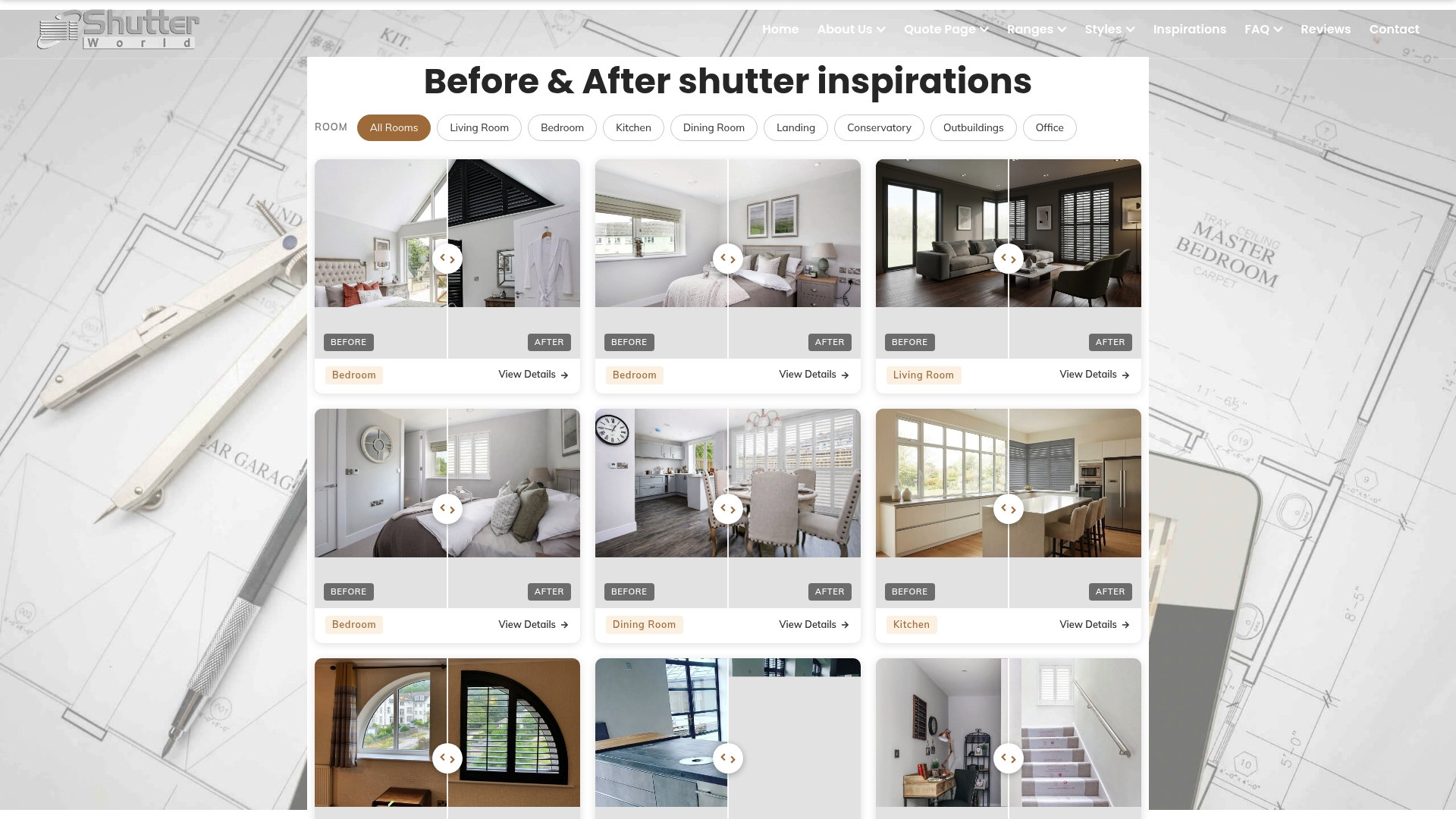
With over 25 years of experience fitting bespoke shutters across the UK, Shutterworld provides a fully managed service from in-home survey through to professional installation, backed by product and workmanship guarantees. If you are ready to see how the right shutter transforms a room, explore the full range of interior window shutters or request a free consultation today.
FAQ
What are the four main parts of a window shutter?
The four main structural components of a window shutter are the frame, louvers, stiles, and rails. Each part has a distinct role in the shutter’s appearance, operation, and long-term durability.
What is the difference between plantation shutters and louvered shutters?
Plantation shutters are a type of louvered shutter distinguished by their wider louvers, typically 89mm or larger. Standard louvered shutters use narrower slats and are more commonly associated with traditional or period architectural styles.
Are shutters the same as blinds?
Shutters and blinds are different products. Shutters are rigid structures mounted directly to the window frame, while blinds use flexible slats or fabric hung from a headrail above the window opening.
What does a mid-rail do on a shutter panel?
A mid-rail divides a shutter panel into two independently operable sections. This allows you to adjust the upper louvers for light while keeping the lower section closed for privacy, which is particularly useful in ground-floor rooms.
Why does stile quality matter when choosing shutters?
Stiles are the vertical structural backbone of each shutter panel. Poor quality stiles cause the panel to twist or sag over time, which misaligns the louvers and makes the shutter difficult to operate. Solid hardwood or engineered stiles are the most reliable choice for long-term performance.