
Shutter testing standards: a UK compliance guide

TL;DR:
- UK shutter standards enforce fire resistance, safety, and security through certification, installation, and ongoing maintenance. Proper compliance involves matching installation to tested configurations, conducting witnessed commissioning, and keeping detailed documentation. Regular servicing and responsible oversight prevent costly failures and ensure legal and insurance compliance.
Shutter testing standards are the formalised benchmarks that guarantee a shutter’s safety, performance, and regulatory compliance in any property renovation or design project. The three standards that govern most UK installations are BS EN 1634-1 for fire resistance, EN 13241 for operational and structural safety, and PAS 24 for forced entry resistance. Together, they determine whether a shutter is legal to sell, install, and maintain in the UK. Whether you are a homeowner specifying shutters for a renovation or a professional managing a commercial fit-out, understanding these standards protects you from legal liability, voided insurance, and genuine safety risk.
What key shutter testing standards apply in the UK?
The UK’s shutter compliance framework rests on three distinct standards, each targeting a different performance characteristic.
BS EN 1634-1 governs fire resistance testing for fire-rated shutters. It assigns either an integrity rating (E) or a combined insulation and integrity rating (EI), depending on how long the shutter contains fire and limits heat transfer. Fire-rated shutters must bear UKCA marking to demonstrate legal conformity with this standard. A shutter with an EI rating provides a higher level of protection than one with an E rating alone, because it also limits the temperature rise on the unexposed face.
EN 13241 sets the requirements for roller shutters and industrial or commercial doors, covering safety, structural strength, and operational performance. Roller shutters must comply with EN 13241 to be legally sold or installed in the UK. Without UKCA marking confirming EN 13241 compliance, a shutter is not lawful for the UK market regardless of its physical quality.
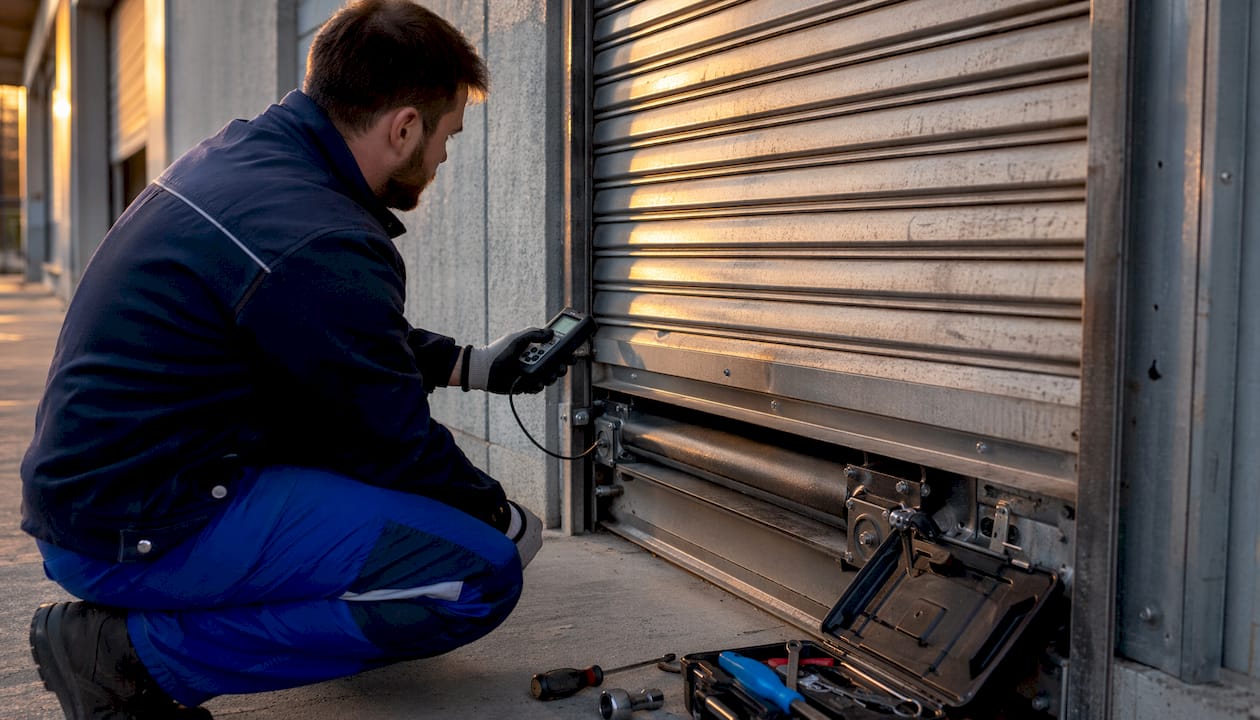
PAS 24 is the UK’s core pass or fail security certification standard. It tests shutters and doors against forced entry and corresponds directly to insurer requirements for residential and commercial properties. Security experts confirm that UKCA marking paired with EN 13241 testing is the minimum legal and insurance threshold for shutters sold in the UK.
The three standards cover distinct shutter categories:
- Fire shutters: tested to BS EN 1634-1, rated E or EI, UKCA marked
- Roller shutters: tested to EN 13241 for structural and operational safety, UKCA marked
- Security shutters: tested to PAS 24 for forced entry resistance, aligned with EN 13241
Pro Tip: When specifying shutters for a mixed-use property, check whether a single product holds multiple certifications. Some fire-rated shutters also carry PAS 24 ratings, which reduces the number of products you need to manage and document.
How are shutter testing standards enforced after installation?
Certification at the factory level is only the starting point. The shutter’s rated performance depends entirely on installation matching the tested configuration.
BS EN 1634-1 test results are specific to the entire assembly, including the supporting steelwork, fixings, and installation gaps. Any deviation from the tested setup invalidates the fire resistance rating, even if the shutter itself is fully certified. This is the single most misunderstood aspect of shutter compliance in UK property projects.
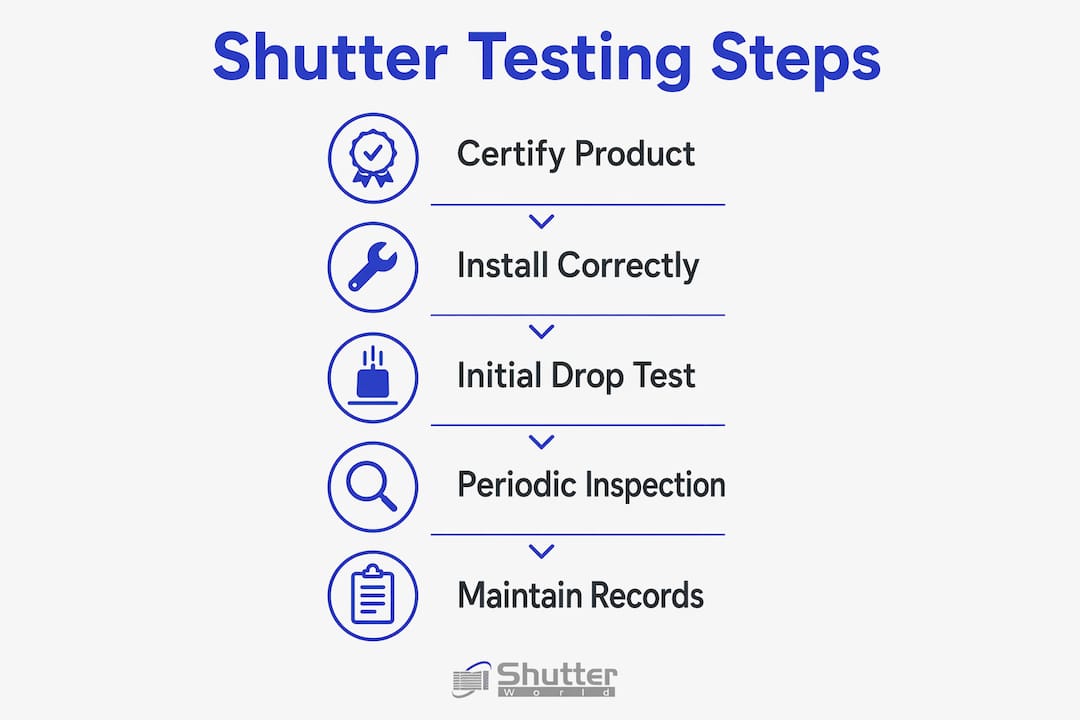
Commissioning procedures formalise the handover between installation and operation. A disciplined commissioning process includes the following steps:
- Verify dimensions and support steelwork against the tested configuration drawings.
- Confirm alarm integration by testing the shutter’s response to the building’s fire alarm signal.
- Calibrate descent speed to the manufacturer’s specification.
- Conduct a witnessed initial drop test to confirm the shutter closes fully and correctly under fire alarm activation.
- Test powered operation safety devices to verify obstruction detection and emergency stop functions.
A witnessed initial drop test establishes the baseline for all future periodic testing and compliance audits. Without it, there is no documented proof that the shutter performed correctly at the point of handover.
Documentation is not optional. Every installation requires a declaration of conformity, commissioning certificate, and a maintenance schedule. The Regulatory Reform (Fire Safety) Order 2005 assigns legal responsibility for ongoing compliance to the “responsible person,” typically the building owner or facilities manager. That duty begins the moment the shutter is commissioned, not when a problem arises.
Pro Tip: Request a copy of the tested configuration drawing from the manufacturer before installation begins. Compare it against the site conditions. If the structural opening differs from the tested setup, resolve the discrepancy before the shutter is fitted, not after.
What best practices support ongoing shutter performance?
Commissioning marks the beginning of a shutter’s compliance lifecycle, not the end. Shutter performance testing is an ongoing obligation, not a one-time event.
Typical servicing frequencies for fire shutters in commercial settings are annual or semi-annual in high-use or high-risk areas. Each service covers cleaning, safety device checks, and alarm interface testing. Maintenance reports document every visit and any remedial actions taken, creating the paper trail required for compliance audits and insurance claims.
The core best practices for ongoing shutter maintenance are:
- Annual inspection as a minimum: schedule servicing before the anniversary of commissioning to avoid compliance gaps.
- Document every visit: maintenance reports must record the date, scope of work, findings, and any parts replaced.
- Test alarm integration at every service: improper alarm integration is a leading cause of shutter failure during fire safety inspections.
- Retest after any repair or modification: any change to the shutter assembly, including replacing a spring or motor, requires a fresh functional test before the shutter returns to service.
- Use specialist maintenance providers: general contractors rarely hold the competency to service fire-rated or security-rated shutters correctly. Use providers with demonstrable experience in the specific standard your shutter is certified to.
Good shutter maintenance practice also protects the aesthetic and mechanical integrity of interior shutters over time. The same discipline that keeps a fire shutter compliant keeps a plantation shutter operating smoothly for decades.
Pro Tip: Keep a dedicated compliance folder for each shutter installation, containing the declaration of conformity, commissioning certificate, tested configuration drawing, and all subsequent maintenance reports. Auditors and insurers expect this level of organisation.
What are the common compliance pitfalls in shutter testing?
Most compliance failures in UK shutter installations are avoidable. They stem from gaps in specification, installation, or documentation rather than from product defects.
The most frequent pitfalls are:
- Deviating from the tested configuration: changing the structural opening size, fixing method, or lintel detail after certification invalidates the fire resistance rating.
- Failing to integrate with alarm systems: wiring faults or incorrect alarm interfaces cause shutters to fail activation tests even when the mechanical components function correctly.
- Skipping commissioning documentation: a shutter that has never had a witnessed drop test has no verified baseline. Inspectors treat this as a compliance failure regardless of the product’s certification.
- Buying uncertified products: without UKCA marking and the relevant standard certification, a shutter is not legal for sale or installation in the UK. The price saving is never worth the liability.
- Neglecting retesting after modifications: any repair, replacement component, or structural alteration triggers a retesting obligation.
The consequences of these failures are serious. Legal liability falls on the responsible person under the Regulatory Reform (Fire Safety) Order 2005. Insurance policies routinely exclude claims where shutters were not maintained or installed to the certified standard. In the worst case, a non-compliant shutter fails during a fire event.
“Fire safety specialists stress that maintenance responsibilities extend beyond installation, requiring systematic inspections and record-keeping to satisfy fire safety orders. A shutter that passes its initial commissioning test but receives no documented servicing is not compliant. Compliance is a continuous state, not a one-time achievement.”
The most reliable way to avoid these pitfalls is to appoint a single point of responsibility for shutter compliance from specification through to ongoing maintenance. That person, whether an architect, facilities manager, or specialist contractor, should understand the relevant standards and hold the documentation for every shutter in the building.
Key takeaways
Shutter testing standards in the UK require certified products, installation matched to tested configurations, witnessed commissioning, and documented ongoing maintenance to remain legally compliant.
| Point | Details |
|---|---|
| Three core standards | BS EN 1634-1, EN 13241, and PAS 24 govern fire, operational, and security performance respectively. |
| UKCA marking is mandatory | Without UKCA marking, a shutter cannot be legally sold or installed in the UK market. |
| Installation must match tested setup | Any deviation from the certified configuration invalidates the fire resistance rating. |
| Commissioning requires a witnessed drop test | The initial drop test establishes the baseline for all future audits and periodic testing. |
| Maintenance is a legal duty | The responsible person under the 2005 Fire Safety Order must maintain records of all servicing. |
Why compliance is the foundation, not the finish line
Ken’s perspective on shutter safety and standards is shaped by one observation repeated across many property projects: most compliance problems are not discovered during installation. They surface months or years later, during a fire safety audit, an insurance claim, or a building sale.
The assumption that a certified product automatically delivers a compliant installation is the most costly misunderstanding in this sector. A shutter rated to BS EN 1634-1 is only as good as the installation it sits within. I have seen fire shutters with impeccable product certification installed into structural openings that bore no resemblance to the tested configuration. The certification was real. The compliance was not.
The second misunderstanding is that commissioning is a formality. The witnessed drop test is the only moment at which the shutter’s real-world performance is verified against its rated performance. Skipping it, or treating it as a box-ticking exercise, removes the one piece of evidence that protects the building owner, the installer, and the occupants.
My advice to both homeowners and professionals is to treat shutter compliance the way you treat structural engineering. You would not accept a beam without a calculation. Do not accept a fire shutter without a commissioning certificate and a maintenance schedule. The shutter installation process is where compliance is either built in or left out. Getting it right from the start costs far less than remediation.
— Ken
Shutterworld’s approach to compliant, quality shutters
Shutterworld has spent over 25 years supplying and installing bespoke interior shutters across the UK, with a commitment to quality that runs from material selection through to expert fitting.

Every Shutterworld installation begins with a professional in-home survey, ensuring that measurements and specifications align with the window’s actual conditions. For homeowners and developers seeking plantation shutters that combine lasting quality with compliance confidence, Shutterworld’s range spans entry-level MDF through to premium hardwood. For those with complex or architectural windows, bespoke internal shutters are engineered to fit precisely, backed by product and workmanship guarantees. Book a free consultation to discuss your project with a specialist who understands both the design and the compliance requirements.
FAQ
What is BS EN 1634-1 and why does it matter?
BS EN 1634-1 is the British and European standard for fire resistance testing of shutters and doors. It assigns E or EI ratings that confirm how long a shutter can contain fire and limit heat transfer, and UKCA marking confirms legal conformity.
Does EN 13241 apply to interior window shutters?
EN 13241 primarily governs roller shutters and industrial or commercial doors for operational safety and structural strength. Interior plantation shutters fall under different product regulations, though all shutters sold in the UK must meet applicable UKCA marking requirements.
What happens if a fire shutter is installed differently from its tested configuration?
Any deviation from the tested configuration, including changes to fixings, structural supports, or installation gaps, invalidates the fire resistance rating even if the product itself is fully certified.
How often should fire shutters be serviced?
Fire shutters in commercial settings require annual servicing as a minimum, with semi-annual servicing in high-use or high-risk areas. Each service must be documented and records retained for compliance audits.
What is PAS 24 and who needs it?
PAS 24 is the UK’s security certification standard for doors and shutters, testing resistance to forced entry. It is required by many insurers for residential and commercial properties and must be paired with UKCA marking for legal compliance.