
Shutters and child safety protect children with style

Shutters and child safety protection
TL;DR:
- Shutters are considered ‘Safe by Design’ because they contain no cords or loops.
- Proper installation ensures shutters eliminate hazards like finger entrapment and loose components.
- Over their lifespan, shutters offer superior safety, durability, insulation, and aesthetic benefits over blinds.
Most parents assume all window coverings carry roughly the same level of risk. In reality, the difference between a corded blind and a solid panel shutter could not be more significant. Window blind safety regulations classify plantation shutters as ‘Safe by Design’ precisely because they contain no cords, chains, or loops whatsoever. That single design distinction removes the single greatest hazard associated with traditional window coverings. In this guide, we walk you through exactly why shutters outperform every alternative, what to look for when choosing materials, and how professional installation transforms safety from an aspiration into a guarantee your family can rely on every day.
Table of Contents
- Why shutters are the safest window covering for children
- How shutters work: Materials, mechanisms, and design features
- Installation and practical measures for maximum child safety
- Comparing shutters to blinds: Safety, aesthetics, and value
- A fresh perspective: Shutter safety beyond regulations
- Explore bespoke child-safe shutters for your home
- Frequently asked questions
Key Takeaways
| Point | Details |
|---|---|
| Shutters eliminate cord risks | Child-safe shutters are designed without cords, chains, or loops, making them inherently safer than traditional blinds. |
| Regulations support safe design | UK regulations since 2014 ensure shutters comply with ‘Safe by Design’ principles for child safety. |
| Durable materials matter | Quality shutters use robust materials that reduce hazards from breakage or sharp edges. |
| Professional installation is vital | Secure, expert fitting prevents accidents and maximises the child safety of shutters. |
| Shutters offer lasting value | Upfront costs are offset by decades of use, lower maintenance, and better home aesthetics than blinds. |
Why shutters are the safest window covering for children
For years, corded blinds were the default choice in British homes, largely because they were affordable and widely available. What many families did not realise was the genuine danger hiding in those loops. Cord strangulation incidents prompted the British Blind and Shutter Association to launch its BBSA Make It Safe campaign, raising awareness among parents and caregivers across the UK.
The regulatory landscape shifted decisively in 2014. UK window covering regulations now require all new professionally supplied blinds to minimise strangulation risks, either through ‘Safe by Design’ principles or mandatory safety devices such as tensioners and cleats. Shutters, by their very nature, comply with these rules without any additional accessories.
“Window shutters, particularly plantation shutters, are classified as ‘Safe by Design’ under UK child safety regulations because they have no cords, chains, or loops, eliminating strangulation risks associated with traditional blinds.”
This is not a minor technicality. It represents a fundamental architectural difference in how shutters are built. Consider what shutters eliminate entirely:
- Hanging cords that can form loops at child height
- Pull chains used to raise or lower traditional roller or Venetian blinds
- Wand controls with loose fittings that detach over time
- Exposed mechanisms that small fingers can catch on or pull free
Shutter panels sit fixed within their frame. Louvres tilt through an integrated tilt rod that a young child cannot dislodge. There is no loose element, no dangling component, and no hidden pinch point that emerges after a few months of daily use.
For comprehensive guidance on shutter safety regulations and what compliance means for your home, it is worth reviewing the current UK framework in detail. Parents who also want practical, room-by-room guidance will find our essential child-safe shutter tips particularly useful.
Key safety advantage at a glance: Shutters carry inherent ‘Safe by Design’ status, meaning no retrofitting, no additional safety clips, and no annual checks on cord tension. The safety is built in from day one.
How shutters work: Materials, mechanisms, and design features
With the safety credentials established, let us explore the practical features that make shutters so reliable for families with young children.
Shutters are available in three principal materials, each with distinct characteristics:
- Hardwood such as basswood or tulipwood, offering premium rigidity, a smooth paint-ready surface, and impressive longevity when properly sealed
- Composite or MDF with polypropylene coating, like our Seattle range, which resists warping in humid environments such as bathrooms and kitchens
- Aluminium, well suited to external-facing applications or conservatories where moisture resistance is a priority
The mechanism itself is what sets shutters apart from virtually every alternative. Shutters operate via solid tilt rods or integrated hidden mechanisms, with robust louvres made from durable, child-safe materials that resist breaking into small parts or pinching fingers. This matters enormously in a home with toddlers who routinely test every surface within reach.
The comparison below illustrates how shutter materials perform against the most relevant child-safety criteria:
| Feature | Hardwood shutters | Composite shutters | Corded blinds |
|---|---|---|---|
| Cord or chain present | None | None | Yes |
| Risk of splintering | Low (quality product) | Very low | N/A |
| Pinch points | None | None | Mechanism edges |
| Durability | Excellent | Excellent | Moderate |
| Child safety rating | Safe by Design | Safe by Design | Requires safety device |
For a broader look at child friendly window treatments, including options suited to different room types, we have additional resources to guide your decision.
Pro Tip: Avoid purchasing cheap imported shutters from unverified suppliers. Low-grade timber can splinter along the grain under pressure, creating sharp edges. Always request material certification and ask your installer about the origin and finish of every component.
Beyond child safety, solid shutter panels also offer practical home security benefits. A properly fitted shutter is considerably harder to force open than a standard blind, adding an additional layer of security your household benefits from around the clock.
Installation and practical measures for maximum child safety
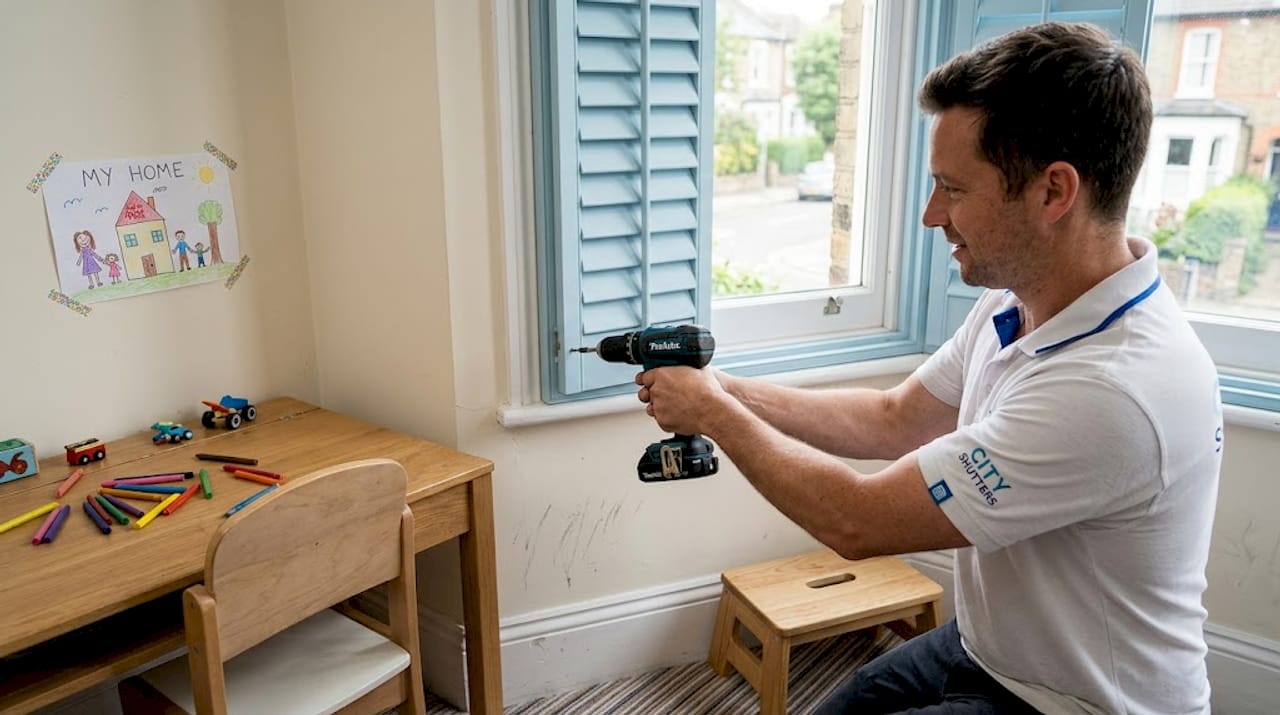
Understanding shutter design is only part of the equation. Proper installation is vital for safety, and this is an area where many homeowners underestimate the difference a qualified fitter makes.
Professional installation ensures that every panel is secured within a correctly measured frame, with no gaps that could trap small fingers and no loose fixings that might work free over time. Professional fitting advice consistently highlights that even a well-designed shutter can become a hazard if fitted incorrectly, particularly around edges and hinge points.
Beyond the shutter itself, the surrounding environment matters. Consider the following checklist after installation:
- Remove climbing opportunities. Position beds, chairs, and toy storage away from window walls so children cannot use furniture to reach the window ledge
- Inspect panel edges. Run your hand along all louvre edges immediately after fitting to confirm there are no rough patches or exposed fixing points
- Test the tilt mechanism. Open and close louvres several times to confirm the rod moves smoothly and shows no signs of loosening at the fixing points
- Check the frame seal. Confirm that the shutter frame sits flush against the window reveal with no protrusions that could catch clothing or skin
- Revisit after six months. A simple visual check ensures fixings remain tight and no wear has developed in high-use rooms
The table below outlines key installation checks and the risks they address:
| Installation check | Risk addressed | Recommended timing |
|---|---|---|
| Frame flush fit | Finger entrapment | At point of installation |
| Louvre edge smoothness | Cuts and abrasions | Immediately post-fit |
| Hinge tightness | Panel instability | 6 months post-installation |
| Furniture clearance | Fall from height | Ongoing |
Research into deaths of children from falls from windows and balconies highlights fall prevention as a genuine priority. While shutters have no documented cord strangulation risk, positioning furniture away from windows remains one of the simplest and most effective steps any parent can take. For further guidance on safe shutter installation and current installation regulations, our dedicated resources cover the full process step by step.
Pro Tip: Always ask your installer for a written workmanship guarantee. Reputable companies stand behind their fitting with documented assurance, giving you genuine peace of mind well beyond the installation day.
Comparing shutters to blinds: Safety, aesthetics, and value
Once you know shutters are safe, it is worth seeing how they stack up against other popular options in a way that matters to your family’s daily life.
The safety distinction is clear. Shutters have no cords or chains, whereas blinds present documented hazards and require extra safety devices to meet the 2014 regulations. That alone is a compelling reason for households with children under five. But the full picture goes further.
“Shutters cost more upfront but last decades with lower maintenance versus cheaper blinds needing frequent replacement, and they are superior for aesthetics and insulation in the UK climate.”
When you account for the full lifetime of ownership, shutters versus blinds comparisons consistently favour shutters on total value. A quality shutter, properly fitted, can remain in excellent condition for twenty years or more. A mid-range blind typically requires replacement every three to five years.
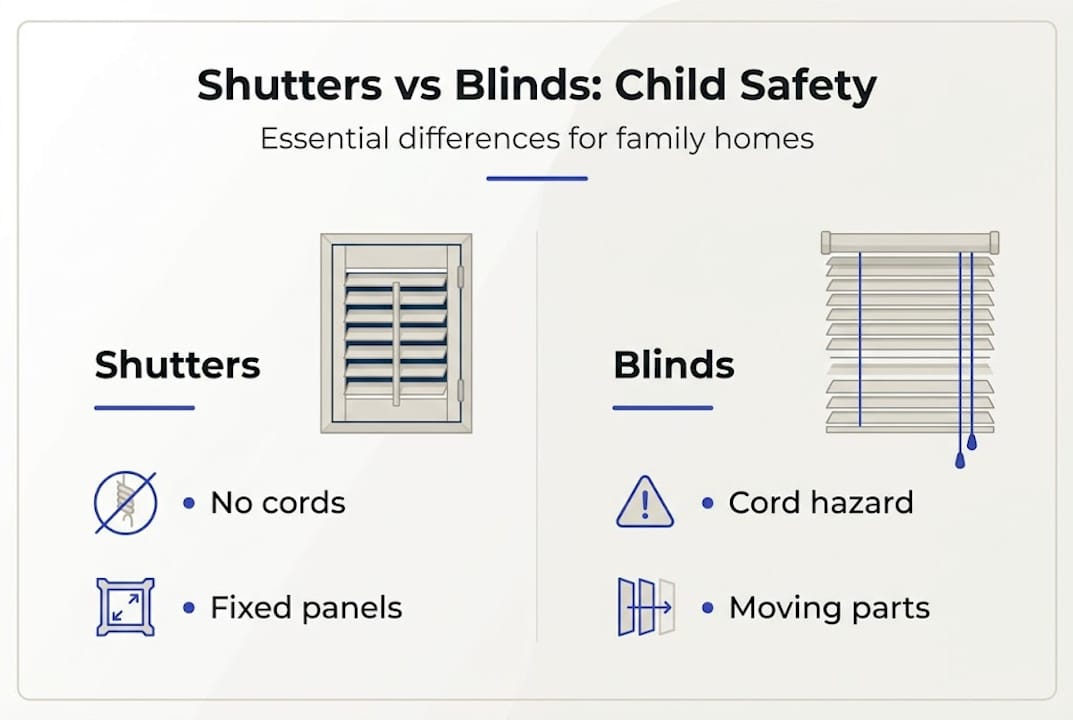
Here is how the two options compare across the factors that matter most to UK parents:
| Factor | Shutters | Blinds |
|---|---|---|
| Cord or chain hazard | None | Present without safety device |
| Lifespan | 20 or more years | 3 to 5 years typically |
| Thermal insulation | Excellent | Moderate |
| Maintenance | Wipe clean, minimal | Regular cleaning, mechanism care |
| Aesthetic impact | Premium, timeless | Functional, variable |
| Upfront cost | Higher | Lower |
Beyond safety, shutters deliver measurable thermal insulation benefits that matter in British winters. Solid louvres and a tight-fitting frame reduce heat loss through window areas, contributing to lower energy bills. That is a practical gain that accumulates year on year.
For aesthetics, the impact is transformative. Child-safe shutter tips frequently note that parents are pleasantly surprised by how much shutters elevate a room’s character. Where blinds tend to fade into the background, shutters become a deliberate design feature that adds value and visual appeal. Our certified shutters meet every relevant UK standard while looking genuinely beautiful in any interior setting.
A fresh perspective: Shutter safety beyond regulations
Most guides stop at the regulatory checklist. We think that is where the genuinely useful conversation begins.
Regulations set a minimum. They tell you what a product must not do. They do not tell you what a product should do over fifteen years of family life, through toddler years, primary school, and teenage bedrooms. That longer view is what we encourage every parent to adopt when making this decision.
The uncomfortable truth is that not all shutters are created equal. Some imported products technically pass minimum standards but are manufactured with lower-grade timber that can splinter under sustained pressure. Others are fitted by unqualified installers who leave small gaps at hinge points or fail to seat the frame correctly. These are the advanced shutter safety tips that rarely appear in a basic buyer’s guide.
Our view, shaped by over 25 years fitting shutters across the UK, is straightforward. Buy right once. A premium, professionally fitted shutter removes hazards, holds its finish, and never needs replacing during your children’s years at home. The alternative, replacing budget blinds every few years while managing cord clips and tensioners, costs more in time, money, and anxiety than people realise. For families who want child-proof treatments that genuinely stand the test of time, the premium choice is also the practical one.
Explore bespoke child-safe shutters for your home
Ready to make your windows child-safe without compromising on style? At Shutter World, we have spent over 25 years helping UK families find the perfect shutter solution for every room, window shape, and budget.

Our range of plantation shutter installations covers everything from classic hardwood to moisture-resistant composite, all fitted by our expert team with full workmanship guarantees. Whether you are drawn to the timeless appeal of our beautiful window shutters or need a fully tailored approach, our bespoke internal shutters are engineered precisely to your window dimensions. Book your free in-home survey today and let us help you create a safer, more beautiful home for your family.
Frequently asked questions
Are window shutters totally safe for children?
Yes. Shutters are classified as ‘Safe by Design’ under UK child safety regulations, with no cords, chains, or loops, eliminating the strangulation risks associated with traditional blinds entirely.
Do shutters need special installation to be safe?
Yes. Professional installation is vital to ensure secure fitting, eliminate sharp edges, and prevent loose components, particularly when lower-quality imported products are avoided in favour of premium materials.
Do regulations cover shutters as well as blinds?
Yes. Shutters inherently comply with UK window covering regulations introduced in 2014, as their design requires no additional safety devices to meet ‘Safe by Design’ standards.
Are there any risks with shutters for young children?
Major risks are avoided when quality materials and secure fitting are used. Cheap imported shutters may splinter, so always select a reputable supplier with certified products and professional installation.
How do shutters compare to blinds for safety?
Shutters are significantly safer. Unlike blinds, they carry no cord hazards and require no additional safety devices, making them the preferred choice for any home where young children are present.
Recommended
- 7 Essential Tips for Choosing Kids Safe Window Shutters | Shutter World
- 6 Most Effective Child Friendly Window Treatments
- Shutters and Home Security with Lighting control shutters
- 5 Stylish Shutter Styles for Your Home | Shutter World UK
- Turvallisuus kaihdinten käytössä – Miten ehkäiset riskit – Nordic Blinds Oy