
Shutters and minimalism: a perfect pairing

TL;DR:
- Interior shutters are naturally minimalist window treatments that replace cluttered fabrics with a clean, architectural surface. They provide precise light control and privacy, enhancing spatial clarity without visual noise. Proper design, craftsmanship, and proportion are essential to seamlessly integrate shutters into a minimalist interior.
There is a persistent myth that shutters and minimalism are incompatible. The assumption is that shutters are too architectural, too present, too much. In reality, the opposite is true. Interior shutters, the term designers use for fixed-frame, louvred or solid-panel window coverings, are one of the most naturally minimalist window treatments you can choose. They replace the visual noise of curtain rails, fabric folds, and billowing drapes with a single, clean plane that sits flush with your window reveal. This article covers the design principles behind that compatibility, the styles that work best, and the practical steps for getting it right in your own home.
Key takeaways
| Point | Details |
|---|---|
| Shutters suit minimalism | Interior shutters deliver clean lines and precise light control that align directly with minimalist design values. |
| Material and finish matter | Choosing neutral or tonal finishes ensures shutters blend with the spatial palette rather than competing with it. |
| Precision installation is non-negotiable | Flawless fitting with hidden hardware maintains the geometric clarity minimalism demands. |
| Louvre size affects the atmosphere | Wider louvres open up views and flood rooms with softened light; narrow louvres suit more structured, formal spaces. |
| Bespoke fit beats off-the-shelf | Made-to-measure shutters designed for your specific window reveal are the only way to achieve a truly seamless result. |
Shutters and minimalism: why they work together
To understand why shutters suit a minimalist interior so well, you first need to understand what minimalism actually asks of a room. It is not simply about owning less. It is a design philosophy built on spatial clarity, quality over quantity, and the disciplined use of every element. A minimalist room earns its calm. Nothing in it is accidental.
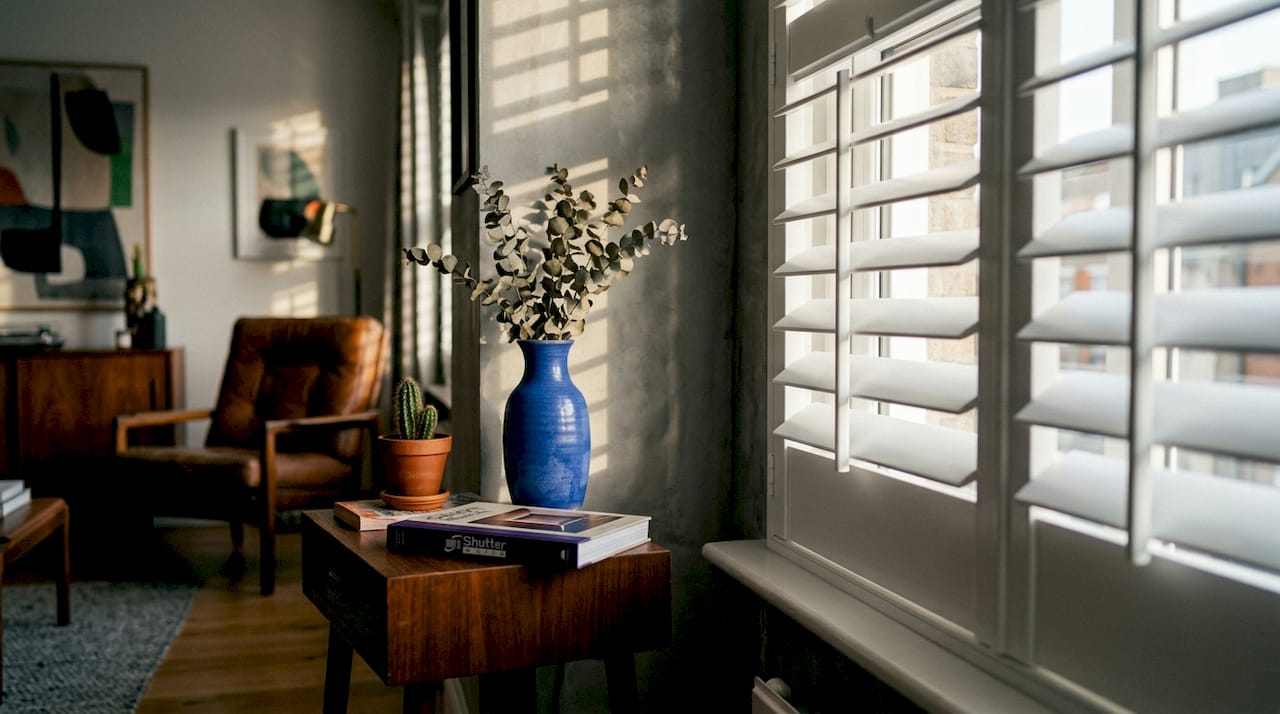
Window treatments are one of the most visually dominant features in any room. Curtains introduce colour, pattern, texture, and movement. Roller blinds can look clean when down but reveal a cluttered mechanism when raised. Roman blinds add fabric bulk. Each of these options introduces elements that minimalism actively works to remove.
Interior shutters, by contrast, are architectural. They sit within or against the window frame and become part of the wall rather than a feature applied to it. Natural light is the central decorative element in a minimalist interior, and shutters are uniquely equipped to manage it. Tilt the louvres and you direct shafts of light across a pale floor. Open them fully and the room floods with daylight. Close them and the space becomes a quiet, private retreat. No other window covering gives you that range with so little visual interference.
Minimalism also demands flawlessly executed details, because there is nowhere to hide imperfection. This is where craftsmanship becomes the deciding factor. Poorly fitted shutters with uneven gaps, visible fixings, or misaligned louvres will disrupt the serene geometry a minimalist room depends upon. Well-crafted, precisely installed shutters, on the other hand, feel as though they were always part of the building.
- Minimalism prioritises spatial clarity and functional necessity over decoration
- Natural light is treated as a design material, not just a background condition
- Window treatments must contribute to the geometry of a room, not fight it
- Material restraint means palettes are typically limited to three or four finishes throughout a space
Pro Tip: When planning your window treatments for a minimalist room, treat the shutter frame as a structural element, the same way you would a door frame or skirting board. Its proportions should echo the other fixed joinery in the room rather than stand apart from it.
Light control and privacy without visual clutter
One of the most practical benefits of choosing shutters for a minimalist home is the degree of control they give you over light and privacy simultaneously. Most window coverings ask you to choose one or the other. Curtains drawn for privacy block light entirely. Sheers offer light but little privacy. Shutters let you have both at once, which is a genuinely underappreciated advantage.
Wide louvres allow unobstructed views when fully open, and when angled, they bounce softened light into the room while blocking direct sightlines from outside. This is particularly valuable in urban homes where street-level windows face passers-by. You can sit in a well-lit room reading comfortably while the pavement view is fully screened. No other standard window treatment achieves that with such simplicity.
The table below compares shutters against common alternatives across the criteria most relevant to minimalist interiors.
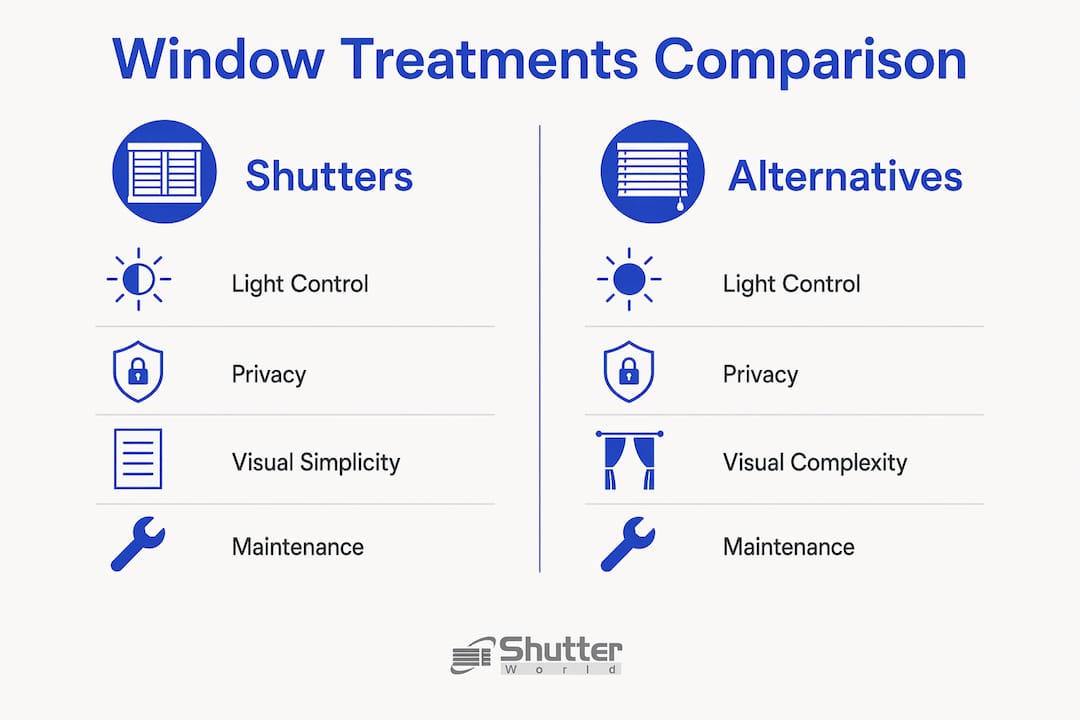
| Window treatment | Light control | Privacy at daytime | Visual complexity | Maintenance |
|---|---|---|---|---|
| Interior shutters | Precise, adjustable | Excellent | Very low | Low |
| Roller blind | Basic, limited angle | Good when down | Low | Low |
| Roman blind | Partial only | Good when down | Moderate | Moderate |
| Curtains | Limited adjustment | Moderate | High | High |
| Sheer curtains | Diffused, fixed | Poor | Moderate | High |
It is also worth understanding how louvre size interacts with light quality. Larger louvres, typically 89mm or wider, create broader, more dramatic light panels and suit functional window coverings in open-plan spaces where the goal is generous natural light. Smaller louvres at 47mm or 63mm produce a more rhythmic, structured effect and suit rooms where a sense of order and containment is the priority.
One technical point that many homeowners overlook is light leakage at the edges. Inside-mounted treatments can leave light gaps of several millimetres on each side, which creates a halo effect that undermines the clean perimeter a minimalist room needs. Shutters installed to the full depth of the window reveal, or mounted on a precisely fitted frame that extends to the wall surface, eliminate this problem entirely.
Pro Tip: Ask your installer about a solid-panel divider rail if you want to tilt the upper and lower sections of a shutter independently. This lets you direct light from the top half of the window towards the ceiling for a diffused glow, while keeping the lower half closed for privacy at eye level. It is one of the most functional refinements available in interior shutters and it does not add visual complexity.
Shutter styles that suit minimal decor
Not every shutter style translates equally well into a minimalist interior. The options that work best share a common characteristic: they prioritise geometry over ornament. Here is a practical breakdown of what to consider.
Plantation shutters are the most widely recognised style and also the most versatile for minimalism and interior design. Their wide louvres, clean frames, and flush fit make them a natural companion to the kind of paired-back, contemporary spaces most minimalist homeowners are working with. The shutter frame thickness and louvre spacing should be treated as compositional decisions, aligned with the rhythm of surrounding joinery rather than chosen arbitrarily.
Flat-panel or solid shutters remove the louvre entirely and replace it with a smooth, flush surface. These work particularly well in bedrooms where complete blackout is the goal and a completely unbroken surface creates a calm, monastic quality. They are increasingly popular in Scandi-influenced interiors and pair beautifully with natural timber floors and whitewashed walls.
Built-in or recessed shutters are the most architecturally integrated option. Systems designed to disappear into the wall cavity when retracted preserve pure lines with no visible mechanism, which is the gold standard for minimalist window styling.
In terms of materials and finishes, the following table outlines the most suitable options for minimalist palettes.
| Material | Finish options | Best suited to |
|---|---|---|
| Premium hardwood | Natural, painted, stained | Warm, Japandi, or natural minimalism |
| MDF with polypropylene coating | Painted, white, grey | Contemporary and clean-lined interiors |
| Aluminium | Powder-coated, matt | Modern, industrial minimalism |
| PVC | White, neutral tones | Wet rooms, conservatories |
Colour choice follows the same logic as material. Minimalist palettes typically use three or four materials across an entire space, and your shutters should be one of them rather than an afterthought. A warm white that matches your trim and ceiling creates continuity. A natural oak finish that echoes your flooring creates depth. Both approaches are correct. What does not work is a shutter finish that introduces a fifth tone into a room that is already at its material limit.
You can also explore stylish shutter styles for modern homes if you are in the early stages of deciding which direction suits your space.
Integrating shutters seamlessly into your space
Getting shutters right in a minimalist interior is less about choosing the most expensive option and more about making every decision with precision and intention. These steps will guide you through it.
- Start with your window geometry. Measure the reveal depth, the frame width, and the distance to any surrounding joinery. Your shutter frame should sit flush with or slightly recessed from the wall plane. Any protrusion creates shadow lines that disrupt the flat, calm surface minimalism depends upon.
- Choose a finish that is already in the room. Do not introduce a new tone. Match the shutter frame colour to your skirting boards, door frames, or ceiling. This makes the shutters read as architecture rather than furniture, which is exactly the effect you want.
- Specify hidden or minimal hardware. Visible hinges, bolts, and tilt rods interrupt the clean surface. Ask for concealed tilt mechanisms and minimal frame fixings. The precision of architectural details in minimalist interiors means that a poorly positioned screw head is as disruptive as a badly placed piece of furniture.
- Consider proportion carefully. A full-height shutter that runs from floor to ceiling on a tall window is a very different visual proposition to a café-style shutter covering only the lower half. Both have their place, but the decision should be driven by the spatial rhythm of the room, not personal preference alone.
- Plan your maintenance from the start. One of the lifestyle benefits of shutters is that they are exceptionally low-maintenance compared to fabric treatments. A damp cloth is sufficient for most cleaning. Choose materials that are resistant to humidity if you are fitting shutters in a bathroom or kitchen, and they will retain their clean appearance for years without intervention.
Pro Tip: If you are retrofitting shutters into a room that already has existing skirting or architrave, bring your installer a sample of the paint finish before specifying your shutter colour. Even white varies enormously between manufacturers, and a slight tonal mismatch will be far more visible in a minimalist room than it would be in a busier interior.
My honest take on shutters and minimal spaces
I have looked closely at a great many minimalist interiors, and the ones that genuinely succeed share one characteristic that is easy to state but surprisingly difficult to achieve: every single element has been chosen with the same level of care. Floors, walls, joinery, and window treatments are all held to the same standard.
What I have found is that shutters often become the element that reveals whether a minimalist interior is truly considered or just under-decorated. A room stripped of curtains and accessories can look calm. Or it can look unfinished. Shutters are one of the few window treatments that read as intentional rather than absent. They complete the architecture rather than covering it.
The mistake I see most often is treating shutters as a product decision rather than a design decision. Homeowners choose a shutter from a brochure without thinking about frame proportions, louvre rhythm, or how the finish will sit against the existing joinery. The result is technically correct but visually restless. The room does not quite settle.
My advice is to spend as much time on the specification as you do on the selection. The width of the frame, the size of the louvre, the depth of the reveal, the exact paint code: these details matter more in a minimalist room than anywhere else. Get them right, and shutters will feel as though they were designed into the building from the beginning. That is the standard to aim for.
— Ken
Bespoke shutters for minimalist homes
If this article has confirmed what you suspected, that the right shutters can genuinely complete a minimalist interior rather than complicate it, the next step is finding a solution built to the precision that your space deserves.
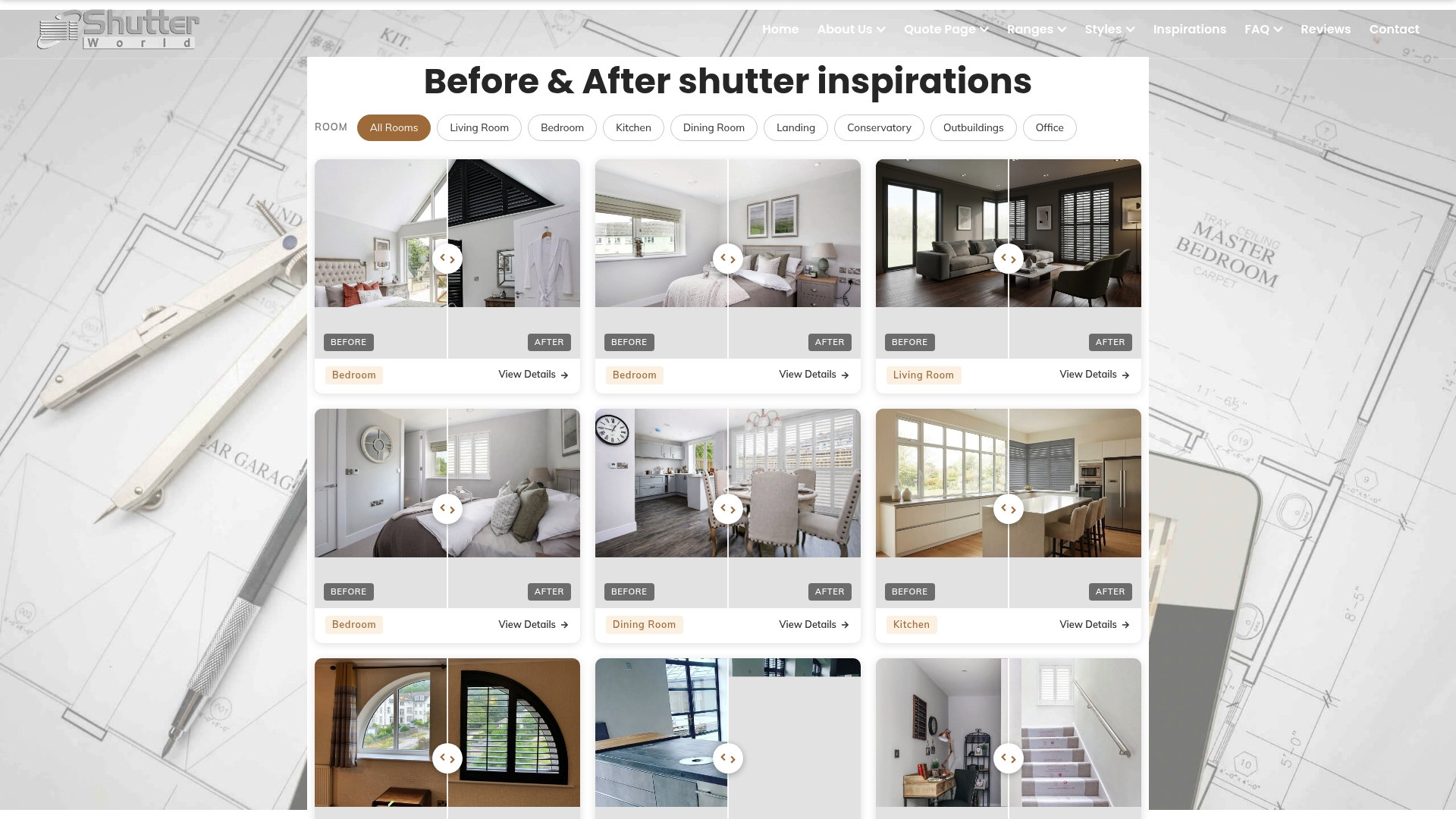
At Shutterworld, we design and install plantation shutters and a full range of interior window shutters made specifically for your window dimensions, your reveal depth, and your design palette. Every shutter we produce is made to measure, fitted by experienced professionals, and backed by both product and workmanship guarantees. If you are ready to see what a truly bespoke fit looks like in practice, explore our tailored shutter solutions or book a free in-home survey. We will bring the expertise. You simply tell us what your space needs.
FAQ
Are shutters suitable for a minimalist interior?
Yes. Interior shutters sit flush within the window frame, replace visually complex fabric treatments, and provide precise light control, making them one of the most naturally compatible window coverings for minimalist design.
What shutter style works best for minimal decor?
Plantation shutters with wide louvres and slim frames are the most versatile choice. Flat-panel solid shutters suit bedrooms where complete simplicity and blackout are both required.
How do I choose the right shutter colour for a minimalist room?
Match the shutter frame to existing joinery such as skirting boards or door frames. This makes the shutters read as part of the architecture rather than a separate feature, which is the defining quality of a successful minimalist window treatment.
Do shutters control light better than roller blinds?
Shutters offer significantly more control because you can angle the louvres to direct light precisely while maintaining privacy. Roller blinds provide a flat block when lowered but offer no intermediate light-shaping capability.
Can shutters help with privacy without losing natural light?
Yes. Angling the louvres blocks direct sightlines from outside while still allowing diffused daylight into the room. This is a practical benefit that most other window treatments cannot replicate.