
Transform your home with interior window shutters

Interior window shutters
TL;DR:
- Interior window shutters offer UK homeowners superior control, style, and energy efficiency compared to curtains or blinds. They are bespoke, durable, and designed to fit unique window shapes, enhancing both privacy and home value. Proper maintenance and material choice ensure long-lasting, architecturally integrated window solutions.
Most UK homeowners still reach for curtains or blinds as the default window covering, yet there is a solution that delivers far greater control, style, and long-term value: interior window shutters. Considered by many to be a purely traditional feature, modern shutters are anything but old-fashioned. As detailed in our guide on why shutters increase home value, today’s bespoke shutter designs address privacy, light management, and energy efficiency in ways that curtains simply cannot match. This guide walks you through everything you need to know, from choosing the right type and material to caring for them over time.
Table of Contents
- What are interior window shutters?
- Key benefits of interior window shutters for UK homes
- Choosing the right material and finish for your shutters
- Customising shutters for unique window shapes and tricky spaces
- Essential care tips to maximise the life of your shutters
- Why bespoke interior shutters are the future of stylish UK homes
- Ready to upgrade? Explore bespoke shutters for your home
- Frequently asked questions
Key Takeaways
| Point | Details |
|---|---|
| Shutters suit any shape | Interior shutters can be customised for bay, arched, and tricky window designs. |
| Boost energy efficiency | Fitted shutters help reduce heat loss and create a comfortable environment all year round. |
| Privacy without sacrificing style | Get adjustable privacy and light control while adding a stylish statement to your home. |
| Material choice matters | Selecting the right shutter material maximises performance and complements your décor. |
| Simple maintenance, lasting beauty | Routine care keeps your shutters looking and working beautifully for years. |
What are interior window shutters?
Interior window shutters are solid or louvred panels fitted inside the window frame, either as a fixed frame or on hinges that allow them to open and close. Unlike curtains that hang from a rail above the window, shutters are built directly into your window recess, making them a permanent architectural feature rather than a temporary dressing. That distinction matters enormously for both appearance and practicality.
There are four main shutter styles for living rooms and throughout the home that UK homeowners tend to choose from:
- Plantation shutters: The most popular style, featuring wide horizontal louvres that tilt to control light and airflow. Ideal for living rooms, bedrooms, and kitchens.
- Solid panel shutters: A classic design with no louvres, offering complete blackout and a period-appropriate look suited to older or listed properties.
- Café style shutters: Covering only the lower half of the window, these preserve the view from outside whilst providing privacy at eye level. Perfect for street-facing rooms.
- Tier-on-tier shutters: Two independent panels stacked one above the other, giving you the ability to open the top independently of the bottom. Outstanding flexibility for rooms where you want natural light without sacrificing privacy.
Here is a concise comparison to help you assess main shutter types before making a decision:
| Style | Privacy level | Light control | Best room |
|---|---|---|---|
| Plantation | High | Excellent | Living room, bedroom |
| Solid panel | Complete | Blackout only | Period properties, bedrooms |
| Café style | Medium (lower half) | Good | Kitchen, dining room |
| Tier-on-tier | Very high | Excellent | Street-facing rooms, bathrooms |
Each style brings its own character to a room, so your choice should reflect how you actually use the space day to day.
Key benefits of interior window shutters for UK homes
Now that you know the types, it is important to see why interior shutters have become a sought-after upgrade in British homes. The advantages go well beyond appearance.
Privacy and light control
Unlike net curtains, which either block the view or do not, shutters offer precise, adjustable privacy. Tilt the louvres slightly and you allow daylight in whilst keeping the neighbours’ gaze out. Open them fully and you flood the room with natural light. This level of granular control simply does not exist with conventional blinds or curtains.
Energy efficiency
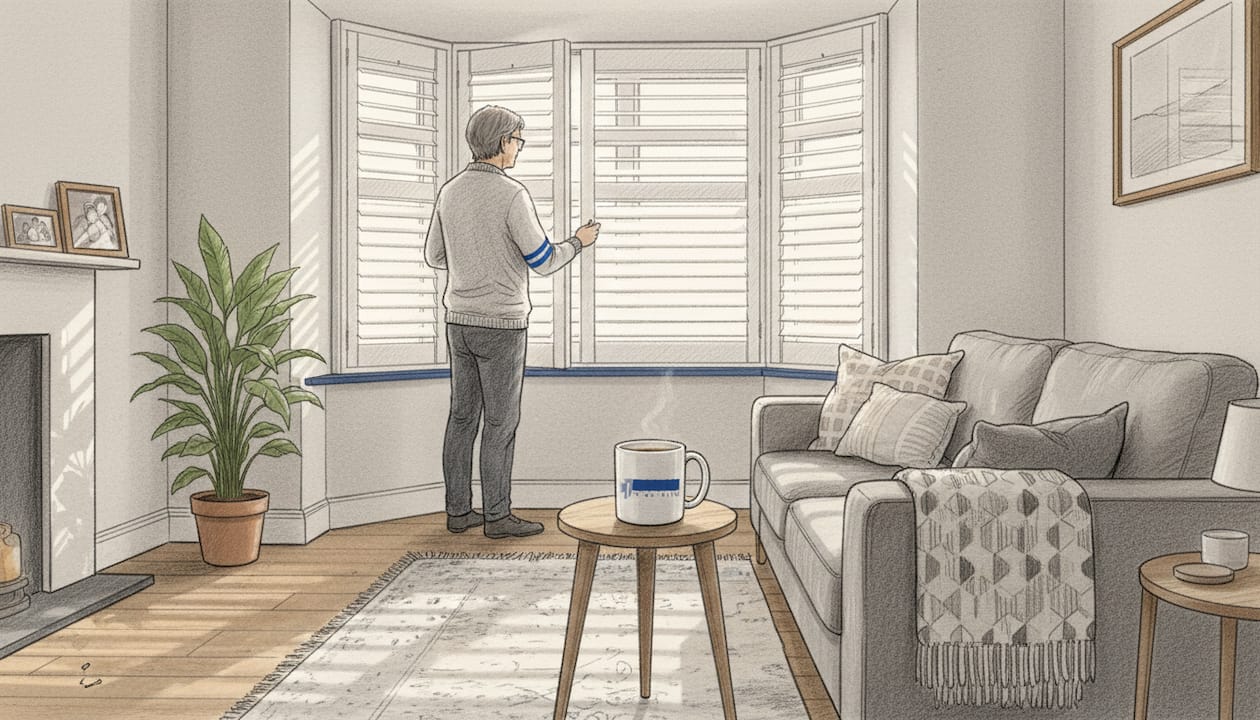
This is where shutters genuinely surprise most homeowners. A well-fitted set of interior shutters creates an insulating layer at the window, trapping air between the glass and the room. Research into shutters and energy savings confirms that shutters can help reduce heat loss through windows significantly, which is particularly relevant given the ongoing pressure on UK household energy bills. In summer, closing shutters during the hottest part of the day reflects solar heat before it enters the room, keeping temperatures comfortable without leaning on air conditioning. For a deeper look at the mechanics, our resource on energy efficient shutters covers the thermal benefits in detail. Homeowners looking at long-term savings should also explore reducing energy bills with shutters for practical guidance tailored to British housing stock.
Style and character
Shutters bring a timeless, architecturally considered quality to any interior. Whether your home is a Victorian terrace, a 1930s semi, or a contemporary new-build, there is a shutter style and finish that enhances rather than fights your existing design. Paint them in a crisp white for a clean Scandi aesthetic, or choose a natural hardwood stain to complement warm, traditional interiors.
Key benefits at a glance:
- Adjustable privacy without sacrificing natural light
- Thermal insulation that reduces heating and cooling costs
- Long service life compared to fabric blinds or curtains
- No fabric to fade, gather dust, or require replacement
- Adds perceived value and kerb appeal to your property
Pro Tip: If you want maximum natural light with louvres open, choose a wider louvre size of 76mm or 89mm. For rooms requiring greater privacy without sacrificing airflow, a narrower 47mm louvre gives you more slat coverage per panel.
Choosing the right material and finish for your shutters
To make the most of these benefits, you need to select the right material and finish for your space and lifestyle. The four main options each have distinct strengths, and the right choice depends on your room conditions as much as your taste.
| Material | Durability | Humidity resistance | Appearance | Typical cost |
|---|---|---|---|---|
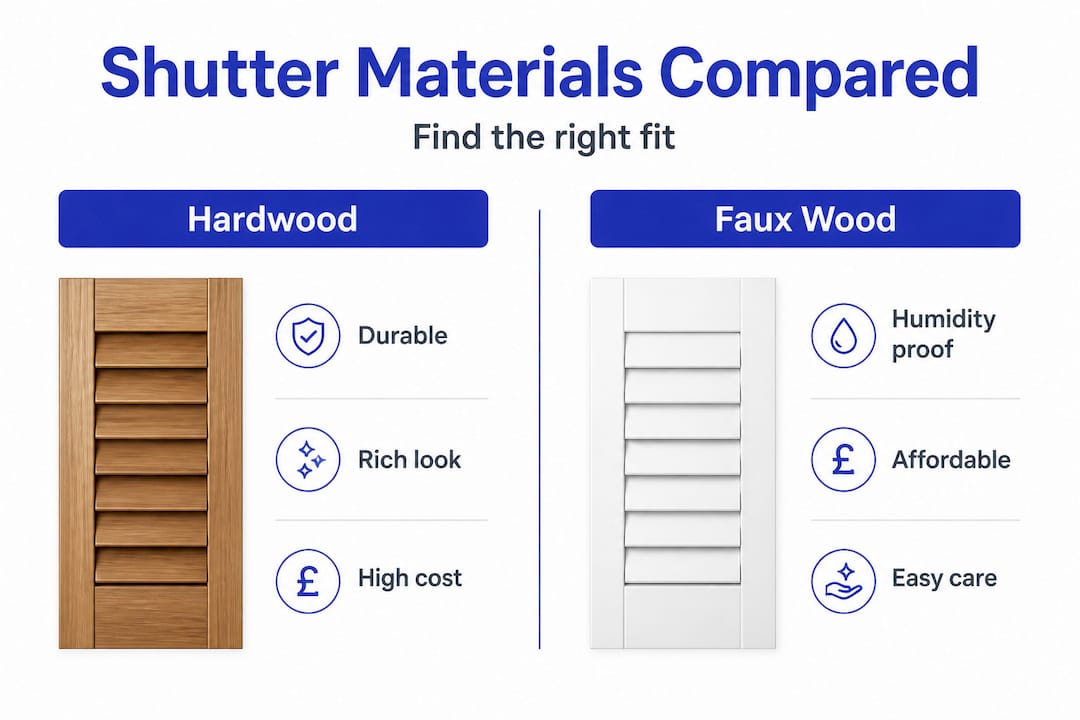
| Solid hardwood | Excellent | Moderate | Premium, natural grain | Higher |
| Faux wood (MDF/PVC) | Very good | Excellent | Clean, painted finish | Mid-range |
| Aluminium | Outstanding | Superior | Contemporary, slim | Mid to higher |
| Composite | Good | Very good | Versatile, paintable | Mid-range |
Solid hardwood remains the benchmark for luxury. Our Montana range, crafted from premium hardwood, delivers a richness of grain and depth of finish that no synthetic alternative replicates. It is ideally suited to living rooms, hallways, and bedrooms where conditions remain reasonably stable.
Faux wood shutters, such as our Seattle range featuring durable MDF with an extruded polypropylene coating, are the practical choice for kitchens and bathrooms. They will not warp, swell, or crack in steam-prone environments, and they are exceptionally easy to clean.
Aluminium shutters suit contemporary homes and spaces with large glazed areas. Their slim profiles and precise engineering give a modern, architectural quality. They are also the most resilient option in genuinely wet conditions.
How to choose the right material in four practical steps:
- Assess humidity levels. Bathrooms, utility rooms, and kitchens demand moisture-resistant materials. Faux wood or aluminium are the sensible choices here. Hardwood belongs in dry, stable environments.
- Consider UV exposure. South-facing windows receive intense sunlight year-round. Hardwood can fade and dry out without proper treatment, so ensure it is factory-sealed or painted. Faux wood handles UV exposure with less maintenance.
- Match your interior style. Contemporary interiors pair beautifully with smooth painted MDF or aluminium. Traditional or period homes benefit from the warmth and texture of real wood.
- Plan for maintenance. Every material benefits from regular care. Following proper shutter cleaning and maintenance tips will extend the life and beauty of your investment regardless of which material you choose.
Pro Tip: Always request a sample before committing to a finish. Colours and textures look noticeably different in natural light compared to a showroom or screen, and what appears crisp white in a brochure can read slightly warm or cool against your walls.
Customising shutters for unique window shapes and tricky spaces
Once you have chosen your materials, you may want to know how shutters can be tailored to challenging or statement windows. This is where bespoke engineering truly sets custom shutters apart from anything available off the shelf.
The right solution for every shape: never settle for ill-fitting off-the-shelf products when precision-made shutters are built to complement every window, exactly as it stands.
Many UK homes have windows that fall well outside standard dimensions. Victorian bay windows, Georgian arches, Edwardian porthole features, and modern angled roof lights all present genuine challenges for standard blinds and curtains. A curtain pole simply cannot follow the curve of an arched window. A roller blind cannot fill a triangular attic window cleanly. Our guide on shutters for tricky shapes walks through the engineering solutions available for every scenario.
Window shapes that bespoke shutters can be precisely engineered to fit:
- Bay windows: Multi-panel frames that follow the angles of the bay, creating a cohesive look with individual panels for each section.
- Arched and curved windows: Specially shaped fixed top sections paired with operable lower panels, preserving the architectural drama of the arch.
- Triangular and angled windows: Common in loft conversions and contemporary extensions, these require precisely cut panels that mirror the geometry of the opening.
- Porthole and circular windows: A fixed, circular shutter panel provides a striking, symmetrical finish for these distinctive features.
- Large glazed expanses and bifold doors: Full-height shutters or bi-fold shutter systems that track back neatly when not needed, maintaining clean sightlines.
- Skylights and roof lights: Specialised frames designed for overhead glazing, controlling solar gain and glare without the condensation problems that fabric solutions often create.
The precision required for these applications makes professional measurement and fitting non-negotiable. Even a few millimetres of inaccuracy in a curved or angled frame will result in panels that bind, gap, or simply look wrong. This is why a professional in-home survey is the foundation of every installation we carry out.
Essential care tips to maximise the life of your shutters
Even the best shutters need a little care. Here is how to keep them spotless and working flawlessly for years to come.
Following a structured routine, as outlined in our shutter maintenance tips, is the single most effective way to protect your investment and keep your shutters looking freshly installed.
Step-by-step guide to routine shutter care:
- Weekly dusting. Use a dry microfibre cloth or a soft-bristle brush to remove surface dust from louvres and panels. Work from top to bottom so displaced dust falls onto areas you have not yet cleaned.
- Monthly wipe-down. Dampen a microfibre cloth with warm water and a small amount of mild washing-up liquid. Wipe each louvre individually, supporting it gently with your other hand to avoid stressing the tilt mechanism. Dry immediately with a clean, dry cloth.
- Seasonal mechanism check. Open and close each panel, and tilt the louvres through their full range. Listen for any creaking or stiffness. A very small amount of silicone-based lubricant applied to hinges and tilt rods will keep everything moving smoothly. Avoid oil-based products, which attract dust.
- Annual inspection. Check all mounting points and frame fixings. Tighten any loose screws and inspect the paint or stain finish for chips. Touching up small areas promptly prevents moisture ingress and prolongs the life of the surface.
Pro Tip: Never use bleach-based sprays, abrasive cleaners, or solvent-based products on painted or coated shutters. Even on faux wood, harsh chemicals can break down the surface coating over time. A simple microfibre cloth and warm soapy water handle 95% of cleaning tasks without any risk.
Consistent care like this means your shutters will retain their structural integrity and visual appeal for a decade or more, making them an outstanding long-term investment compared to blinds or curtains that typically require replacement every few years.
Why bespoke interior shutters are the future of stylish UK homes
We have spent over 25 years fitting shutters across the UK, and in that time we have noticed a consistent pattern: homeowners who choose bespoke shutters rarely look back, whilst those who compromise on an off-the-shelf alternative frequently find themselves frustrated within a year or two.
The reason is rarely about aesthetics alone. It is about fit. A shutter that does not fill its opening precisely allows draughts in at the edges, creates uneven light gaps, and never quite looks as polished as it should. The difference between a well-fitted bespoke panel and a standard-size blind adapted to a non-standard window is immediately visible, and it only becomes more apparent over time.
What most interior design guides miss is that personalisation is not a luxury extra. It is fundamental to whether a shutter actually performs its job. Light control only works when there are no gaps around the frame. Thermal insulation only functions when the shutter sits correctly within the recess. Privacy is only complete when panels close without misalignment. None of these outcomes are reliably achievable without precise measurement and craftsmanship built around your specific window.
There is also the question of evolving taste. Generic solutions tend to date. A well-chosen, professionally fitted set of tailored shutter solutions becomes part of the architecture of your home, as natural as the skirting boards or the coving. They move with the life of the house rather than against it. Our view, borne of experience, is that investing in bespoke from the outset costs less over ten years than cycling through two or three rounds of cheaper alternatives that never quite work as well as they should.
Ready to upgrade? Explore bespoke shutters for your home
Feeling inspired to transform your own windows? You have taken the time to understand what shutters can do, and now the most valuable next step is to explore solutions built precisely for your home. ✨
Whether you are drawn to the classic elegance of plantation shutters, the precision engineering of our made-to-measure shutters, or you want a fully tailored solution through our bespoke interior shutters service, our team is ready to guide you from first enquiry through to a flawless installation. Book your free in-home survey today and discover what genuinely transformative window dressing looks like in your own space. Your satisfaction is our priority, and we are with you every step of the way.
Frequently asked questions
Are interior window shutters energy efficient?
Yes, shutters help retain heat in winter and keep rooms cooler in summer by creating an insulating air layer at the window, which can meaningfully reduce energy bills. Our resource on energy efficient shutters explains the thermal mechanisms in practical detail.
Can shutters be made for bay or arched windows?
Yes, made-to-measure shutters are ideal for covering unique window shapes such as bay and arched designs, with panels precisely engineered to follow every curve and angle. Find out more in our guide on tricky window shapes.
What is the best material for shutters in bathrooms?
Faux wood or aluminium shutters are the best choice for humid areas, as both materials resist moisture, warping, and cracking far better than solid hardwood in steam-prone environments.
How often do shutters need cleaning?
A quick dust once a week and a deeper clean with a damp cloth every month keeps shutters looking their best, with a seasonal mechanism check to maintain smooth operation. Our detailed shutter maintenance tips cover every step.
Do shutters add value to your home?
Yes, high-quality interior shutters make your property more attractive to buyers and can increase perceived and actual value, as explored in our guide on why shutters increase home value.