
Wood vs MDF shutters: best fit for bespoke UK windows

Wood vs MDF shutters
TL;DR:
- Hardwood shutters excel in shaping, durability, and refinishing, ideal for complex and long-term uses.
- MDF shutters suit standard rectangular windows, dry environments, and budgets but have shape limitations.
- Material choice should consider window shape, room humidity, and long-term maintenance, not just aesthetics.
Choosing between wood and MDF shutters feels straightforward until you stand in front of an arched window, a sweeping bay, or a uniquely angled recess and realise the decision carries far more weight than you first imagined. Many UK homeowners discover too late that the shutter material they chose simply cannot accommodate the shape or finish their home deserves. Whether you are drawn to the warmth of natural hardwood or the clean, factory finish of engineered board, understanding the real differences between these two materials is the first step toward a result you will be proud of for years to come.
Table of Contents
- What are wood and MDF shutters?
- Comparing wood and MDF: performance, style, and longevity
- When to choose wood, MDF, or composites for your UK home
- Key considerations for bespoke and tricky-shaped windows
- Why material choice is about more than price or trend
- Discover your perfect bespoke shutters with Shutter World
- Frequently asked questions
Key Takeaways
| Point | Details |
|---|---|
| Material matters for shape | Wood is the only true option for complex or uniquely shaped windows, as MDF cannot be custom-carved. |
| Humidity needs composites | For bathrooms and coastal locations, waterproof composites outperform both wood and MDF. |
| Value vs versatility | MDF suits standard windows and tight budgets, but wood is best for longevity, flexibility and premium finishes. |
| Specialist advice counts | Always consult expert fitters when choosing shutters for unusual or high-value spaces. |
What are wood and MDF shutters?
Before comparing performance, it helps to understand what these materials actually are and why each occupies a distinct place in the world of bespoke interior shutters.
Wood shutters are crafted from solid hardwoods such as basswood, poplar, or teak. Each piece is shaped, jointed, and finished by skilled craftspeople, producing a shutter with genuine grain character and the structural integrity to hold precise angles, curves, and custom profiles. The natural composition of hardwood means it responds well to specialist finishing, painting, and staining, giving you a truly personalised result. As hardwood shutter benefits demonstrate, this material has long been favoured for premium UK interiors where longevity and visual richness matter most.
MDF shutters are manufactured from medium-density fibreboard, an engineered material formed by binding wood fibres with resin under heat and pressure. The result is a dense, uniform board that accepts a smooth factory finish exceptionally well. MDF shutters are typically produced with a polypropylene or lacquer coating applied in controlled conditions, which delivers a consistent, flawless appearance straight from the factory. Explore MDF shutter benefits to understand where this material genuinely excels.
Common misconceptions are worth addressing directly:
- MDF does not mean low quality. In the right application, it is a highly capable material.
- Wood shutters are not always better across every metric. Context is everything.
- Both materials can look stunning when specified and installed correctly.
- The biggest differentiator is not appearance alone but suitability for your specific window type.
The key distinction, as expert views on shutter materials consistently confirm, is that hardwood outperforms MDF in premium UK interiors involving unusually shaped windows, where precision engineering and long-term resilience are non-negotiable.
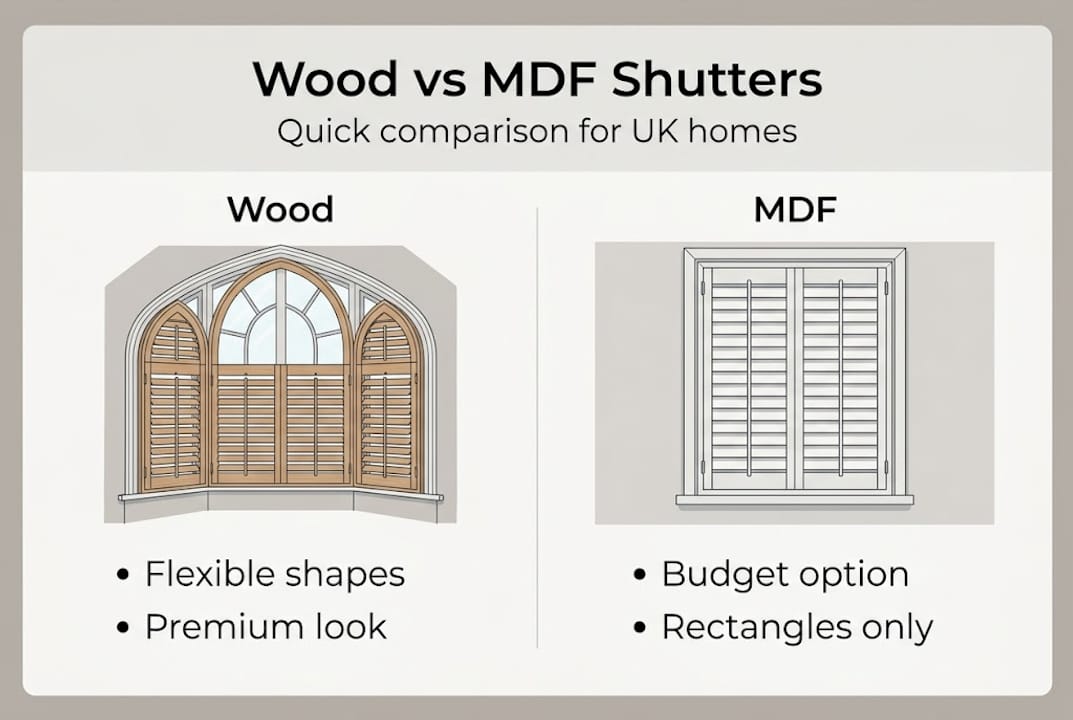
Comparing wood and MDF: performance, style, and longevity
Now that we have defined them, let us see how wood and MDF shutters actually measure up across the attributes homeowners care about most.
| Attribute | Wood shutters | MDF shutters |
|---|---|---|
| Durability | Excellent, long service life | Good in dry conditions |
| Moisture resistance | Moderate (treat appropriately) | Lower, swells when damp |
| Finish options | Paint, stain, specialist colours | Factory finish, limited refinishing |
| Shape flexibility | High, including curves and angles | Limited to rectangular frames |
| Warp resistance | Strong with quality hardwood | Can warp with humidity changes |
| Maintenance | Periodic cleaning, occasional refinish | Wipe-clean, difficult to refinish |
The table makes one thing clear: wood holds a decisive advantage wherever shape flexibility and long-term finish quality are priorities. Shutter materials compared in detail reveal that MDF performs reliably in controlled, dry environments but shows limitations when conditions become less predictable.
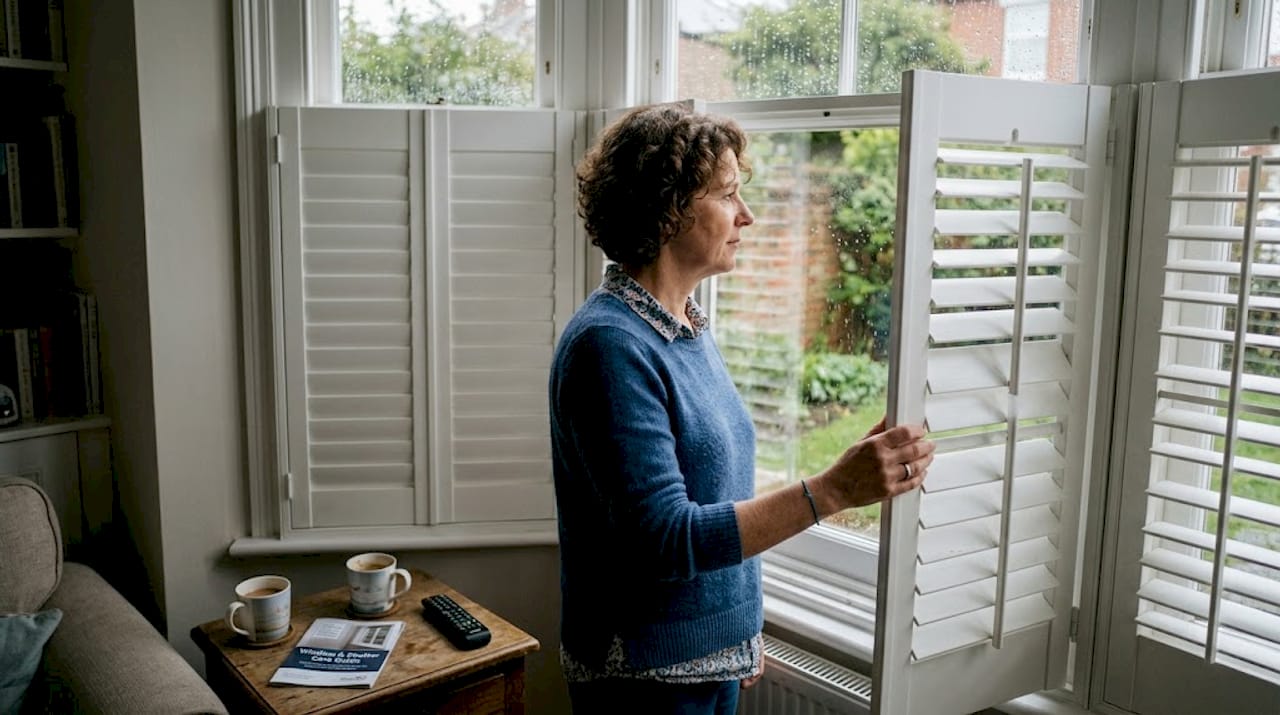
One critical limitation often overlooked is that MDF shutters cannot be easily carved or shaped for unusual window openings and are restricted to standard rectangular applications. This is not a minor caveat. For homes with architectural features, it effectively rules MDF out entirely.
Maintenance considerations also differ meaningfully:
- Wood: Wipe down with a lightly dampened cloth, avoid prolonged moisture exposure, and refinish with a specialist if required.
- MDF: Simple to keep clean day to day, but the factory coating cannot easily be repainted or restored if damaged.
Pro Tip: If your windows are standard rectangular openings in a consistently dry room such as a sitting room or study, MDF shutter durability can represent genuine value without compromise. Reserve hardwood for rooms with variable conditions or any window that departs from the rectangular norm.
When to choose wood, MDF, or composites for your UK home
Comparison is useful, but real-world needs differ. Here is how to match the right material to your specific space.
- Choose wood when your windows are arched, angled, triangular, or bay-shaped, when you want a premium painted or stained finish that can be refreshed over time, or when the shutter will be a long-term architectural feature. Wood shutters for bay windows are particularly well suited to period properties and larger, statement openings.
- Choose MDF when your windows are straightforward rectangular openings in a dry interior room, and when budget is a primary consideration without compromising on appearance for standard applications. MDF’s factory finish can look impeccably clean in the right context.
- Choose composites when moisture is the defining factor. Bathrooms, en suites, kitchens with steam, and coastal homes all present humidity levels that challenge both wood and MDF. For these environments, bathroom shutter materials made from waterproof composite are the only truly reliable solution.
“In high-humidity UK coastal or bathroom settings, neither wood nor MDF is ideal. Waterproof composites are preferred over both for long-term performance.”
This is a point many homeowners miss when focusing solely on aesthetics. A beautiful hardwood shutter installed in a steam-filled bathroom will deteriorate far sooner than expected, regardless of its quality. Similarly, exploring shutters for humid rooms reveals that composite materials have advanced significantly and can now replicate the look of painted wood with impressive fidelity.
Pro Tip: Before committing to any material, assess two things honestly: the typical humidity level in the room and whether your window shape departs from a simple rectangle. If either factor is present, your material choice narrows considerably, and a specialist survey becomes invaluable.
Key considerations for bespoke and tricky-shaped windows
Shape and size flexibility is where the real test happens. For homeowners with architectural windows, the material question is not just about preference. It becomes a matter of what is physically achievable.
| Window shape | Wood suitable? | MDF suitable? |
|---|---|---|
| Standard rectangle | Yes | Yes |
| Bay window | Yes | No |
| Arched or circular | Yes | No |
| Triangular or angled | Yes | No |
| Skylight or roof window | Yes (specialist fit) | No |
| Bi-fold or large span | Yes | Rarely |
As expert advice on shape confirms, MDF shutters are limited to standard rectangular shapes and cannot be carved or engineered to follow unusual profiles. Wood, by contrast, can be precisely cut, jointed, and shaped by experienced craftspeople to follow virtually any architectural contour.
For homeowners with bespoke windows, here is what to ask any provider before committing:
- Can you produce a template or detailed drawing of how the shutter will fit my specific shape?
- What material do you recommend for this particular window, and why?
- How is the frame constructed to accommodate the angle or curve?
- Will the louvres (the adjustable slats) operate correctly within a non-rectangular frame?
- What guarantee covers both the product and the installation workmanship?
Exploring solutions for tricky-shaped windows and selecting panels for bespoke windows gives further clarity on how a specialist approaches these installations from the very first survey. The precision required is considerable, and it is precisely why experienced craftsmanship matters so much at this level.
Why material choice is about more than price or trend
Having broken down materials, comparisons, and real-world scenarios, there is an important perspective that often gets lost in the excitement of choosing a new shutter style.
We see it regularly: a homeowner selects MDF because it fits the immediate budget or because a showroom finish looks appealing, only to find the shutter cannot be refinished when décor changes, or that it simply was not available in the shape their window required. The disappointment is not about the product failing. It is about misaligned expectations from the start.
Shutter selection for bespoke or architecturally interesting homes should be treated as a permanent fixture decision, much like choosing a floor or a staircase. As qualitative expert views consistently point out, hardwood outperforms MDF in premium UK interiors with unusual shapes, not because MDF is inferior in every way, but because the application demands more than MDF can offer.
The most overlooked consideration is repairability. Wood can be touched up, repainted, and restored. It evolves with your home. MDF, once damaged or dated, typically needs full replacement. For a long-term investment in a bespoke interior, the complete material guide makes a compelling case for treating material choice with the same care you would give any significant home improvement decision.
Discover your perfect bespoke shutters with Shutter World
For homeowners ready to act on reliable advice, your trusted next step is closer than you think.

At Shutter World, we bring over 25 years of bespoke shutter expertise to every project, from straightforward rectangular windows to the most demanding architectural shapes. Our bespoke shutter solutions are designed around your home, your windows, and your vision, not a one-size catalogue. Whether you need guidance on the best material for a complex bay or want to explore our plantation shutter installations, our team is ready to help. We also specialise in helping homeowners cover tricky-shaped windows with precision-engineered solutions that look as though they were built into the very fabric of your home. Book your free consultation today.
Frequently asked questions
Are MDF shutters suitable for bay or arched windows?
No, MDF shutters are generally limited to rectangular shapes and do not work for bay, arched, or irregular windows. For these openings, MDF’s shape limitations make hardwood the only practical choice.
Which is more durable in everyday use, wood or MDF shutters?
Experts consistently agree that wood shutters typically outlast MDF, particularly in premium settings or where window shapes require custom engineering. Hardwood’s durability advantage is well established across specialist sources.
What’s best for bathroom or coastal home shutters: wood, MDF, or something else?
Neither pure wood nor MDF is ideal for high-humidity rooms such as bathrooms or coastal properties. Waterproof composites are recommended as the most reliable long-term solution in these environments.
Are wood shutters always more expensive than MDF?
Wood shutters usually carry a higher price due to the craftsmanship and custom shaping involved, but they offer unmatched shape flexibility and a premium finish that can be refinished as your home evolves.
Can MDF shutters be repainted or refinished?
MDF shutters typically have factory-applied coatings that make refinishing very difficult, whereas solid wood shutters can usually be repainted or restored by a specialist as your décor changes over time.